
Repricing the Fed’s Terminal Rate: What Rising Short-Term Yields Could Mean for Gold
Following the Federal Reserve’s return to rate hikes, markets are once again confronting a key question: is the interest-rate market still underestimating the endpoint of this tightening cycle?
Bank of America’s rates strategy team recently warned that the federal funds rate could rise above 5%, while recommending that investors watch for further upside in two-year U.S. Treasury yields. At the same time, PIMCO has noted that core PCE inflation is easing only gradually. Combined with the Fed’s increasingly clear anti-inflation stance, this suggests policy rates may not peak as quickly as markets had previously expected.
For traders, this is more than a bond-market repricing story. It could become an important turning point for the U.S. dollar, real yields, and the volatility structure of XAUUSD.
What Markets May Be Underestimating Is Not the Next Hike, but “Higher for Longer”
Markets have largely priced in the possibility of additional rate hikes. The real point of disagreement, however, is whether the Fed will only hike once or twice more, or whether it will push rates above 5% and keep them elevated for longer.
Bank of America’s view deserves attention because it is not based solely on inflation data. Instead, it focuses on changes in the Fed’s policy reaction function. If policymakers do not believe current interest rates are sufficiently “restrictive,” then the market’s pricing of the terminal rate may remain too low.
Using frameworks such as the Taylor Rule, a reasonable policy rate could be around 5.3% when inflation remains above target and demand stays resilient. This means that if markets are still trading on the assumption that the hiking cycle ends around 4.5% to 4.75%, short-term rates may face renewed upward pressure.
In other words, rising short-term Treasury yields are not merely about “one more rate hike.” They reflect a growing market acceptance that the Fed may not rush to ease policy—and may be willing to maintain higher rates to tighten financial conditions.
A Flattening Yield Curve Signals a Repricing of Tightening Expectations
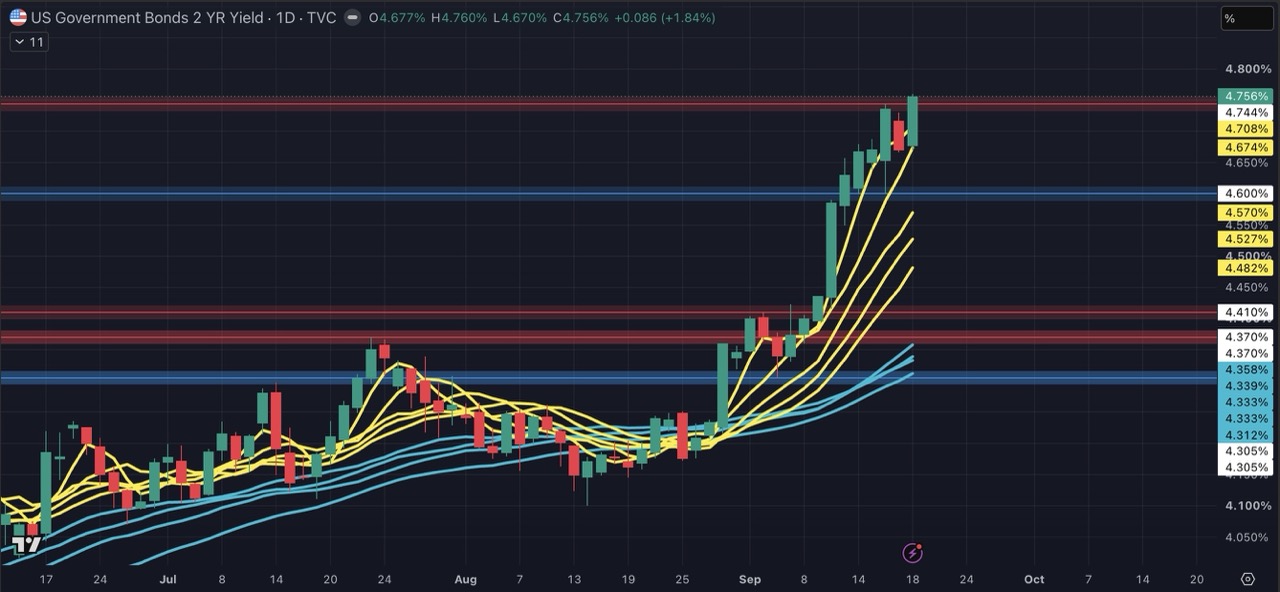
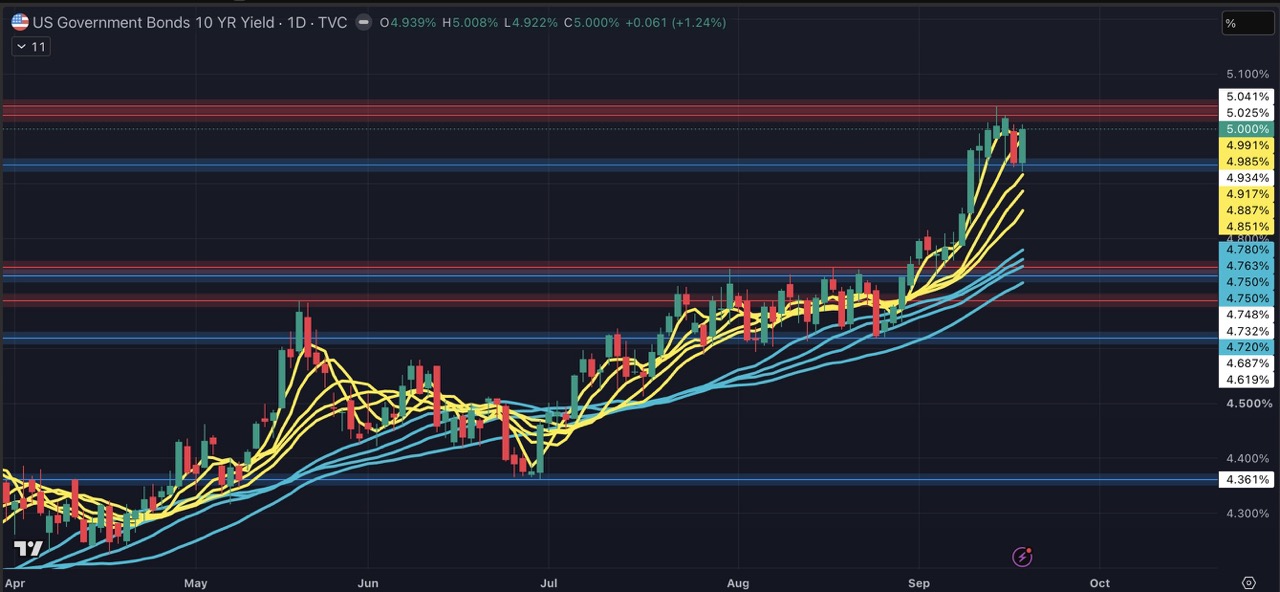
In this environment, two-year Treasury yields tend to be more sensitive than ten-year yields. Short-dated rates primarily reflect expectations for policy rates over the next few quarters. As markets raise their expectations for the number of Fed hikes, the terminal rate, or the duration of restrictive policy, two-year yields often move higher first.
Bank of America expects two-year Treasury yields to potentially rise toward 5%, while ten-year yields could also approach 5% by year-end. This pattern—where short-end yields rise first while long-end yields remain relatively contained—suggests that the yield curve may continue to flatten.
 |
 |
However, a flatter yield curve does not necessarily mean markets are immediately pricing in a recession. More accurately, it shows that investors are weighing two competing forces:
-
Short-end pressure: A more forceful Fed stance against inflation, with more hikes or a longer period of elevated rates than expected.
-
Long-end constraints: Higher rates may weigh on consumption, corporate financing, and housing, limiting medium- to long-term growth expectations.
-
Inflation risk premium: Energy prices, geopolitical tensions, tariffs, and supply-side pressures could prevent long-term yields from declining significantly.
As a result, the market may not see a uniform surge across the entire yield curve. Instead, short-term rates could undergo repeated repricing, while long-term yields fluctuate between slowing-growth concerns and persistent inflation risks.
For XAUUSD, the Key Is Not Just Rates—It Is Real Yields and the U.S. Dollar
Gold does not generate interest income, so higher rates generally increase the opportunity cost of holding it. If the Fed remains hawkish, short-term Treasury yields rise, and the U.S. dollar strengthens at the same time, XAUUSD will usually face near-term pressure.
However, simply turning bearish on gold because “rates are rising” may overlook the complexity of the current macro environment.
For gold, the more important combination is real yields, the U.S. dollar, and risk sentiment:
1. If nominal yields rise faster than inflation expectations
Real yields move higher, which is typically bearish for gold. This is the most direct transmission channel of Fed tightening expectations.
2. If yields rise while inflation expectations also increase
Real yields may not rise substantially, limiting the pressure on gold. If markets begin to worry about unanchored inflation or delayed policy responses, gold may even attract safe-haven demand.
3. If high rates trigger financial-market volatility or growth concerns
Even if the dollar and yields remain elevated, safe-haven demand may support gold prices. This is especially relevant when equity valuations, corporate financing conditions, or geopolitical risks become the dominant market focus.
This is why XAUUSD deserves close attention in the current environment. Gold may no longer move in a simple linear pattern of “hawkish Fed equals lower gold prices.” Instead, it may enter a more volatile phase where interest rates, inflation, and safe-haven demand pull prices in different directions.
Trading View: Watch for Data-Driven Two-Way Gold Volatility
The market’s next focus will be core PCE, CPI, nonfarm payrolls, wage growth, and Fed officials’ definition of what constitutes a “restrictive” policy stance.
If core inflation remains elevated and the labor market stays resilient, markets may continue to raise terminal-rate expectations. That would likely support short-term yields and the U.S. dollar, putting downward pressure on XAUUSD.
But if economic data begin to show that high rates are rapidly weakening demand, or if liquidity and credit risks emerge in financial markets, gold could rebound as safe-haven demand rises. For CFD traders, this means opportunities may exist on both sides of the market—not just in a single bullish or bearish direction. The key is to identify shifts in rate expectations, dollar momentum, and critical technical levels.
In a high-volatility environment, it may be more useful to track the pace of terminal-rate repricing than to assume gold must rise or fall. When two-year Treasury yields, the U.S. Dollar Index, and gold prices begin to diverge, traders should pay close attention.
Conclusion
If the Fed does push interest rates above 5%, markets will not simply be pricing in another rate hike. They will be reassessing the prospect of a prolonged “higher-for-longer” regime. Short-term Treasury yields may still have room to rise, while XAUUSD could experience sharper two-way volatility as real-yield pressure competes with safe-haven demand.
To capture gold-market opportunities driven by Fed policy decisions, inflation data, and U.S. dollar movements, consider trading XAUUSD CFDs on Bitget and respond flexibly to both bullish and bearish market conditions. CFDs involve leverage, which can amplify both potential returns and losses. Always use stop-losses, manage position size carefully, and ensure that your trading decisions match your risk tolerance.
All trading education provided by Bitget is for educational purposes only and should not be considered financial advice. The strategies and examples shared are for reference only and may not reflect actual market conditions. CFD trading involves significant risk, including the potential loss of capital. Past performance does not guarantee future results. Please conduct thorough research and ensure that you understand the risks involved. Bitget is not responsible for any trading decisions made by users.


- What Markets May Be Underestimating Is Not the Next Hike, but “Higher for Longer”
- A Flattening Yield Curve Signals a Repricing of Tightening Expectations
- For XAUUSD, the Key Is Not Just Rates—It Is Real Yields and the U.S. Dollar
- Trading View: Watch for Data-Driven Two-Way Gold Volatility
- Conclusion