
Analyst: Fed Rate Hike Drives Gold Price Correction, Decline Is a Long-Term Buying Opportunity

Huitong Network, September 17—— Influenced by the resilience of the US economy and stubborn inflation, the market widely expects the Federal Reserve to raise interest rates consecutively in the second half of the year, which will suppress gold prices in the short term. However, FxPro Chief Analyst Alex Kuptsikevich believes that the correction triggered by rate hikes is an excellent opportunity for long-term allocation. Gold prices have already demonstrated resilience against declines. In the long run, core supporting factors such as fiscal risks and policy maneuvering remain solid, and any price pullback provides a prime window for portfolio configuration.
The US economy continues to show strong resilience, and coupled with persistently high inflation, the market generally believes the Federal Reserve will implement consecutive rate hikes in the second half of 2026. This expectation will weigh on gold prices in the short term. However, FxPro Chief Market Analyst Alex Kuptsikevich has a different view; he believes
Expectations for Another Fed Rate Hike This Year Are Bullish for Gold
On Thursday (September 17, East 8 Zone), the Federal Reserve announced a 25-basis point rate hike, and the market anticipates that before the end of 2026, there is nearly an 80% chance of another rate hike.
In the latest precious metals research report, Alex Kuptsikevich analyzes that Fed rate hikes could actually provide buying support for gold. He said: “The benchmark scenario in the interest rate futures market is for tighter monetary policy, with the Federal Open Market Committee projecting that there may be more room for rate hikes later this year. Under such circumstances, the US dollar would remain stable, easing market concerns about the Fed losing long-term control, and long-term US Treasury yields are likely to fall. The overall environment would be relatively friendly for gold. However, if the Committee signals three rate hikes this year, the US dollar would strengthen significantly, triggering a wave of sell-offs in the precious metals market.”
Gold Price Resilience Stands Out, Hawkish Surprises Remain the Biggest Short-Term Risk
Amid ongoing rate hike expectations, the gold market has shown notable resilience, with spot prices once again climbing above $4,300.
Alex Kuptsikevich adds that the main risk facing gold is the Fed issuing signals that are more hawkish than market expectations. In the past three weeks, the strengthening US dollar and rising US Treasury yields have continued to suppress the price of this non-interest-bearing asset. However, whenever the dollar’s upward momentum slows, gold quickly rebounds; gold price volatility is closely tied to the strength of the US dollar.
Beyond Short-term Trends: Geopolitical and Fiscal Risks Support Gold's Long-term Value
Fed rate hikes may intensify discontent from the White House, and ongoing pressure from the White House on the Fed could fuel devaluation trades. The US fiscal predicament remains unresolved, the Treasury’s interventions in the forex and bond markets are increasing, and market demand for decentralized hard assets like gold is rising as a result.
Alex Kuptsikevich notes: “Under such a macro backdrop,
Conclusion
The resilience of the US economy combined with persistent inflation has made expectations for rate hikes in the second half of the year almost a foregone conclusion—short-term interest rate factors remain the main drivers disturbing gold prices. The market is already betting on two rate hikes this year; the Fed's actual statement and dot plot guidance will determine whether gold rebounds or experiences sell-offs. From a long-term perspective, US fiscal pressure and the policy dynamics between the White House and the Fed all preserve gold’s allocation value.
Amid short-term price swings, analysts believe corrections are opportunities for long-term gold positioning, and investors need to closely monitor Fed speeches and the interactions among the US dollar and Treasury yields.
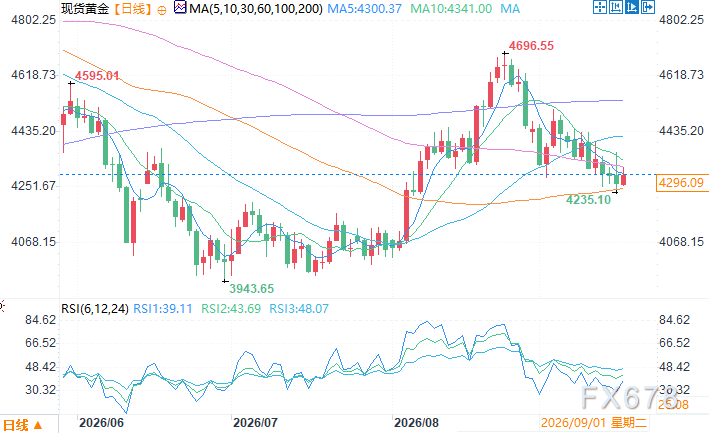
Spot gold daily chart Source: EasyHuitong
East 8 Zone, September 17, 12:20 Spot gold quoted at $4294.60/ounce
Disclaimer: The content of this article solely reflects the author's opinion and does not represent the platform in any capacity. This article is not intended to serve as a reference for making investment decisions.
You may also like
The Capital Trends Behind the AI Computing Power Rebound: JPMorgan Fund Flows Reveal Retail Buy-In "Shrinking," Pouring Into Nvidia, SanDisk and Other Computing Power Core Companies
What has been revealed is not a "complete withdrawal of retail investors from AI," but rather a significant slowdown in overall market entry pace under macroeconomic pressure, with stock selections becoming more concentrated. In response to the Federal Reserve's unanimous decision to raise interest rates by 25 basis points, increasing the policy rate to 3.75%–4.00%, JPMorgan's assessment is: if this is simply a withdrawal of last year's "insurance-style rate cuts" during a shallow rate hike cycle—and if corporate earnings remain strong and the Middle East situation does not further spiral out of control—the stock market is still capable of absorbing rising interest rates.
Vote Result 7-2! Bank of Japan Raises Interest Rates at Fastest Pace Since 1990, Does Not Signal a Clearly More Hawkish Stance
The Bank of Japan has raised interest rates to 1.25%, marking the highest level since 1995 and the sixth increase since exiting the negative interest rate policy in March 2024. Out of the nine committee members, Asada and Sato voted against the hike, citing the current economic situation, reflecting ongoing internal disagreements over further tightening. In its statement, the Bank of Japan indicated it will continue to raise rates and adjust the degree of monetary easing, but the forward guidance language showed limited changes from the July statement, without sending notably more hawkish signals.


