Gold and silver prices rise as yields fall, but the risk of a Fed rate hike in December remains

FX168 Financial News, October 6th—— On Tuesday (October 6th) during the US morning trading session, spot gold and silver prices moved higher. US long-term Treasury yields retreated from the multi-decade highs reached on Monday, while international oil prices fell below $100 per barrel, creating room for precious metals to continue their rebound after the non-farm payrolls data release. Spot gold traded around $4,165.31 per ounce, up 0.60% on the day; spot silver traded around $61.326, up 0.44% on the day.
On Tuesday (October 6th) during the US morning trading session, spot gold and silver prices moved higher. US long-term Treasury yields retreated from the multi-decade highs reached on Monday, while international oil prices fell below $100 per barrel, creating room for precious metals to continue their rebound after the non-farm payrolls data release. Spot gold traded around $4,165.31 per ounce, up 0.60% on the day; spot silver traded around $61.326, up 0.44% on the day.
The market is currently intertwined between bullish and bearish factors. On the one hand, the labor market is signaling weakness, while on the other hand, inflation pressures remain persistent. The US non-farm payroll report for September showed that the unemployment rate remained at 4.2%, with average hourly earnings rising 0.1% month-on-month; combined, July and August nonfarm job numbers were revised down by 60,000. The US ISM Services Purchasing Managers Index for September came in at 54.9, with the price index hitting its highest level since July 2022. Federal funds futures indicate that there is a nearly 78% chance rates will remain unchanged at the October 28 FOMC meeting, but there is still a high probability of at least one rate hike by December.
The 10-year US Treasury yield is near 5.27%, with the 30-year yield around 5.63%. The dollar index has pulled back from the nearly 18-month high set on Monday. A series of key events that could determine the path of interest rates are coming up next: Fed officials' speeches on Tuesday; the release of the September FOMC meeting minutes on Wednesday; weekly initial jobless claims data on Thursday; and the preliminary Michigan consumer sentiment index for October on Friday. Weakness in labor data or consumer sentiment will support gold prices; however, if inflation expectations remain high or the meeting minutes send a hawkish signal, the high-yield environment will continue to weigh on precious metals.
The situation in the Strait of Hormuz and the US-Iran standoff remains unresolved, but with regional oil exports resuming and emergency reserve oil being released into the market, short-term pressures on oil prices have eased. In the last week of September, Middle Eastern crude exports for four days exceeded pre-war levels; at the same time, the G7 agreed to release 100 million barrels of strategic crude oil and diesel reserves. Saudi Arabia's cut to the November official selling price for Arab Light crude to Asia signals an improvement in oil supply conditions. However, geopolitical risk premiums have not fully dissipated: repeated tanker attacks in the Strait of Hormuz, Houthi strikes on Saudi targets, and damage to Gulf region infrastructure keep traders alert to potential further supply shocks. A decline in oil prices could marginally weaken the inflationary forces driving up US Treasury yields and the dollar, supporting gold; but ongoing security risks in the Gulf keep safe-haven buying in gold active, and energy market volatility remains a factor for Fed policy considerations.
Risk appetite warmed somewhat in global markets before the US stock market opened. Dow Jones mini futures rose 281 points, or 0.55%; S&P 500 mini futures rose 30.75 points, or 0.39%; Nasdaq 100 mini futures rose 192 points, or 0.61%, with the AI tech sector leading gains once again.
Other major external markets: New York Mercantile Exchange West Texas Intermediate (WTI) crude fell, trading below $88 a barrel; Brent crude traded near $97.97. The benchmark US 10-year Treasury yield held around 5.284%. The dollar index weakened, but remains elevated.
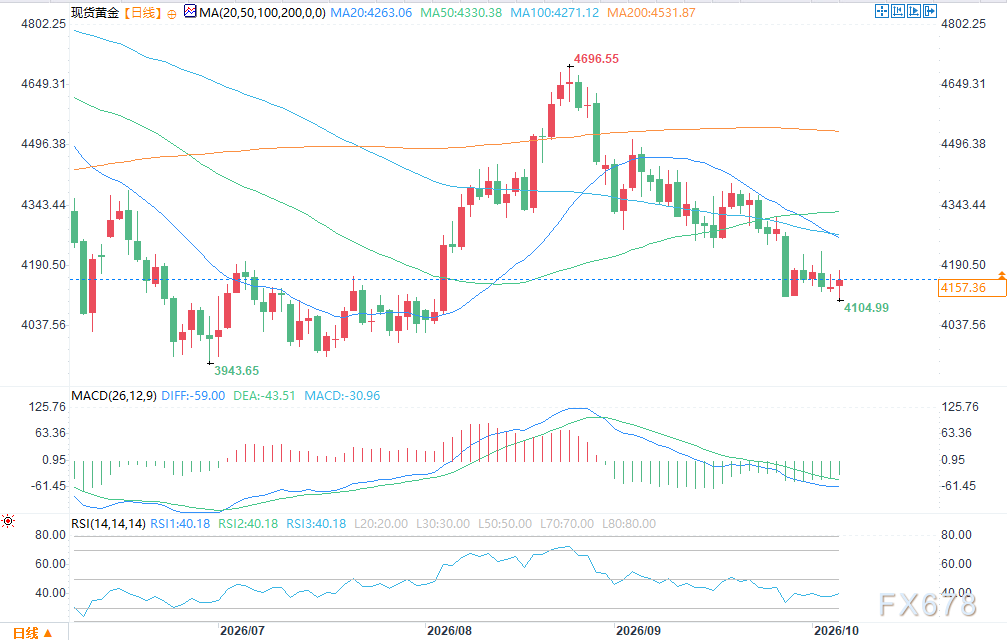
(Spot Gold Daily Chart Source: EFX168)
The next upside target for gold bulls is to push the price above the $4,203.61-$4,230.51 resistance zone. If this is effectively broken, the next target will be $4,319.61, followed by $4,330.43. In the short term, bears aim to push the price below $4,103.52, with further downside targets at $3,996.06 and then $3,942.10. The first resistance lies at $4,203.61, followed by $4,230.51, while the first support level is at $4,164.44, with the next at $4,103.52.
The next upside target for silver bulls is to push the price above the $61.744-$63.060 range. If this is breached, the focus shifts to $65.090, followed by the key psychological level at $66.000. Bears are targeting a break below $59.960, with subsequent downside at $58.940 and then $57.640. The first resistance is at $61.744, followed by $63.060; the initial support is at $60.715, with the next at $59.960.
Disclaimer: The content of this article solely reflects the author's opinion and does not represent the platform in any capacity. This article is not intended to serve as a reference for making investment decisions.
You may also like
Bitcoin steady near $86,000 as S&P 500, Nasdaq reach new record highs
Charles Schwab Executive Says: “This Crypto Cycle Is Really Different”

Matt Hougan Says “Zombie Altcoins Will Disappear,” Citing One Altcoin as a Major Exception
Republicans criticize AI danger claims, Democrats question the influence of "big tech" on the Trump administration's AI policy and demand disclosure of regulatory framework amendment procedures
A Republican senator sent a letter to the CEO of Anthropic, warning against adopting an "alarmist" attitude towards AI and urging him to emphasize AI's potential to improve people's lives, enhance national security, and address AI threats. Meanwhile, two Democratic senators wrote to U.S. government officials, including the Treasury Secretary, requesting clarification on whether tech giants influenced the government's adjustment of the AI regulatory framework through lobbying between May and June of this year, and called for the disclosure of records of communication between companies and the government.