
Tokenized Finance is Growing but Remains Fragmented, IMF Says

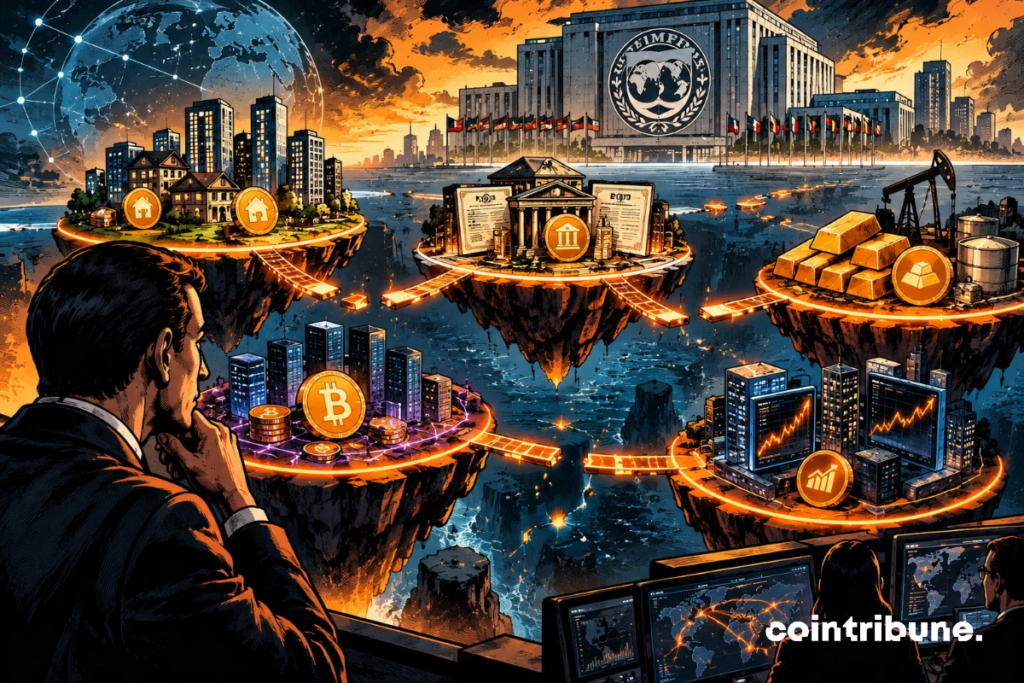
The tokenization of financial assets promises faster transactions and markets open 24 hours a day. Yet, the sector remains limited. In its latest report, the IMF highlights that volumes remain low compared to traditional markets and that platforms struggle to communicate with each other.
In brief
- Public tokenized assets represent about 65 billion dollars, while pensions (repos) reach 303 billion dollars in average daily volume.
- More than half of tokenized stock trades take place outside US market hours. About 80% of transactions involve less than one share.
- The IMF calls for clarifying legal rules, harmonizing regulation, and improving interoperability between platforms and traditional systems.
A still limited market
In theory, tokenization allows grouping several stages of a financial transaction, from its validation to its settlement. This simplification attracts institutional investors, as shown by major sector events this fall. However, the figures show that the market is far from mass adoption.
In its October financial stability report, the IMF estimates that public tokenized assets, excluding pensions, represent about 65 billion dollars. Tokenized stocks weigh only 2.3 billion dollars, more than 70% of which rest on two platforms: Ondo Finance and Backed Finance.
Pensions stand out with an average daily volume of 303 billion dollars. This figure shows that collateral management is among the most concrete uses of tokenization. Despite this progress, activity remains concentrated in the United States and a few offshore locations. Moreover, platforms still operate on networks that are hardly compatible.
Continuous trades, often fractional
Tokenization already meets some investor needs. More than half of tokenized stock trades take place outside US market hours. This trend confirms the interest in continuously accessible markets. Furthermore, about 80% of transactions involve less than one share, highlighting the importance of small investors.
Platforms are precisely developing fractional share offerings backed by crypto-assets. However, these markets remain less liquid and about 1.5 times more volatile than their traditional equivalents.
Moreover, information published overnight is reflected in prices at the opening of traditional markets. The two universes thus remain closely linked.
Instantaneity also entails risks
Tokenization does not eliminate financial risks. On the contrary, it can accelerate their spread. By reducing settlement times, it gives market participants less time to manage liquidity and adjust positions. In this context, registry interconnection and the use of leverage can amplify tensions.
To support the sector’s development, the IMF identifies four priorities: legal certainty, regulatory clarity, interoperability, and the reliability of settlement assets. It also advocates technology-neutral rules: the same activity should be subject to the same requirements, regardless of the system used.
Finally, the institution favors settlement in central bank money and warns against contagion risks linked to private solutions, notably stablecoins. In July, the IMF had already ed on the risks of massive bank runs related to stablecoins.
Tokenization could therefore transform financial markets, but its growth will depend as much on the robustness of its infrastructure as on its ability to gain the trust of participants.
Maximize your Cointribune experience with our "Read to Earn" program! For every article you read, earn points and access exclusive rewards. Sign up now and start earning benefits.
Disclaimer: The content of this article solely reflects the author's opinion and does not represent the platform in any capacity. This article is not intended to serve as a reference for making investment decisions.
You may also like
Humana stock closes down 2.37%; Medicare ratings upgrade reported after the bell
Pyth Network price jumps 14%: Why is PYTH rising?
3 Undervalued Altcoins With Major Q4 2026 Upside Potential


