Sandisk surges 11%, storage and chip stocks see massive short-term options volume—has the "AI stock god" made another move?
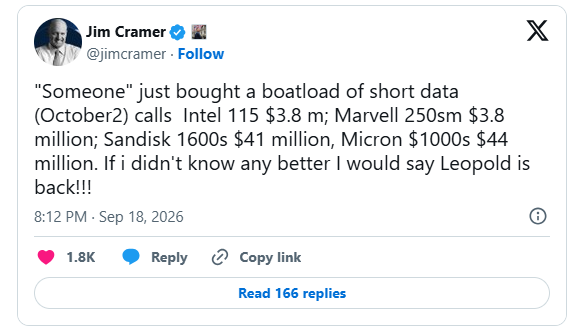
On Friday, about $96 million in short-term call options poured into four AI chip stocks: SanDisk, Micron, Intel, and Marvell. During intraday trading, SanDisk’s share price surged as much as 11%.
Seeing this “massive explosion” of short-dated options activity, CNBC host Jim Cramer commented on social platform X: “Looks like Leopold is back with a vengeance!”
If you’ve been tracking global investment opportunities in AI computing power and large language models, you’re definitely familiar with Leopold Aschenbrenner.
This former core research scientist at OpenAI and high-profile founder of the AI-focused hedge fund Situational Awareness became known for using extreme leverage and aggressively buying short-dated call options in semiconductor and AI companies. In 2024, his fund started with about $225 million and built up to around $4.5 billion through highly leveraged AI bets.
In July this year, the fund suffered a “spectacular blowup,” plummeting 67% during the AI sector’s correction and offloading most of its holdings to Citadel. The Financial Times described it as the single largest loss in hedge fund history. Yet, despite this, the fund still booked an annual gain of around 80% for the year.
At the end of July, Aschenbrenner wrote to investors stating that he would “fight another day,” “learn necessary lessons,” and pledged that all public market investments would be run on a “fully paid” basis going forward.
Last week, CNBC reported that the fund had rebuilt options positions in AMD, Bloom Energy, and CoreWeave. This time, the focus shifted to storage and chip stocks—the fund’s two largest holdings prior to the crash.
Composition of Nearly $100 Million in Call Options
According to intraday trading data compiled by ZeroHedge, the details for these call options expiring on October 2 are as follows:
- Micron (MU): Strike price 1000, about 10,000 contracts, premiums around $44 million
- SanDisk (SNDK): Strike price 1600, about 4,200 contracts, premiums around $41 million
- Intel (INTC): Strike price 115, about 20,000 contracts, premiums around $7.3 million
- Marvell (MRVL): Strike price 250, about 3,500 contracts, premiums around $3.85 million
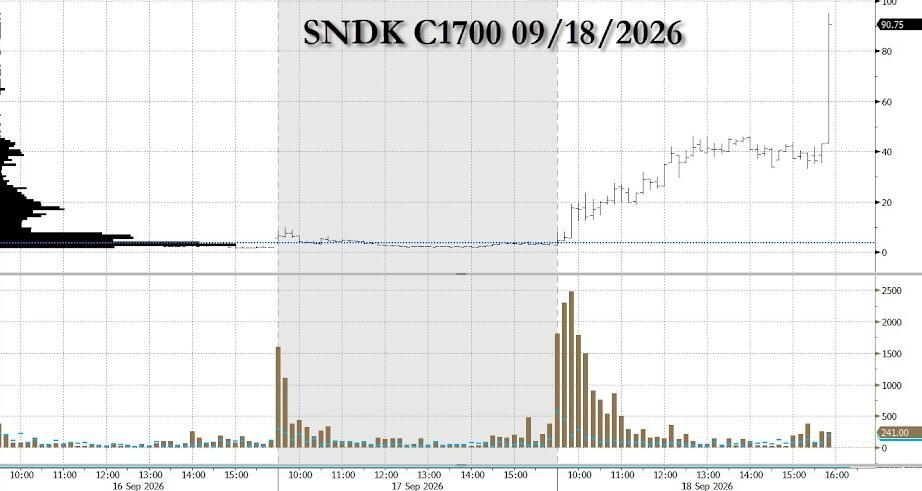
At the time, SanDisk was trading around its strike price, already above the strike; Micron about 990, nearly at-the-money; Intel’s and Marvell’s strike prices were slightly higher than their current prices. The weekly highs for Micron and SanDisk were 1255 and $2354, so current levels are still some distance from these highs.
With only two weeks until expiration, these contracts carry high time decay and gamma sensitivity, leaving virtually zero room for directional error.
Cramer pointed out that the October expiry falls after Micron’s fiscal Q4 earnings—a report that historically moves the entire storage sector. Back in August, he had a bullish outlook on the sector, believing that AI data center demand and supply discipline were reshaping the storage industry’s traditional boom-bust cycle.
Why the Market Points to the "AI Stock God"
SEC filing documents have yet to reveal the buyer, but the market’s speculation around Aschenbrenner is well-founded.
The most direct clue is the underlying assets. Situational Awareness’s end-of-June regulatory filings show $5.7 billion in SanDisk and $5.6 billion in Micron holdings, the two largest positions. These nearly $100 million in options premiums are likewise concentrated on the same two stocks.
The trading method also matches. The fund was previously known for extremely leveraged, short-term bets on AI momentum, with leverage reaching up to 400%. Large, short-dated call options were its signature tool—massive purchases would trigger dealers’ gamma hedging, driving stock prices higher in the short term.
The timeline also lines up. According to the Financial Times on September 11, Aschenbrenner had rebuilt positions with Flex Options in AMD, Intel, SK Hynix, SanDisk, and CoreWeave. Nomura strategist Charlie McElligott spotted a signal: a cumulative $315 million in option premiums flowing into AI and semiconductor stocks over several days, with $1.1 billion in Delta exposure. He also noticed that call option skew for semiconductor ETFs over the next three months had spiked to record levels.
Changed Tools, Unchanged Logic
Unlike July, when Aschenbrenner relied on total return swaps (TRS) from major banks like Goldman Sachs for leverage, this time he is believed to have switched to fully-paid options—where maximum loss is limited to the premium paid, with no risk of margin calls or forced liquidation.
There are practical reasons for this change. Following the crash, JPMorgan terminated its lending relationship with the fund, the SEC requested information from banks that had provided financing, and former prime brokers came under US Department of Justice investigation. According to the Financial Times, Aschenbrenner turned to tech-focused broker Clear Street to reestablish cooperation.
But the strategy’s underlying logic remains unchanged. McElligott observed that these trades displayed the characteristic “spot up, volatility up” linkage—highly reminiscent of the market pattern before July’s blowup. Still establishing massive, concentrated positions in relatively illiquid momentum names, the intent is to trigger a chain-reaction price rally. If momentum reverses, all premiums go to zero and leverage can’t be adjusted to cushion losses.
The fund’s Q3 13F report will be filed in mid-November, when the true buyer behind these trades can be confirmed from regulatory documents.





