Bitcoin crossed $105,000 this morning but failed to hold the move. It pulled back sharply despite two big global developments: a trade agreement between the United States and the United Kingdom, and a second deal with China, which was a pretty big deal.
These were supposed to act as catalysts. They didn’t. The entire crypto market dropped 2% in 24 hours, wiping $70 billion off total value and dragging the market cap to $3.45 trillion, according to data from CoinGecko.
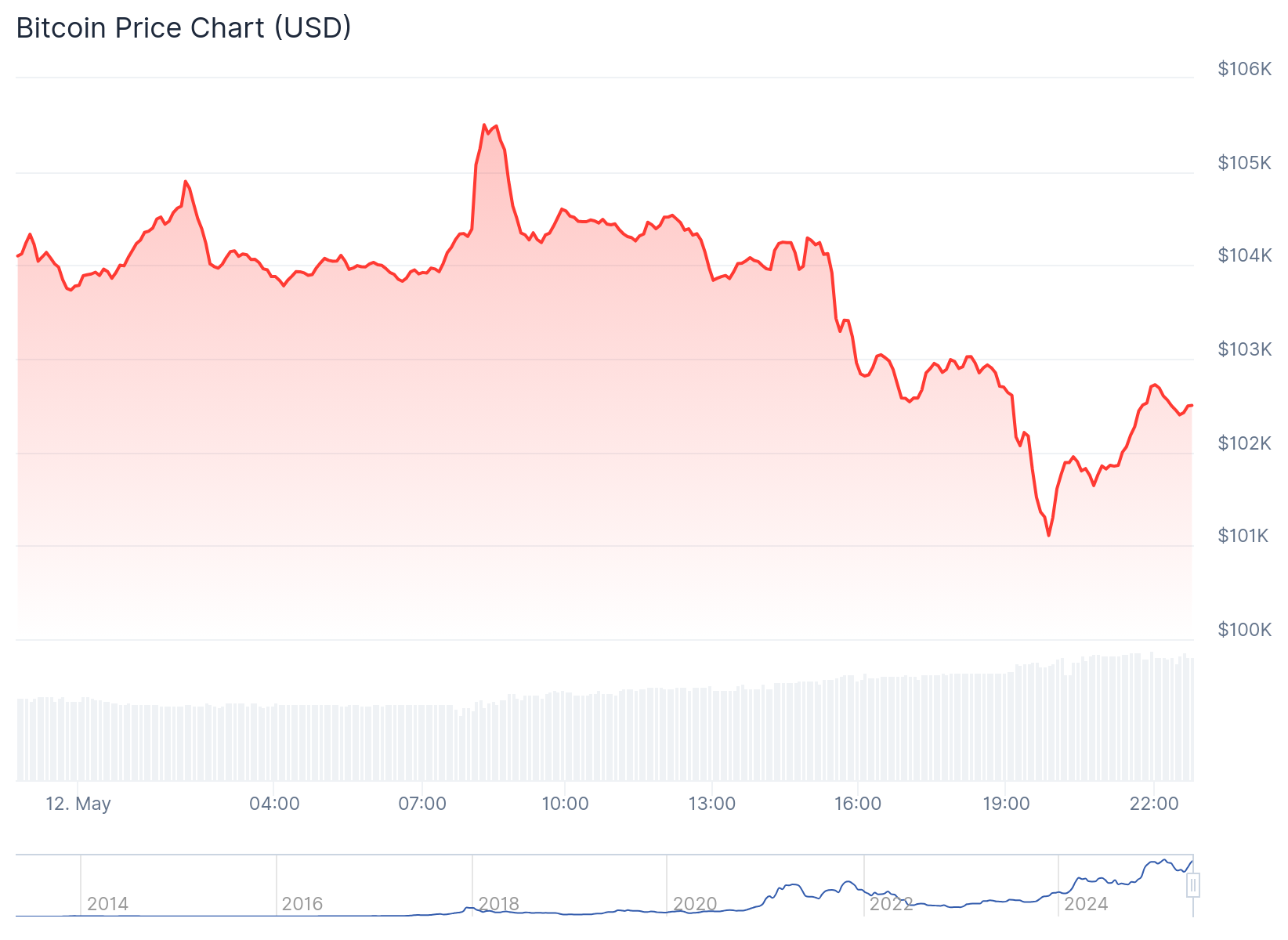
The return of Bitcoin above the six-figure level was one of the few events that caught attention across exchanges. Still, traders were waiting for something more — a full retest of its all-time high at $109,588.
That breakout never came. Price stalled, momentum dropped, and aggressive buy orders started to dry up.
Futures and spot signals don’t align
Momentum indicators painted a strong start. Spot CVD flipped positive. Spot volume bounced back to its lower support band, showing signs of buyer interest. ETF inflows also continued, giving extra support to the price. But actual trading activity began to weaken soon after.
The futures market lagged behind. Open interest was slow to recover, and funding rates only turned positive recently. However, one sign stood out: perpetual CVD began rising steadily from the March lows. That signaled more aggressive long positions entering the market.
In the options market, activity mirrored that trend. Traders pushed open interest higher. The volatility spread recovered, and skew remained deeply negative. This suggests a strong directional bias — upward — but also increased risk, because too many traders were positioned in the same direction. That kind of imbalance often leads to liquidations if price moves against them.
On-chain data shows pressure building
Activity on-chain was quieter. The number of active addresses and total transfer volume were slowly climbing. At the same time, network fees stayed low. The realized cap — which tracks the value of coins based on their last move — started to rise again. But it wasn’t because new people were rushing in. Inflows of new capital stayed weak.
Instead, the STH/LTH ratio showed that long-term holders were still dominating the market. Short-term holders remained a minority, showing little urgency to enter. Holding behavior stayed strong, but that also meant not much new demand was arriving.
The current setup is risky. 94% of the total Bitcoin supply is now in profit. The NUPL — which tracks market sentiment — is approaching euphoric levels. The Realized Profit/Loss Ratio has hit 2.38, meaning investors are sitting on significant gains. That gives them a clear incentive to sell.
Even with that pressure, the setup could last longer. As long as demand continues to build — especially from new participants, this type of market structure can stretch out for several more weeks. It’s happened before during bullish phases in previous cycles.
One of the strongest signals right now is the realized price, which is the average cost basis for all Bitcoin holders. Historically, when this turns lower, it’s a signal of weakness. That’s not happening here. The realized price is still moving higher.
The reason? Institutional investors are buying. Firms like Strategy are purchasing large amounts of Bitcoin through spot ETFs, which pushes realized price up. The more capital comes in at higher price levels, the more the realized price increases. This signals that the uptrend isn’t broken yet.
As Bitcoin stayed steady, gold tumbled. It fell to $3,208 per ounce, nearly hitting its monthly low. That contrast showed how Bitcoin managed to hold its position even without bullish momentum.
At the time of reporting, Bitcoin was trading at $102,800. Over the last 24 hours, a total of $699.71 million in leveraged positions were liquidated across the market. Long positions made up most of the damage at $484.85 million, while shorts lost $214.86 million.
Out of that, Bitcoin traders lost the most — $80.02 million. Ethereum came in next with $45.49 million. All other coins added another $31.53 million to the overall total. The largest individual loss came from Bybit’s BTC/USD pair, where one position worth $11 million got liquidated.
Your crypto news deserves attention - KEY Difference Wire puts you on 250+ top sites