
Q1 2025 Data Reveal Sky-High Costs and a New Pecking Order in Bitcoin Mining

Q1 2025 tested Bitcoin miners with rising costs and lower margins post-halving. Riot, Cango, and Core Scientific stood out with strategic pivots and output leadership.
In Q1 2025, the Bitcoin mining industry faced numerous challenges due to the halving event and the increased network difficulty.
This analysis will use data from publicly listed Bitcoin mining companies such as Cipher Mining, Riot Platforms, Core Scientific, Hut 8 Corp, TeraWulf, Bitfarms, and Cango to summarize, compare, and evaluate their financial performance, mining output, and development strategies.
Financial Performance
Bitcoin mining companies in Q1 2025 exhibited significant disparities in financial performance.
Riot Platforms recorded the highest revenue at $161.4 million, primarily from Bitcoin mining ($142.9 million), with an output of 1,530 BTC. However, per-unit mining costs surged to $43,808/BTC from $23,034/BTC year-over-year, reflecting the impact of the halving and increased network difficulty.
Core Scientific reported an impressive net profit of $581 million, largely driven by non-cash valuation adjustments ($622 million). Revenue dropped 55.7% to $79.525 million, and adjusted EBITDA was negative at $6.107 million.
Bitfarms saw a 33% revenue increase to $67 million, but its gross profit margin fell from 63% to 43%, with a net loss of $36 million. Cango achieved revenue of $145.2 million, with $144.2 million from Bitcoin mining, producing 1,541 BTC at a high average cost of $70,602/BTC.
Meanwhile, Hut 8 Corp and TeraWulf faced significant challenges, with revenues declining by 58% ($21.8 million) and $34.4 million, respectively, alongside substantial net losses ($134.3 million and $61.4 million).
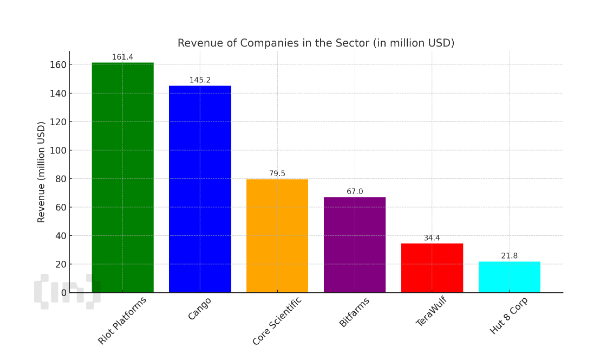 Revenue of mining companies
Mining Output and Bitcoin Holdings
Regarding mining output, Cango led with 1,541 BTC, followed by Riot Platforms (1,530 BTC) and Bitfarms (1,166 BTC). Cipher Mining mined 174 BTC in April but sold 350 BTC, reducing its holdings to 855 BTC, of which 379 BTC were collateralized.
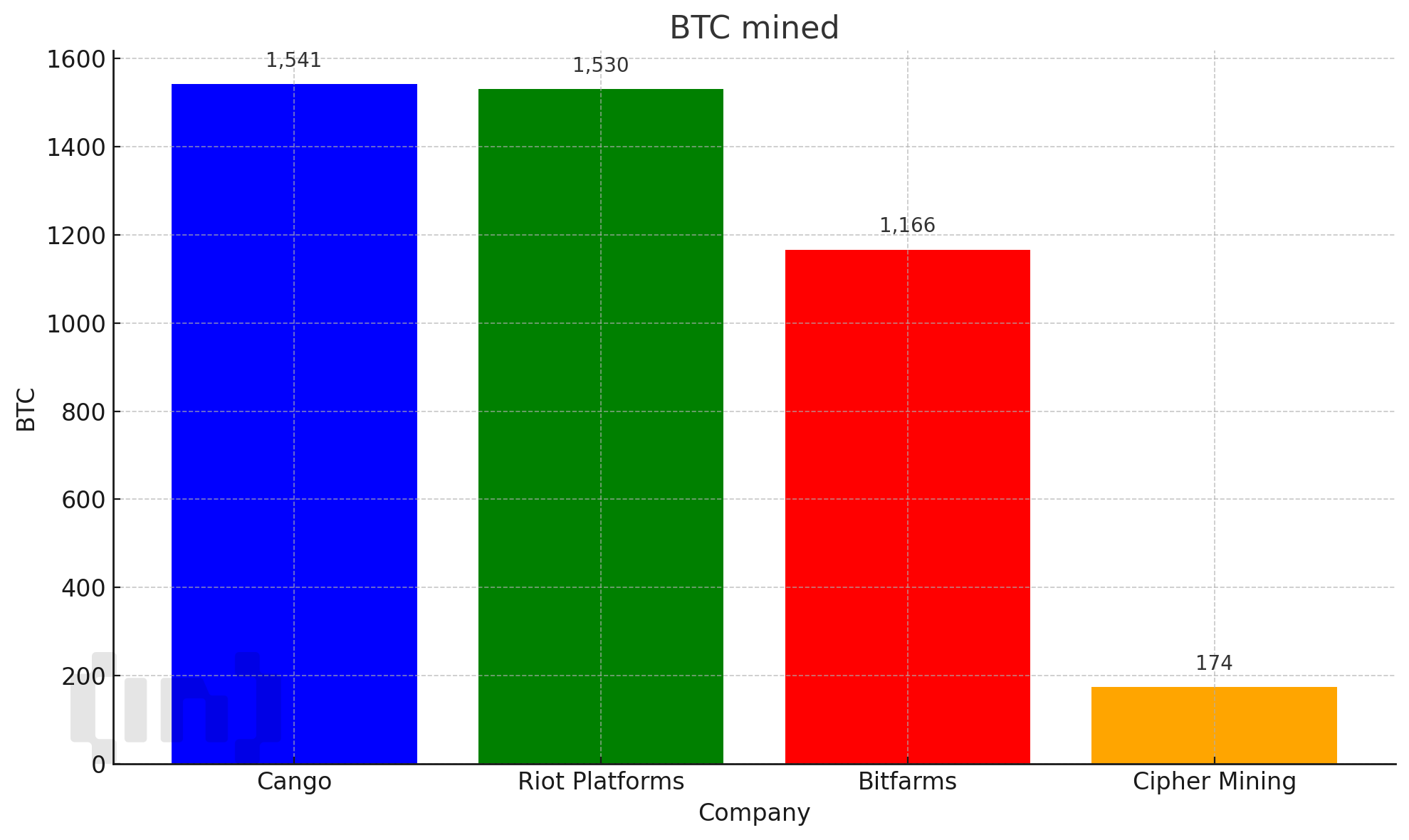 Production of mining companies
Riot Platforms held the largest Bitcoin reserve with 19,223 unrestricted BTC, Bitfarms held 1,166 BTC, and Cango maintained significant cash and short-term investments ($347.4 million).
Core Scientific did not disclose specific Bitcoin holdings but focused on expanding managed services with a 250MW contract for CoreWeave, expected to generate $360 million in revenue by 2026.
Q1 2025 was challenging for Bitcoin mining companies due to the Bitcoin halving and increased network difficulty. Riot Platforms and Cango led in output and revenue, but high mining costs posed challenges. Core Scientific and Hut 8 are pivoting toward sectors like AI to reduce reliance on mining.
Disclaimer: The content of this article solely reflects the author's opinion and does not represent the platform in any capacity. This article is not intended to serve as a reference for making investment decisions.
You may also like
AI Agents Challenge Traditional Banking Security: 5 Cryptocurrencies Worth Trying as Blockchain Identity Advances

Uber Technologies stock closes 3.43% lower; 15-minute RSI sits at 27.11
Counter-terrorism forces take to the streets, Louvre closes! France erupts in a new wave of protests over the weekend, with turmoil threatening to spread across Europe
France is engulfed in a new wave of violent protests, with 70,000 security personnel deployed urgently and curfews imposed in multiple cities. Macron admits to mishandling the response. Financial markets have sounded the alarm early — the spread between French and German government bonds has surged to its highest level since the European debt crisis, PMI has fallen below the threshold for expansion, luxury shops have boarded up windows, the Louvre Museum has closed, and Paris City Hall estimates losses of tens of millions of euros. The turmoil also threatens to spread across Europe.
Bitcoin Miners Are Fleeing to AI: So Why Is the Hash Rate Surging?

Crypto prices
More


