
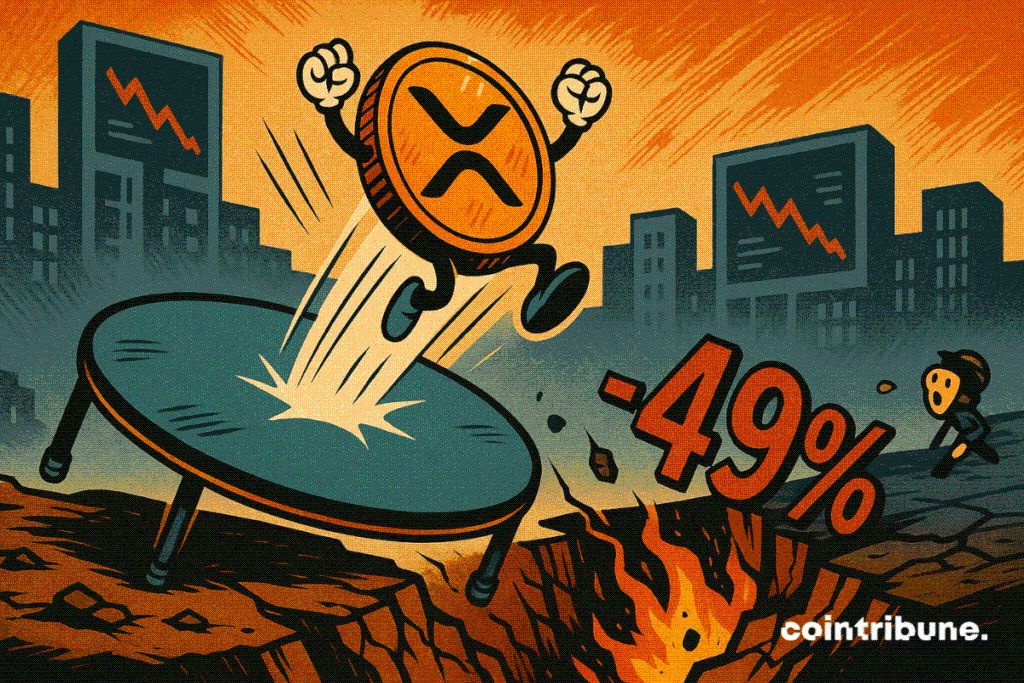
Crypto: XRP Rebounds But Trading Volume Drops By Nearly 49%!

While markets scrutinize upcoming regulatory decisions, XRP experiences an unexpected surge. Having become the fourth largest market cap in the sector, the asset saw a strong rebound after two sessions of decline, sparking a brief wave of optimism. However, behind this technical signal lies a more nuanced reality: trading volume has collapsed by nearly 49% in 24 hours. In a tense environment where every movement fuels speculation, XRP once again becomes a barometer of the crypto market’s contradictions.
In brief
- XRP begins a technical rebound after two days of decline, reaching $2.192 with a 2.18% increase in 24 hours.
- Trading volume collapses by 48.96%, falling to $1.76 billion despite price increase.
- Several key technical indicators remain under watch, including the 50-day and 200-day moving averages at $2.26 and $2.34 respectively.
- Market outlook remains uncertain, between institutional hopes and short-term technical fragility signals.
A technical rebound, but apparent market disinterest?
After two consecutive days of decline on Wednesday and Thursday, XRP experienced a bullish surge this Friday. Indeed, Ripple’s crypto regained ground to reach $2.192 after finding solid support at $2.08.
This slight recovery of +2.18% over 24 hours temporarily reassured asset holders, relieved to see the crypto initiate a turnaround after a volatile week.
However, this improvement is contradicted by a major data point that tempers the optimism. Trading volume sharply dropped by 48.96%, settling at only $1.76 billion, according to CoinMarketCap figures .
Technical data confirms a mixed recovery, marked by several contradictory signals:
- Volume decline: -48.96% over 24 hours, falling from nearly $3.5 billion to $1.76 billion, signaling operator disinterest despite the price increase;
- A persistent resistance zone: the XRP price still faces a technical barrier between $2.50 and $2.60, which the current rebound fails to cross;
- Moving averages under watch: the 50-day and 200-day indicators, at $2.26 and $2.34 respectively, are key thresholds to confirm a lasting reversal;
- A neutral chart structure: XRP continues to evolve within a symmetrical triangle pattern, typical of a consolidation phase where the outcome depends on volume resurgence.
Analysis shows the market remains extremely cautious. Thus, the gap between price recovery and volume collapse causes legitimate doubt. The current rise may not be supported by genuine investor conviction but rather by an isolated technical rebound.
To exit this zone of uncertainty, XRP will need to validate stronger signals, beginning with a significant volume increase and the overcoming of major technical resistances.
Fundamentals in motion: from stablecoin to ETF, XRP reshapes its ambitions
While the market monitors on-chain data, major announcements are emerging. According to a SEC filing , the Chinese company Webus International announced the creation of a corporate treasury of $300 million based on XRP, an ambitious initiative that could strengthen the asset’s credibility as a liquidity tool.
At the same time, Ripple obtained approval from Dubai regulators for the launch of its RLUSD stablecoin, a crypto pegged to the US dollar designed to streamline payments on the XRP Ledger ecosystem. These developments reflect an international expansion strategy, both in regulatory and technological adoption terms.
However, it is primarily the highly anticipated decision by the US regulator on Franklin Templeton’s spot XRP ETF, scheduled for June 17, that could serve as a decisive catalyst. Approval of such a product would potentially open the doors to massive institutional inflows into XRP by offering a regulated exposure avenue to the asset.
ETF approval could alter liquidity dynamics and reposition XRP as a cornerstone of the institutional ecosystem.
In this context, the implications of a favorable outcome are considerable. If Franklin Templeton’s ETF were approved, combined with structural efforts surrounding RLUSD and the Webus treasury, XRP could regain a more organic momentum, driven both by adoption and institutional demand. Conversely, a SEC rejection and prolonged stagnation in trading volume would reinforce the idea that the current rebound is merely an illusion.
Disclaimer: The content of this article solely reflects the author's opinion and does not represent the platform in any capacity. This article is not intended to serve as a reference for making investment decisions.
You may also like
Uber Technologies stock closes 3.43% lower; 15-minute RSI sits at 27.11
Counter-terrorism forces take to the streets, Louvre closes! France erupts in a new wave of protests over the weekend, with turmoil threatening to spread across Europe
France is engulfed in a new wave of violent protests, with 70,000 security personnel deployed urgently and curfews imposed in multiple cities. Macron admits to mishandling the response. Financial markets have sounded the alarm early — the spread between French and German government bonds has surged to its highest level since the European debt crisis, PMI has fallen below the threshold for expansion, luxury shops have boarded up windows, the Louvre Museum has closed, and Paris City Hall estimates losses of tens of millions of euros. The turmoil also threatens to spread across Europe.

Bitcoin Miners Are Fleeing to AI: So Why Is the Hash Rate Surging?

Once frenzied buying, now the "ammunition warehouse" shrinks by 51 trillion KRW! Korean retail investors can no longer afford to buy
In four months, Korean retail investors' "ammunition stockpile" has dropped by 36.5%, returning to levels seen at the beginning of the year. Although retail investors have collectively made net purchases exceeding 75 trillion won, they are still absorbing the sell-off, but the influx of new funds has dried up, and the replenishment rate lags far behind the consumption rate. Combined with the KOSPI plunging nearly 20% this month, continued net selling by foreign investors, and concerns over AI-related credit risks, the Korean stock market may find it difficult to see a sustained rebound in the short term without support from private investors' funds.
Crypto prices
More


