
XRP shows signs of rebound but declining on-chain activity signals more risk ahead

XRP is recovering from recent lows but weakening XRP Ledger metrics may indicate further challenges.
Trading at $2.25 as of press time, XRP ( XRP ) is up 3.8% over the last day. The price is near the upper end of its weekly range between $2.09 and $2.29. With 24-hour volume reaching $2.65 billion, trading volume is up almost 180% from the day before, reflecting growing trader interest. Rising volume alongside price gains often hints at stronger conviction among market participants.
Coinglass data also reveals a spike in derivatives activity. XRP’s futures volume has increased 201.98% to $4.82 billion, while open interest has increased 11.48% to $4.09 billion. This can support short-term price movements in either direction since it indicates that more traders are opening positions and placing bets on ongoing volatility.
However, not all signals are positive. According to data from XRP scan, on-chain activity is slipping, raising concerns about the sustainability of this rally. By June 8, there were only about 600,000 payments between accounts, down from almost 900,000 at the beginning of the month.
Likewise, the number of transactions has decreased from roughly 1.5 million at the start of June to just over 1.1 million in the last few days.
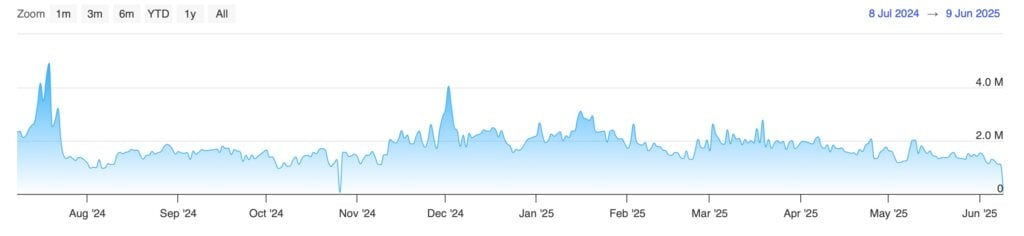 XRP transaction count. Credit: XRPScan
The number of active addresses has also declined, now sitting below 20,000. These metrics often show user engagement and utility on the XRP Ledger, and their decline may indicate that network demand is waning despite the price increase.
From a technical perspective, XRP has been able to maintain its position above a crucial support level close to $2.08. After recently recovering from this area, the price is now pressing against the middle band of the Bollinger Bands near $2.25. A break above this level could open the way toward the upper band at $2.42.
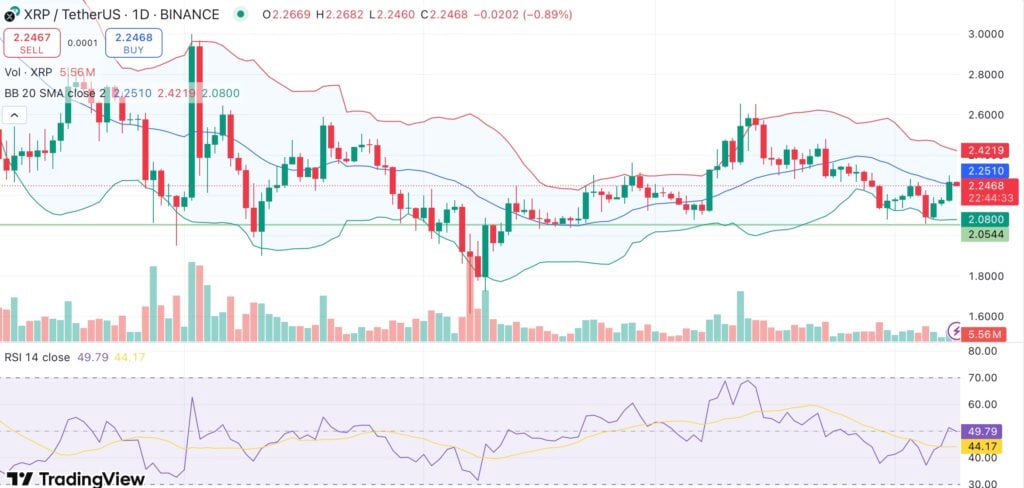 XRP price analysis. Credit: crypto.news
Although it is trending upward after recovering from oversold levels, the relative strength index is still neutral near 50. If momentum builds, bulls could target a move back to the $2.60–$2.65 resistance area seen in late May.
However, if $2.25 is not broken, a retest of $2.08 may occur, and a breakdown there might reveal the $2.05–$2.00 range. Until on-chain metrics reverse course, price gains may remain fragile even as short-term momentum builds.
Disclaimer: The content of this article solely reflects the author's opinion and does not represent the platform in any capacity. This article is not intended to serve as a reference for making investment decisions.
You may also like
Uber Technologies stock closes 3.43% lower; 15-minute RSI sits at 27.11
Counter-terrorism forces take to the streets, Louvre closes! France erupts in a new wave of protests over the weekend, with turmoil threatening to spread across Europe
France is engulfed in a new wave of violent protests, with 70,000 security personnel deployed urgently and curfews imposed in multiple cities. Macron admits to mishandling the response. Financial markets have sounded the alarm early — the spread between French and German government bonds has surged to its highest level since the European debt crisis, PMI has fallen below the threshold for expansion, luxury shops have boarded up windows, the Louvre Museum has closed, and Paris City Hall estimates losses of tens of millions of euros. The turmoil also threatens to spread across Europe.
Bitcoin Miners Are Fleeing to AI: So Why Is the Hash Rate Surging?

Once frenzied buying, now the "ammunition warehouse" shrinks by 51 trillion KRW! Korean retail investors can no longer afford to buy
In four months, Korean retail investors' "ammunition stockpile" has dropped by 36.5%, returning to levels seen at the beginning of the year. Although retail investors have collectively made net purchases exceeding 75 trillion won, they are still absorbing the sell-off, but the influx of new funds has dried up, and the replenishment rate lags far behind the consumption rate. Combined with the KOSPI plunging nearly 20% this month, continued net selling by foreign investors, and concerns over AI-related credit risks, the Korean stock market may find it difficult to see a sustained rebound in the short term without support from private investors' funds.
Crypto prices
More


