
Research Report|In-depth Analysis of Skate & $SKATE Valuation
I. Project Overview

II. Key Highlights
III. Valuation Outlook

IV. Tokenomics
-
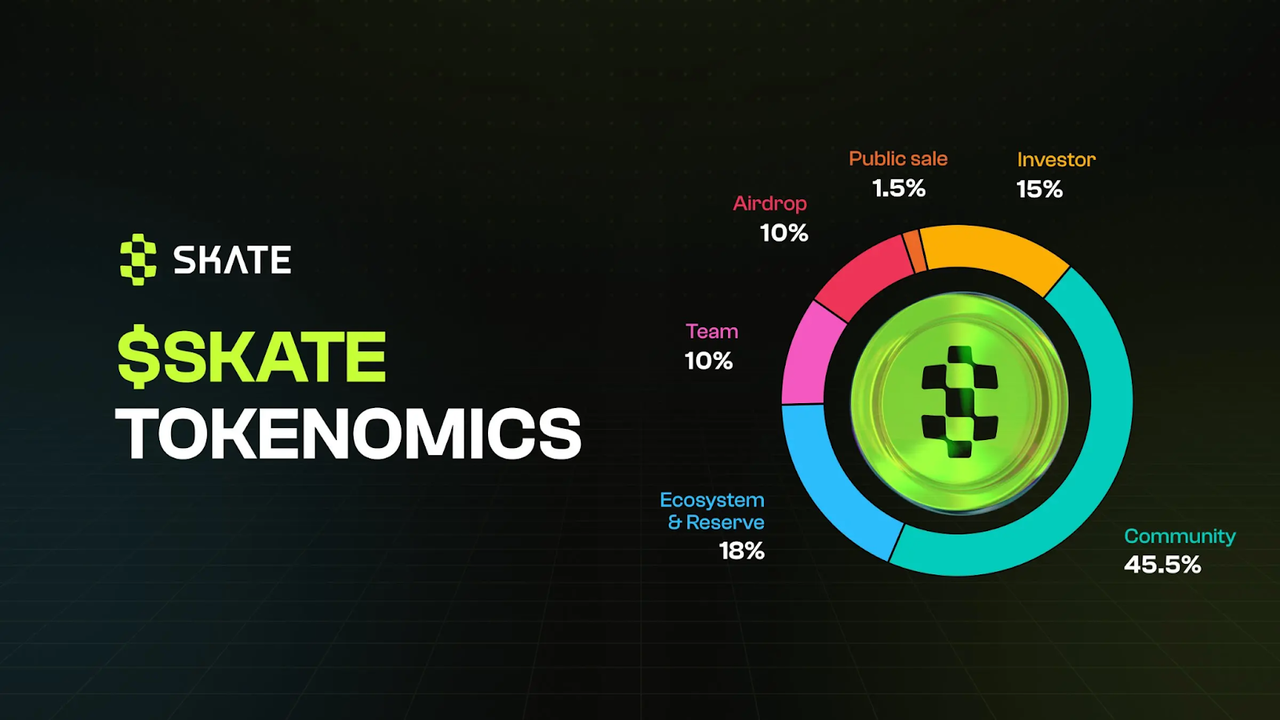
Community Allocation: 45.5% The largest allocation, covering AMM trading incentives, AVS rewards, ecosystem grants, and community proposal funds. Designed to encourage deep participation by developers, validators, and contributors.
-
Ecosystem Reserves: 18.0% Supports DEX liquidity, cross-chain market expansion, LST seed funds, strategic partnerships, and future airdrop reserves—fueling long-term ecosystem growth.
-
Team: 10.0% Allocated to founders and core developers to ensure long-term commitment and ongoing protocol evolution.
-
Initial Airdrop: 10.0% Distributed to early users, AMM traders, event participants, and EigenLayer AVS restakers. Users can opt to “claim stake” for a 30% bonus incentive.
-
Investors Advisors: 15.0% Assigned to early backers and strategic partners to support initial development and expansion.
-
Public Sale: 1.5% Fair launch allocation for the public to widen token distribution and community governance participation.
-
Governance token: $SKATE holders can stake to vote on key parameters, incentive models, and ecosystem proposals. Voting power scales with stake duration and size to encourage long-term alignment.
-
AVS incentives: $SKATE powers cross-chain AVS verification, rewarding Operators and Restakers. A slashing mechanism will be introduced to enhance protocol security and composability.
-
AMM incentives: Used for liquidity mining, trading rewards, and market-making subsidies—boosting protocol usage and depth.
-
Development subsidies: Incentivizes Stateless App development on emerging AltVM chains, helping form a closed-loop of real usage within the Skate network.
-
Contributor rewards: Community members can earn $SKATE through content, tools, and event contributions—driving grassroots ecosystem growth.
V. Team Funding
-
Community Round (March 2024): Raised $1M (undisclosed investors)
-
Seed Round (September 2023): Raised $3.75M from HashKey Capital, Nomad Capital, Mirana Ventures, Spark Digital Capital, Symbolic Capital, Comma3 Ventures, Asymmetry Ventures.
VI. Risks Considerations
-
Early-stage ecosystem: Despite support for EVM, SVM, Move, and TON, Skate’s integrated protocol ecosystem is still in its infancy. Aside from partners like Plume Network, strong network effects and TVL depth have yet to emerge.
-
Liquidity pressures post-TGE: While token distribution is conservative, any misalignment between community incentive unlocks and secondary market demand could lead to short-term liquidity stress. Monitoring trading activity and market feedback post-TGE will be critical.
VII. Official Links
-
Website: https://www.skatechain.org
-
Twitter: https://x.com/skate_chain
-
Discord: https://t.me/skate_app
Disclaimer: The content of this article solely reflects the author's opinion and does not represent the platform in any capacity. This article is not intended to serve as a reference for making investment decisions.
You may also like
Uber Technologies stock closes 3.43% lower; 15-minute RSI sits at 27.11
Counter-terrorism forces take to the streets, Louvre closes! France erupts in a new wave of protests over the weekend, with turmoil threatening to spread across Europe
France is engulfed in a new wave of violent protests, with 70,000 security personnel deployed urgently and curfews imposed in multiple cities. Macron admits to mishandling the response. Financial markets have sounded the alarm early — the spread between French and German government bonds has surged to its highest level since the European debt crisis, PMI has fallen below the threshold for expansion, luxury shops have boarded up windows, the Louvre Museum has closed, and Paris City Hall estimates losses of tens of millions of euros. The turmoil also threatens to spread across Europe.

Bitcoin Miners Are Fleeing to AI: So Why Is the Hash Rate Surging?

Once frenzied buying, now the "ammunition warehouse" shrinks by 51 trillion KRW! Korean retail investors can no longer afford to buy
In four months, Korean retail investors' "ammunition stockpile" has dropped by 36.5%, returning to levels seen at the beginning of the year. Although retail investors have collectively made net purchases exceeding 75 trillion won, they are still absorbing the sell-off, but the influx of new funds has dried up, and the replenishment rate lags far behind the consumption rate. Combined with the KOSPI plunging nearly 20% this month, continued net selling by foreign investors, and concerns over AI-related credit risks, the Korean stock market may find it difficult to see a sustained rebound in the short term without support from private investors' funds.
Crypto prices
More


