
Bitcoin Inflation Falls to 0.27% as Price Eyes $115K


- Bitcoin’s annual inflation rate has dropped to 0.27%, marking its lowest level in 2025.
- The market cap holds strong above $2.17 trillion, with steady buying seen since April.
- Price action and data now support a likely move upward toward the $115,000 price zone.
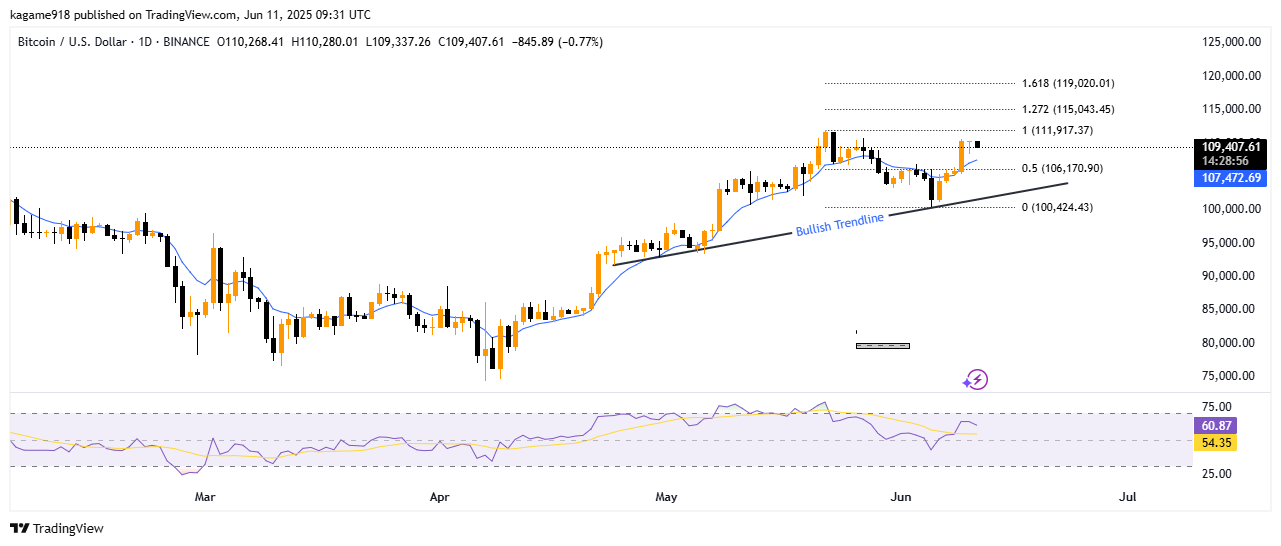
Bitcoin held firm above $109,000 on June 11 after rebounding from the $106,170 support, aligning with the 20-day EMA and Fibonacci level. The price reached a high of $110,280 and remained stable as momentum indicators continued to signal strength. Additionally, on-chain data from Santiment confirmed a sharp drop in Bitcoin’s annual inflation rate to 0.27%, one of the lowest levels this year.
 Source:
TradingView
Market participants continued to defend the $109K–$110K region, keeping short-term volatility contained. Daily candlesticks displayed firm closes and shorter wicks, indicating reduced selling pressure. As this took place, the Relative Strength Index stood at 60.87, staying above the neutral 50 line and suggesting a slightly bullish momentum.
Technical setups aligned with a bullish trendline that emerged in early May, providing traders with increased confidence in the ongoing rally. The following resistance levels are at $111,917 and $115,043. Could Bitcoin maintain this momentum and hit the $115,000 mark?
Inflation Declines as Supply Pressure Weakens
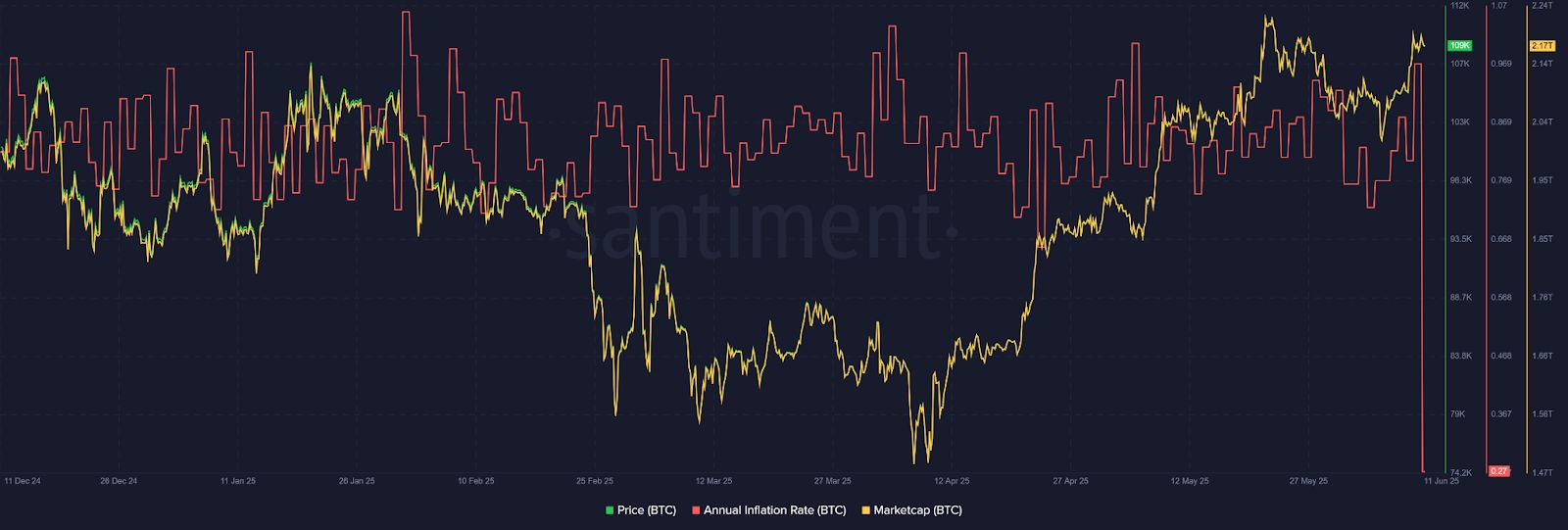
According to Santiment, Bitcoin’s annual inflation rate declined to 0.27% by June 11. This followed several months of high volatility, where inflation had oscillated. The data reflects a considerable reduction in supply-side pressure, making fewer coins available in circulation.
 Source:
Santiment
Between December and late February, inflation showed unpredictable patterns while Bitcoin’s price moved between $83,000 and $98,000. However, the sharp drop in inflation coincided with the asset’s recovery in market value. A noticeable rebound began in mid-April, continuing steadily into June.
In addition to stability in price, this reduced inflation rate can also impact the liquidity of Bitcoin in terms of its supply on various exchanges. With the sluggishness in new issuance, scarcity could soon start to impinge upon price behavior.
Related: Bitcoin Devs Defend Relay Rules as Debate Over Spam Grows
Market Cap Reclaims Strength Above $2.17 Trillion
Bitcoin’s market capitalization now stands at $2.17 trillion, according to the latest chart data. This follows a recovery from early March lows, which clearly shows continued institutional and retail engagement.
The market cap declined steeply in Q1 but recovered consistently from late April through June. This turnaround occurred without major policy or macroeconomic shifts, indicating price movement was led by on-chain dynamics. Having a stable momentum, strong support, and cooling supply pressures, Bitcoin is in a good position to attempt the $115,000 mark.
The post Bitcoin Inflation Falls to 0.27% as Price Eyes $115K appeared first on Cryptotale.
Disclaimer: The content of this article solely reflects the author's opinion and does not represent the platform in any capacity. This article is not intended to serve as a reference for making investment decisions.
You may also like
Uber Technologies stock closes 3.43% lower; 15-minute RSI sits at 27.11
Counter-terrorism forces take to the streets, Louvre closes! France erupts in a new wave of protests over the weekend, with turmoil threatening to spread across Europe
France is engulfed in a new wave of violent protests, with 70,000 security personnel deployed urgently and curfews imposed in multiple cities. Macron admits to mishandling the response. Financial markets have sounded the alarm early — the spread between French and German government bonds has surged to its highest level since the European debt crisis, PMI has fallen below the threshold for expansion, luxury shops have boarded up windows, the Louvre Museum has closed, and Paris City Hall estimates losses of tens of millions of euros. The turmoil also threatens to spread across Europe.

Bitcoin Miners Are Fleeing to AI: So Why Is the Hash Rate Surging?

Once frenzied buying, now the "ammunition warehouse" shrinks by 51 trillion KRW! Korean retail investors can no longer afford to buy
In four months, Korean retail investors' "ammunition stockpile" has dropped by 36.5%, returning to levels seen at the beginning of the year. Although retail investors have collectively made net purchases exceeding 75 trillion won, they are still absorbing the sell-off, but the influx of new funds has dried up, and the replenishment rate lags far behind the consumption rate. Combined with the KOSPI plunging nearly 20% this month, continued net selling by foreign investors, and concerns over AI-related credit risks, the Korean stock market may find it difficult to see a sustained rebound in the short term without support from private investors' funds.
Crypto prices
More


