
Bitcoin ETF Momentum Cools, But Derivatives Markets Remain Optimistic | ETF News

While spot Bitcoin ETFs experienced a slowdown, BTC's derivatives markets continue to show optimism, driven by positive funding rates and strong demand for call options.
Spot Bitcoin ETFs continued their streak of net inflows for the third consecutive day, bringing in over $160 million yesterday. While this marks a healthy continuation of investor interest, it represents a pullback from the $431 million recorded the previous day.
The slowdown comes as BTC tests resistance around the $110,000 mark, stalling upward momentum in the spot market.
ETF Demand Holds Steady for BTC
On Wednesday, net inflows into US-listed spot BTC ETFs totaled $165 million. Although this figure marked continued investor interest in these investment funds, it represented a 61% decline from the $435 million posted on June 10.
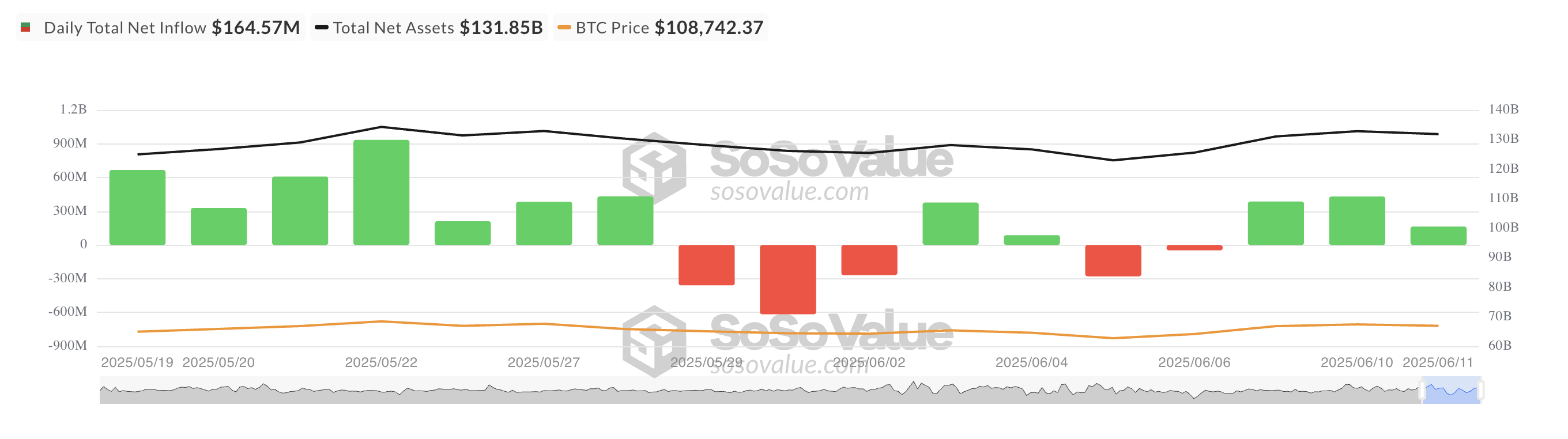 Total Bitcoin Spot ETF Net Inflow. Source:
SosoValue
The slowdown is largely attributed to BTC’s seeming price stagnation around the $110,000 mark over the past two days. This reflects the coin’s struggle to gain upward momentum amid profit-taking activity.
Yesterday, BlackRock’s IBIT led the pack with the highest daily inflows, totaling $131.01 million, bringing its total historical net inflow to $49.24 billion.
VanEck’s HODL ETF recorded the second-highest daily net inflow, bringing in $15.39 million on Wednesday. According to SosoValue, its total historical net inflows have now reached $968.94 million.
Traders Shrug Off Bitcoin’s Decline as Derivatives Signal Strength
Currently trading at $107,939, BTC is down 2% over the past day. Despite this decline, sentiment across BTC’s derivatives market remains largely bullish.
For example, the coin’s futures markets continue to reflect a positive funding rate, an indicator that long positions keep outpacing shorts. As of this writing, this stands at 0.0062%.
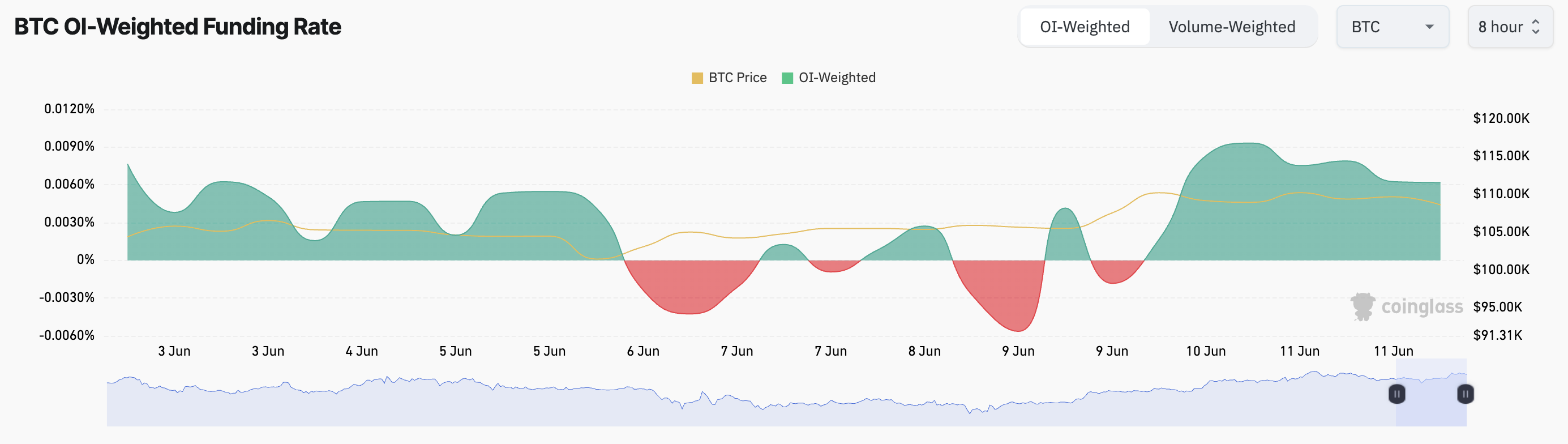 BTC Funding Rate. Source:
Coinglass
The funding rate is a recurring payment between long and short positions in perpetual futures contracts, designed to keep the contract price aligned with the spot price. A positive funding rate like this means traders holding long positions are paying shorts, indicating that bullish sentiment dominates the BTC market.
Furthermore, an assessment of the BTC options market data shows a notable demand for call contracts.
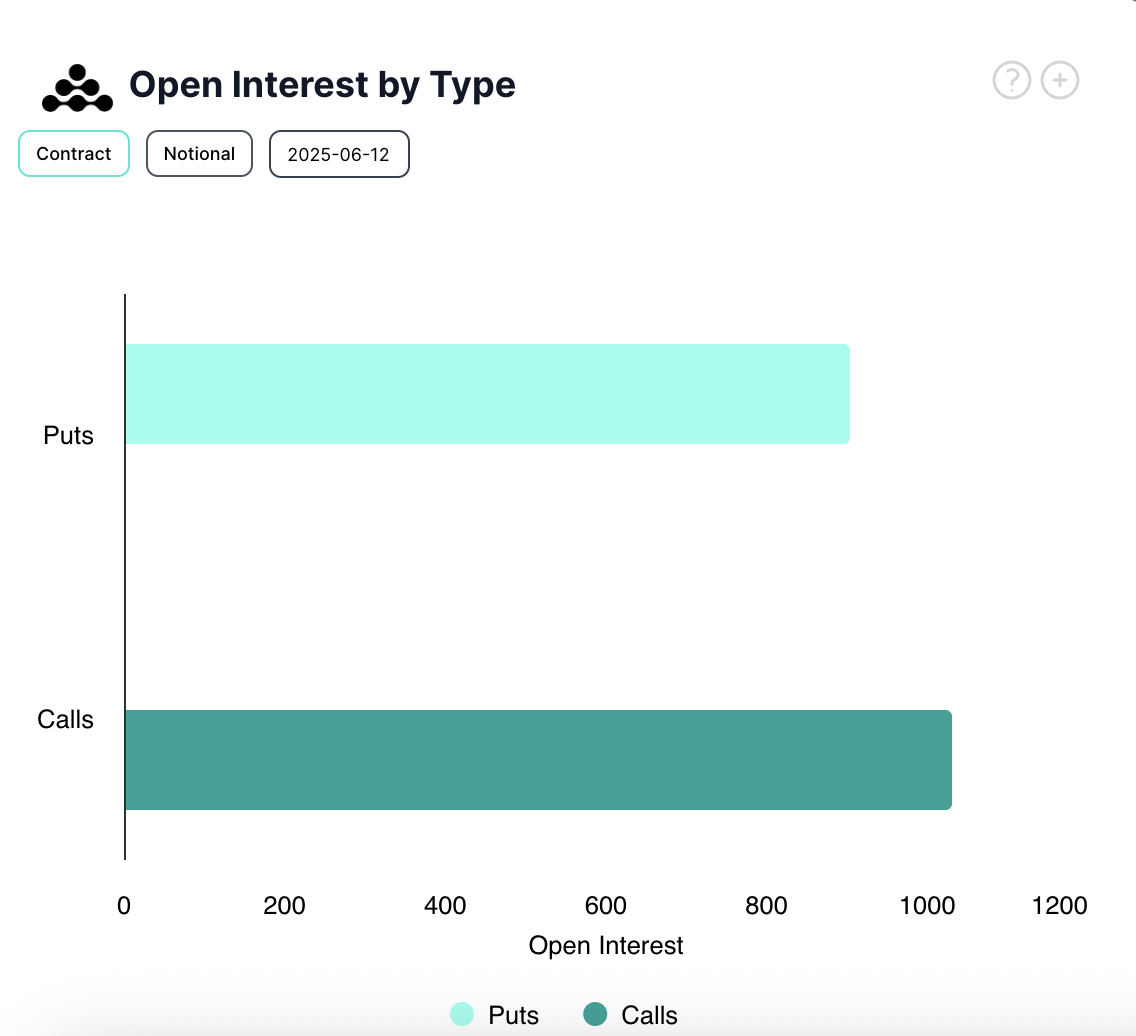 BTC Options Open Interest. Source:
Deribit
This suggests that despite the coin’s lackluster performance over the past day, many traders are positioning for a potential breakout in the near term.
Disclaimer: The content of this article solely reflects the author's opinion and does not represent the platform in any capacity. This article is not intended to serve as a reference for making investment decisions.
You may also like
Bitcoin Miners Are Fleeing to AI: So Why Is the Hash Rate Surging?

Once frenzied buying, now the "ammunition warehouse" shrinks by 51 trillion KRW! Korean retail investors can no longer afford to buy
In four months, Korean retail investors' "ammunition stockpile" has dropped by 36.5%, returning to levels seen at the beginning of the year. Although retail investors have collectively made net purchases exceeding 75 trillion won, they are still absorbing the sell-off, but the influx of new funds has dried up, and the replenishment rate lags far behind the consumption rate. Combined with the KOSPI plunging nearly 20% this month, continued net selling by foreign investors, and concerns over AI-related credit risks, the Korean stock market may find it difficult to see a sustained rebound in the short term without support from private investors' funds.
Apple Prints TD Sequential Sell 9 — Last Two Led to 15.66% and 13.63% Corrections

The Collapse of "Consensus Trading" and the Birth of a New Consensus! Goldman Sachs Explains: Why Institutions Are Currently Significantly Reducing AI Holdings
The extremely crowded trade of "going long on AI, short on everything else" is undergoing a painful unwinding—markets are no longer satisfied with the "burn rate narrative." Mega-scale cloud providers must deliver real, visible revenue conversions alongside $1.1 trillion in capital expenditures. A power gap of 40-50 gigawatts, rising capital costs, and a macro paradigm shift from an era of "overspending" are turning AI trades from a matter of faith into a harsh test of monetization.

Crypto prices
More


