
Over $3.5 Billion Crypto Options Expire Today Amid Strong Ethereum Upside Flows

With over $3.5 billion in Bitcoin and Ethereum options expiring today, market volatility is expected. Despite bearish sentiment, Ethereum shows strong upside flows, leading to potential price swings.
Crypto options expiry this week concerns over $3.5 billion in notional value. The high volume of expiring options is expected to create short-term volatility in the market.
These expiring options coincide with rising global uncertainty amid geopolitical tensions, so traders and investors should prepare for the impact.
Crypto Markets to See $3.5 Billion in Bitcoin, Ethereum Options Expire
With over $3.5 billion worth of Bitcoin and Ethereum options expiring today, data on Deribit shows BTC contracts account for most of it. Today, 27,959 Bitcoin option contracts will expire, sending up to $2.9 billion in notional value down the drain.
The maximum pain level is $106,500, slightly above Bitcoin’s price as of press time. Option traders will experience the most losses at this level.
Meanwhile, these expiring Bitcoin contracts have a put-to-call ratio of 0.91, highlighting the prevalence of Call (purchase) options rather than Put (sale) options. This means traders are leaning bullish rather than bearish.
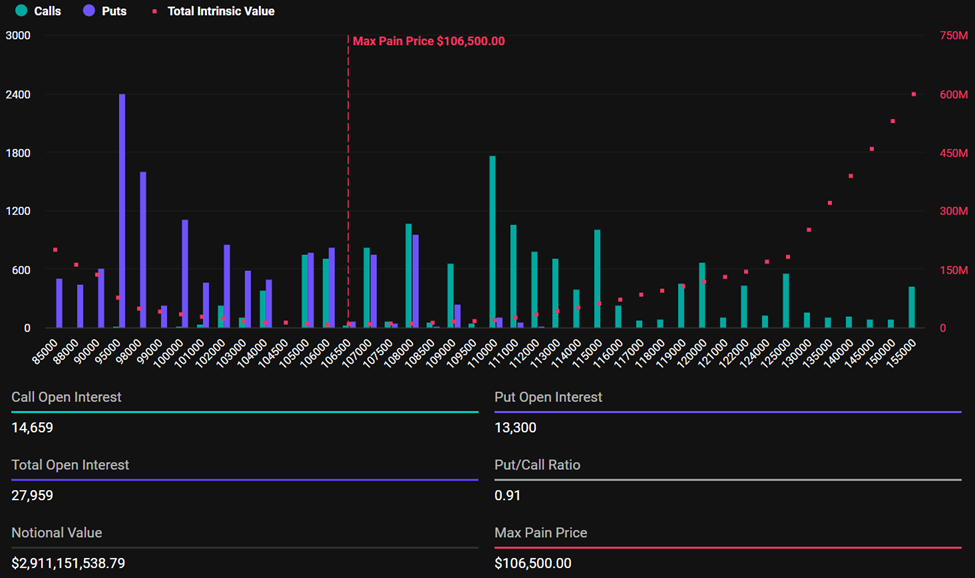 Expiring Bitcoin Options. Source:
Deribit
At the same time, 246,849 Ethereum contracts will expire today, accounting for $617.6 million in notional value.
According to data on Deribit, these expiring options have a put-to-call ratio of 1.14. The maximum pain level or strike price is $2,650. Notably, Ethereum’s put-to-call ratio is above 1, showing a prevalence of Put (sale) options rather than Call (purchase) options.
Ethereum’s put and call options distribution suggests a market tilt toward protecting against ETH price drops, based on the higher put-call ratio of 1.14.
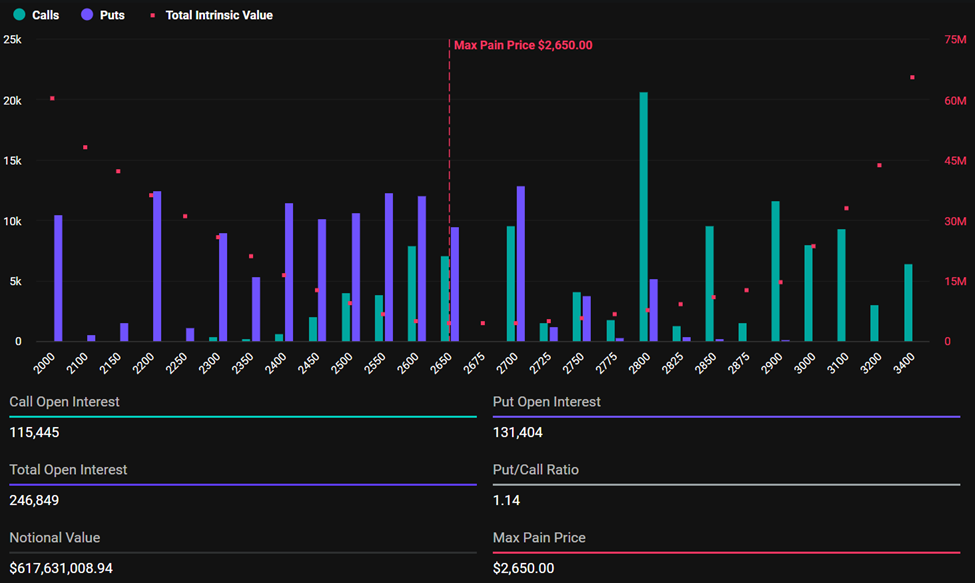 Expiring Ethereum Options. Source:
Deribit
As of this writing, Bitcoin was trading for $104,342, well below its strike price of $106,500. In the same way, Ethereum was also trading below its maximum pain level of $2,650. ETH was exchanging hands for $2,515 as of press time.
According to the Max Pain theory in crypto options trading, as options near their expiration, the underlying asset’s price tends to gravitate toward the strike price. Here, the greatest number of options (calls and puts) would expire worthless, causing maximum financial loss (or “pain”) to option holders.
This theory hinges on the assumption that market makers or large institutional players (smart money), often on the other side of options trades, may influence the underlying asset’s price through trading or hedging activities. Their actions push prices toward the max pain points.
It happens as market makers profit when options expire worthless, as they collect the premiums without paying out.
Ethereum Upside Flows Are Strong Heading Into Expiry
Greeks.live analysts highlight bearish dominance, as seen with multiple traders shifting to buy puts for protection. Deribit notes that ETH upside flows are heading into expiry.
“ETH upside flows are strong heading into expiry. Will traders keep chasing it after Friday, or is this where it cools off?” Deribit posed.
This contrasts with Ethereum’s max pain point, indicating potential volatility given that option expiries often trigger price swings as traders adjust positions. This is especially true when flows defy max pain expectations.
“The group appears divided on market direction, with bears dominating the conversation as multiple traders have shifted to buying puts for protection,” analysts at Greeks.live wrote, highlighting market sentiment.
Analysts at Greeks.live attempt to explain the Put protection strategy, which is displayed among traders who are hedging for downside risk.
According to the analysts, traders are buying put spreads and protective puts, positioning themselves strategically after months of bullish sentiment.
High volatility environment is creating attractive opportunities for put protection, with traders anticipating two standard deviation events and significant price wicks from unexpected news catalysts,” they added.
Catalysts in this regard include US-China trade deals, recent economic indicators such as US CPI inflation data, and developments in the Israel-Iran war.
According to JPMorgan, escalations in the Middle East could derail the Fed’s push to a 2% inflation target.
Disclaimer: The content of this article solely reflects the author's opinion and does not represent the platform in any capacity. This article is not intended to serve as a reference for making investment decisions.
You may also like
Uber Technologies stock closes 3.43% lower; 15-minute RSI sits at 27.11
Counter-terrorism forces take to the streets, Louvre closes! France erupts in a new wave of protests over the weekend, with turmoil threatening to spread across Europe
France is engulfed in a new wave of violent protests, with 70,000 security personnel deployed urgently and curfews imposed in multiple cities. Macron admits to mishandling the response. Financial markets have sounded the alarm early — the spread between French and German government bonds has surged to its highest level since the European debt crisis, PMI has fallen below the threshold for expansion, luxury shops have boarded up windows, the Louvre Museum has closed, and Paris City Hall estimates losses of tens of millions of euros. The turmoil also threatens to spread across Europe.

Bitcoin Miners Are Fleeing to AI: So Why Is the Hash Rate Surging?

Once frenzied buying, now the "ammunition warehouse" shrinks by 51 trillion KRW! Korean retail investors can no longer afford to buy
In four months, Korean retail investors' "ammunition stockpile" has dropped by 36.5%, returning to levels seen at the beginning of the year. Although retail investors have collectively made net purchases exceeding 75 trillion won, they are still absorbing the sell-off, but the influx of new funds has dried up, and the replenishment rate lags far behind the consumption rate. Combined with the KOSPI plunging nearly 20% this month, continued net selling by foreign investors, and concerns over AI-related credit risks, the Korean stock market may find it difficult to see a sustained rebound in the short term without support from private investors' funds.
Crypto prices
More


