
Hedera (HBAR) Price Could Drop 19% If These Key Supports Break

Hedera (HBAR) is under pressure as bearish indicators mount, but deeply oversold RSI hints at a potential bounce if key support holds.
Hedera (HBAR) is under heavy pressure, falling 5% in the past 24 hours and down more than 25% over the last 30 days. The sharp decline has pushed multiple technical indicators into bearish territory, raising concerns about a potential breakdown.
Momentum has weakened significantly, with BBTrend and RSI signaling deteriorating strength and growing selling pressure. All eyes are now on the critical $0.153 support level, which could determine whether HBAR rebounds—or slides further toward new lows.
HBAR Struggles to Regain Momentum
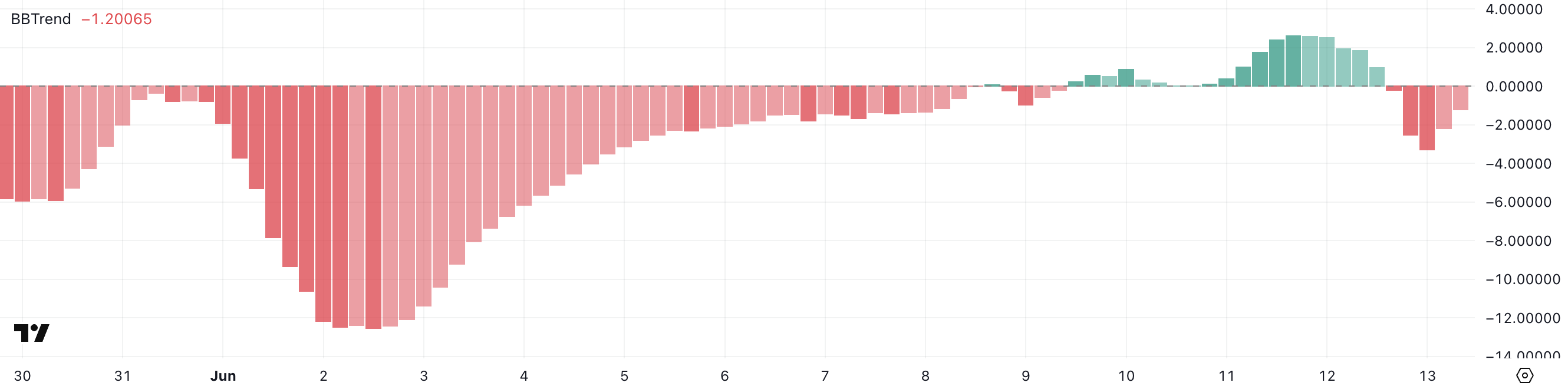
Hedera’s BBTrend is now at -1.2, recovering from -3.27 earlier today but still below the 2.63 seen two days ago.
The drop signals fading bullish momentum after a short-lived rally. HBAR may be shifting from a breakout attempt to a consolidation phase.
The quick bounce from deeper negative levels suggests some buyer support, but the overall trend remains weak.
 HBAR BBTrend. Source: TradingView.
BBTrend, or Bollinger Band Trend, measures the directional strength and volatility of price movements relative to the Bollinger Bands.
Values above +1 typically indicate strong upward momentum, while readings below -1 suggest bearish pressure. With HBAR’s BBTrend hovering at -1.2, the signal leans bearish, but not deeply so—hinting that while selling pressure still dominates, it may be losing intensity.
If the BBTrend moves back toward neutral or flips positive, it could signal a shift toward recovery or renewed buying interest.
HBAR RSI Plunges Below 30: Oversold Signal Points to Possible Rebound
Hedera’s RSI has dropped sharply to 22.29, down from 61.99 just two days ago. This points to quickly increasing selling pressure.
The decline pushes HBAR deep into oversold territory, signaling an aggressive correction. While it may reflect panic selling, it could also open the door for a rebound if buyers step in.
 HBAR RSI. Source: TradingView.
RSI is a momentum indicator that tracks the speed and size of price changes on a scale from 0 to 100. Readings above 70 often mean an asset is overbought, while values below 30 suggest it’s oversold.
HBAR’s current RSI of 22.29 puts it well into oversold territory. If key support holds, this could limit further downside and signal a potential rebound.
Hedera Faces Breakdown Risk at $0.153
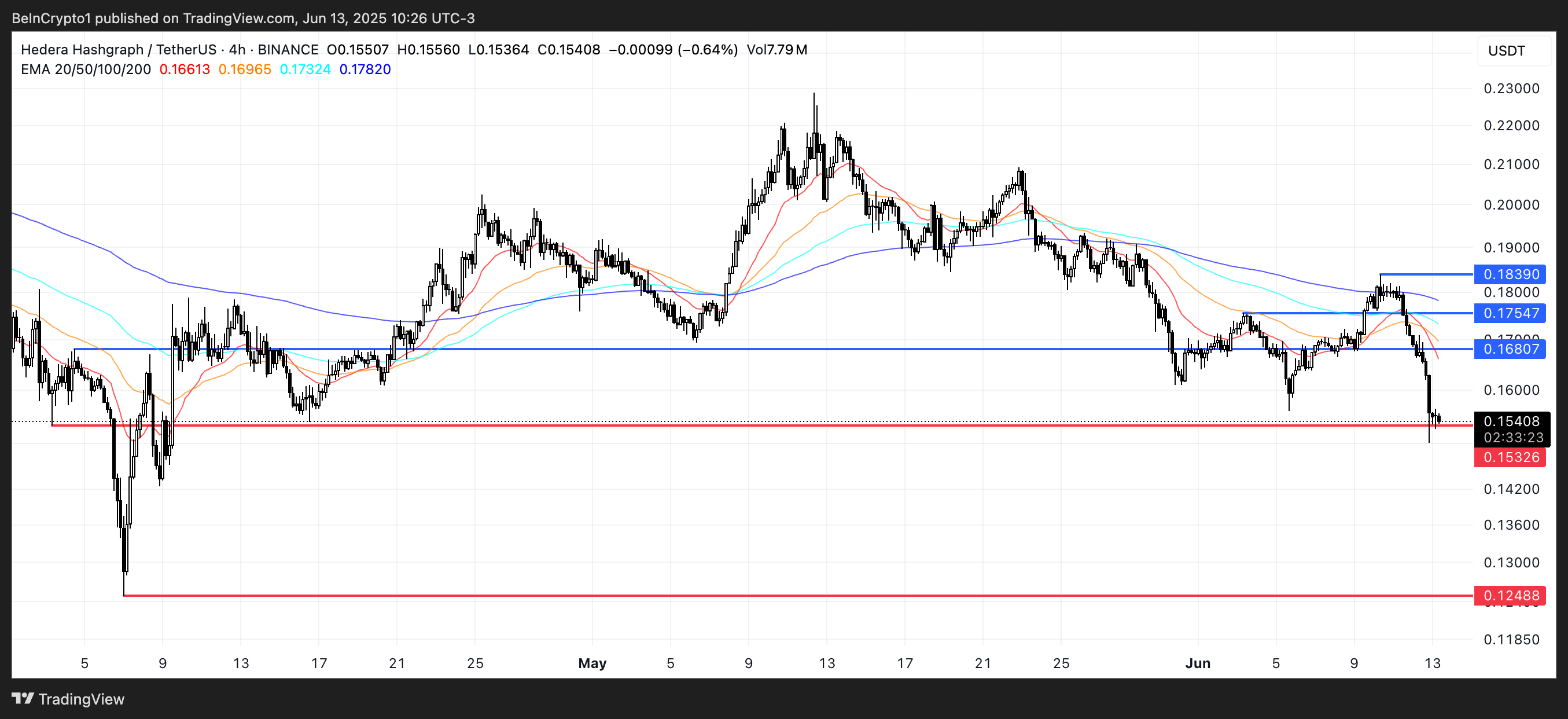
Hedera price is currently hovering just above a key support level at $0.153, a zone that has held in previous pullbacks.
However, if this support is tested and fails, Hedera could decline toward the next major support around $0.124.
Adding to the bearish outlook, HBAR’s EMA lines recently formed a death cross—a technical signal that typically indicates downward momentum and potential for further losses.
 HBAR Price Analysis. Source: TradingView.
That said, a reversal in momentum could quickly change the outlook. If bulls regain control and push HBAR above the immediate resistance at $0.168, the token could then test higher levels at $0.175 and even $0.183 if the uptrend accelerates.
These resistance zones have historically acted as inflection points and would need strong volume to be broken decisively.
Whether HBAR breaks down or rebounds will likely depend on how it behaves around the $0.153 level in the coming sessions.
Disclaimer: The content of this article solely reflects the author's opinion and does not represent the platform in any capacity. This article is not intended to serve as a reference for making investment decisions.
You may also like
Once frenzied buying, now the "ammunition warehouse" shrinks by 51 trillion KRW! Korean retail investors can no longer afford to buy
In four months, Korean retail investors' "ammunition stockpile" has dropped by 36.5%, returning to levels seen at the beginning of the year. Although retail investors have collectively made net purchases exceeding 75 trillion won, they are still absorbing the sell-off, but the influx of new funds has dried up, and the replenishment rate lags far behind the consumption rate. Combined with the KOSPI plunging nearly 20% this month, continued net selling by foreign investors, and concerns over AI-related credit risks, the Korean stock market may find it difficult to see a sustained rebound in the short term without support from private investors' funds.
Apple Prints TD Sequential Sell 9 — Last Two Led to 15.66% and 13.63% Corrections

The Collapse of "Consensus Trading" and the Birth of a New Consensus! Goldman Sachs Explains: Why Institutions Are Currently Significantly Reducing AI Holdings
The extremely crowded trade of "going long on AI, short on everything else" is undergoing a painful unwinding—markets are no longer satisfied with the "burn rate narrative." Mega-scale cloud providers must deliver real, visible revenue conversions alongside $1.1 trillion in capital expenditures. A power gap of 40-50 gigawatts, rising capital costs, and a macro paradigm shift from an era of "overspending" are turning AI trades from a matter of faith into a harsh test of monetization.

Starknet TVL crashes 3.7x to $42M after getting 93% vote to become L1
Crypto prices
More


