
Polyhedra Network’s ZKJ Crashes 60% Amid Liquidity Crisis

ZKJ and KOGE crashed over 50% after liquidity pools were drained, sparking panic selling and community backlash over mismanagement concerns.
Polyhedra Network’s ZKJ token crashed nearly 60% in under an hour on June 15, wiping out over $360 million in market capitalization.
KOGE, the governance token of 48 Club DAO, also dropped by 50% during the same window, losing more than $100 million in market cap.
ZKJ Faces Major Liquidity Mismanagement
The sharp sell-off began when the KOGE/USDT liquidity pool was depleted, leaving liquidity providers unable to exit. Panic selling followed as investors began converting KOGE into ZKJ.
According to early community reports, the KOGE team failed to add USDT to its liquidity pool. This triggered what some users called a “rug from both sides.”
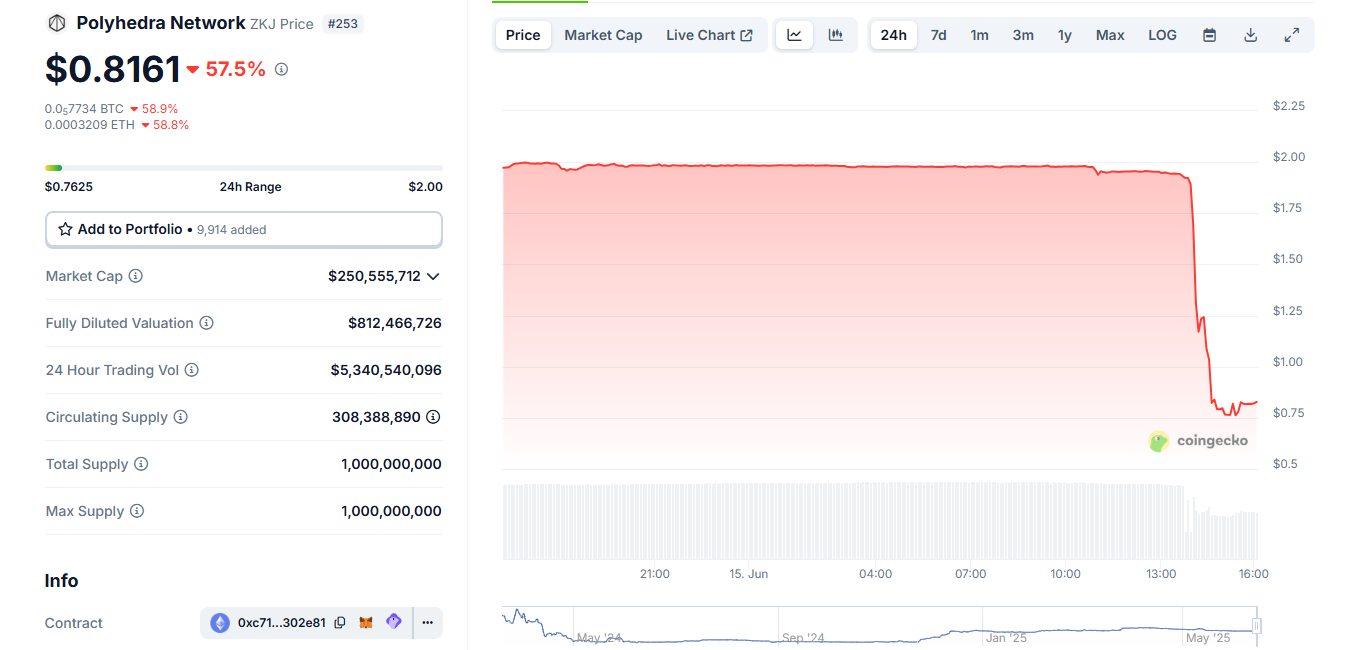 ZKJ Price Crash. Source:
CoinGecko
With no USDT left in the KOGE pool, holders rushed to offload KOGE into the ZKJ pool, which was still actively defended by its team.
However, the rapid influx overwhelmed the ZKJ/USDT pair, causing a domino effect that tanked ZKJ’s price and investor confidence.
— Mayank Dudeja (@imcryptofreak) June 15, 2025
Why is $ZKJ dumping -41.1% today?Price dropped to $1.164 with plunging volume & bearish momentum
Binance Alpha volumes collapsed = whales & bots dominate

Members of the 48 Club DAO, the group behind KOGE, expressed outrage over the incident, accusing the team of negligence and mismanagement.
Social media was flooded with posts demanding accountability from both projects. The phrase “rugged from both sides” trended within crypto circles.
This incident has severely damaged trust in both ecosystems, with users questioning the sustainability of their liquidity strategies.
Yes, $KOGE was fully diluted from day one.And no — 48Club never promise we wouldn’t sell. Neither did Binance for $BNB, right?Do your own research.Take your own risk.
— 48 Club (Est. '17) (@48Club_Official) June 14, 2025
Beyond liquidity concerns, market structure added further pressure. A 5.3% ZKJ token unlock, worth $32 million, is scheduled later this week.
With Binance Alpha volume collapsing, analysts warned that bots and whales dominate the order books, exacerbating volatility in both tokens.
ZKJ and KOGE: Tightly Linked Ecosystems
The crash highlights the intertwined nature of ZKJ and KOGE. Both tokens are frequently paired in liquidity pools and used in farming strategies.
While ZKJ powers zkBridge and ZKP infrastructure, KOGE operates as a governance token for 48 Club—a group focused on BNB Chain DeFi.
Recent coordinated farming and arbitrage activity had inflated volumes between the two, making them vulnerable to liquidity shocks.
Disclaimer: The content of this article solely reflects the author's opinion and does not represent the platform in any capacity. This article is not intended to serve as a reference for making investment decisions.
You may also like
Once frenzied buying, now the "ammunition warehouse" shrinks by 51 trillion KRW! Korean retail investors can no longer afford to buy
In four months, Korean retail investors' "ammunition stockpile" has dropped by 36.5%, returning to levels seen at the beginning of the year. Although retail investors have collectively made net purchases exceeding 75 trillion won, they are still absorbing the sell-off, but the influx of new funds has dried up, and the replenishment rate lags far behind the consumption rate. Combined with the KOSPI plunging nearly 20% this month, continued net selling by foreign investors, and concerns over AI-related credit risks, the Korean stock market may find it difficult to see a sustained rebound in the short term without support from private investors' funds.
Apple Prints TD Sequential Sell 9 — Last Two Led to 15.66% and 13.63% Corrections

The Collapse of "Consensus Trading" and the Birth of a New Consensus! Goldman Sachs Explains: Why Institutions Are Currently Significantly Reducing AI Holdings
The extremely crowded trade of "going long on AI, short on everything else" is undergoing a painful unwinding—markets are no longer satisfied with the "burn rate narrative." Mega-scale cloud providers must deliver real, visible revenue conversions alongside $1.1 trillion in capital expenditures. A power gap of 40-50 gigawatts, rising capital costs, and a macro paradigm shift from an era of "overspending" are turning AI trades from a matter of faith into a harsh test of monetization.
Starknet TVL crashes 3.7x to $42M after getting 93% vote to become L1
Crypto prices
More


