
FOMC Report Causes Bitcoin Dip: Will Sell-Side Pressure Drag Prices Lower?

Bitcoin faces potential downward pressure after a brief dip following the FOMC report. A recovery above $120,000 is crucial for pushing toward new highs, while a drop below $117,261 could signal further losses.
Bitcoin’s price has been rangebound for the last few days, consolidated between $117,261 and $120,000. However, recent market conditions and external influences, such as the Federal Open Market Committee (FOMC) meeting on Wednesday, caused a temporary decline.
As of now, Bitcoin is priced at $118,419, slightly recovering after dipping to $115,700. Despite this recovery, Bitcoin’s path remains uncertain, owing to factors such as sell-side pressure.
Bitcoin is Showing Signs of a Decline Ahead
The Relative Unrealized Profit (RUP) has recently broken above the +2σ band, a level often associated with euphoric market phases. Historically, this setup has preceded market tops, signaling a latent sell-side pressure that could eventually drag prices lower.
The current state of the RUP indicates that a pullback may be likely in the coming days, potentially pushing Bitcoin’s price out of its consolidation range. Given past patterns, a shift toward selling could result in further downward pressure.
For token TA and market updates: Want more token insights like this? Sign up for Editor Harsh Notariya’s Daily Crypto Newsletter here.
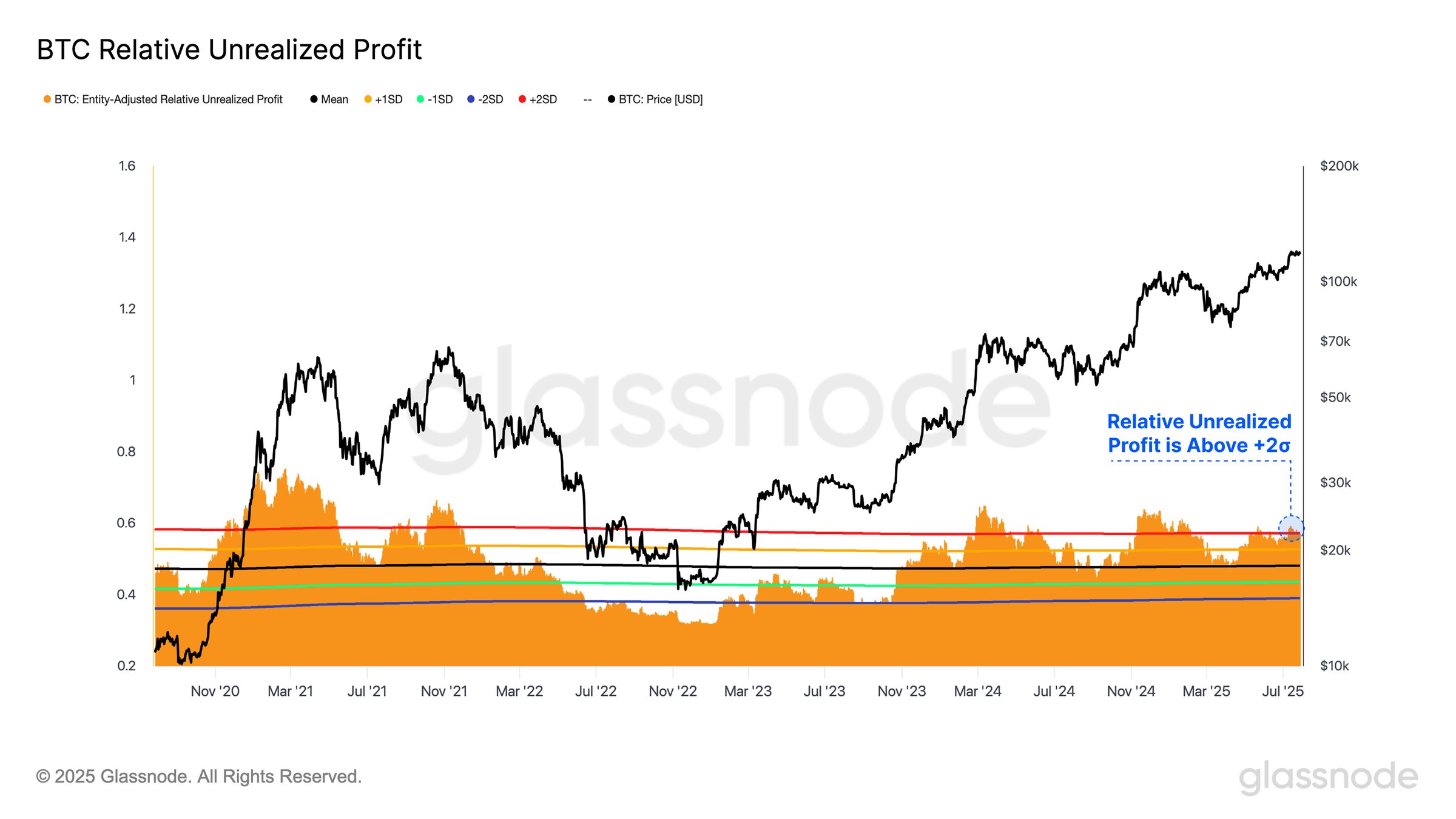 Bitcoin Unrealized Profit Source:
Bitcoin Unrealized Profit Source:
Bitcoin Unrealized Profit Source:
The Squeeze Momentum Indicator (SMI) is signaling that Bitcoin is entering a consolidation phase. Historically, these periods of consolidation, where price movement becomes more limited, have preceded significant price moves once the squeeze is released.
As the squeeze continues to build, Bitcoin’s price is poised for a sharp move in one direction. If the broader market remains bearish, Bitcoin could see a sharp decline, particularly if the SMI confirms this negative trend in the coming days.
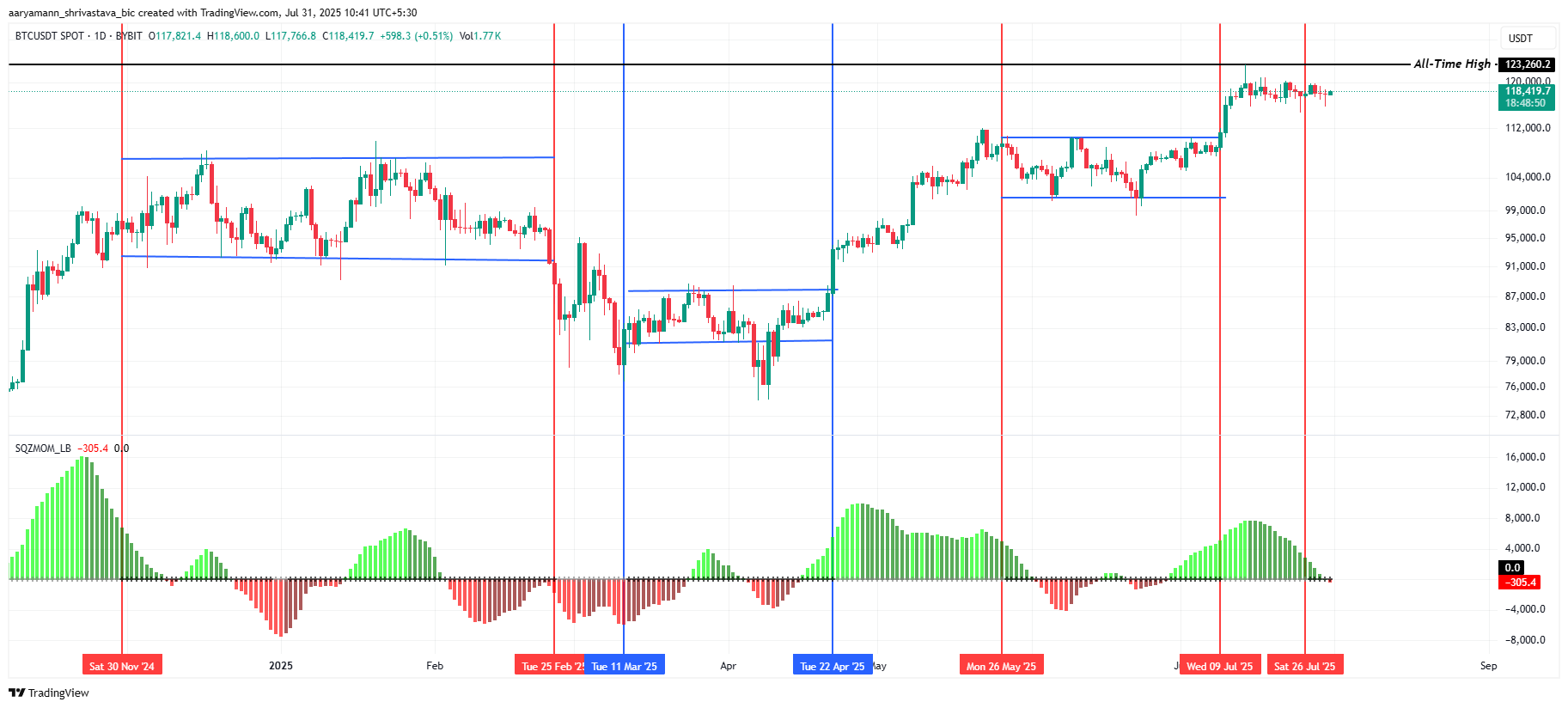 Bitcoin SQM. Source:
Bitcoin SQM. Source:
Bitcoin SQM. Source:
BTC Price Needs To Jump
Bitcoin is currently trading at $118,410, after falling to $115,700 on Wednesday as the FOMC report came out. The market’s response to the Federal Reserve’s decision to keep interest rates unchanged led to BTC’s recovery, but the underlying market conditions still pose risks.
Bitcoin’s price is susceptible to further declines if investors start booking profits, potentially pushing the cryptocurrency below the $117,261 support level. A drop past this support could lead Bitcoin’s price to $115,000 or even lower.
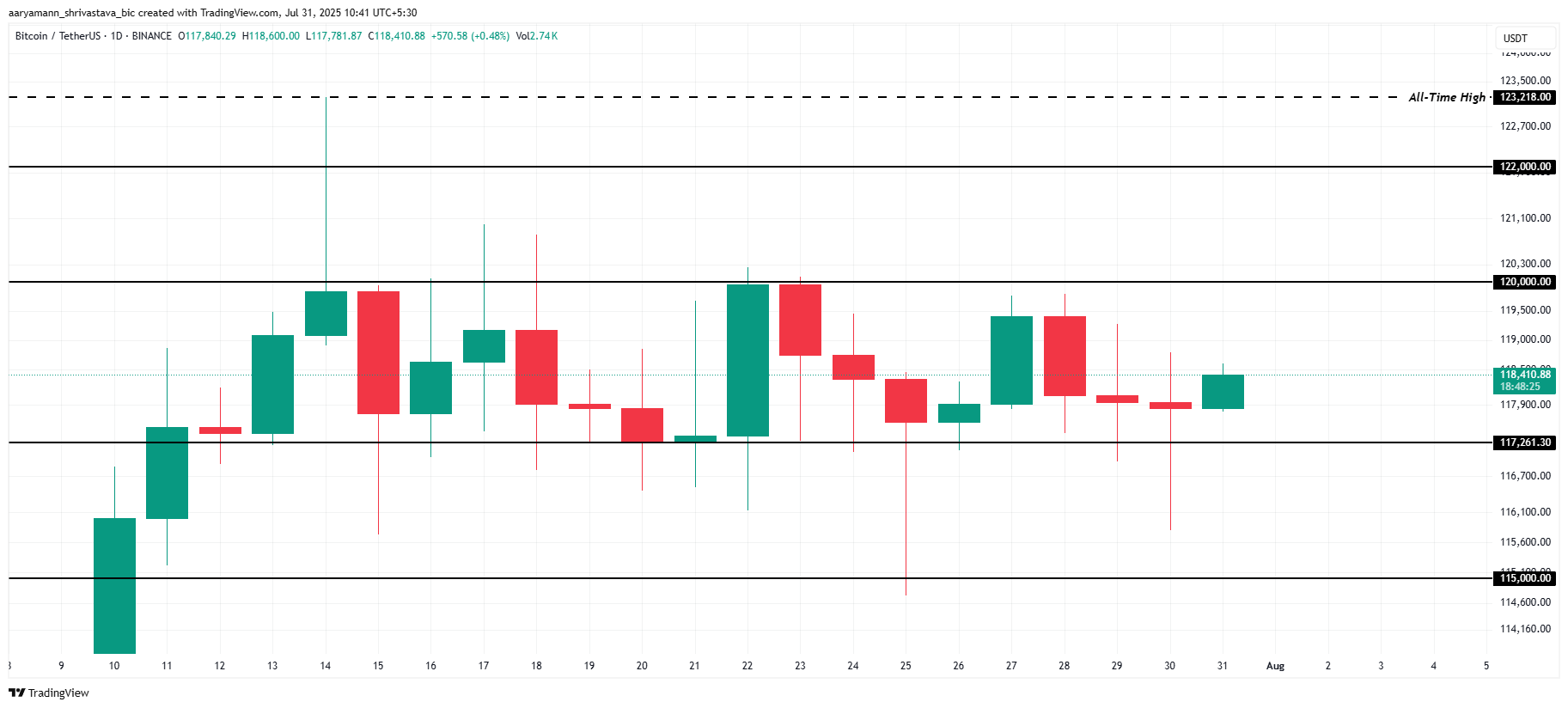 Bitcoin Price Analysis. Source:
Bitcoin Price Analysis. Source:
Bitcoin Price Analysis. Source:
The only way this bearish outlook would be invalidated is if Bitcoin manages to hold above $120,000 and reclaim $122,000 as support. A surge above these levels would likely provide the momentum needed to push Bitcoin toward new highs. However, until that happens, Bitcoin’s price remains vulnerable to fluctuations and market pressures.
Disclaimer: The content of this article solely reflects the author's opinion and does not represent the platform in any capacity. This article is not intended to serve as a reference for making investment decisions.
You may also like
Over $10 billion in market value evaporated in four trading days as CoreWeave (CRWV.US) debt risks trigger sell-off, but Deutsche Bank sees it as a buying opportunity
Deutsche Bank believes that the recent sell-off of CoreWeave lacks sufficient company fundamentals to justify it, and the sharp price correction has instead created a buying opportunity for investors.

Overnight US Stock Market | Inflation Pressure Continues to Rise, All Three Major Indexes Up, Dell (DELL.US) Down 6.8%
At the close of trading, the Dow Jones Industrial Average rose 557.51 points, or 1.08%, to 52,178.99 points; the S&P 500 Index gained 25.18 points, or 0.33%, to 7,744.12 points; and the Nasdaq Composite Index increased by 20.16 points, or 0.08%, to 26,713.03 points.
Interactive Brokers (IBKR.US) Q3 revenue increased by 16% year-on-year, announces over 70% increase in quarterly dividend
Driven by growth in net interest income and commission income, Interactive Brokers' Q3 net revenue increased by 16% year-on-year, with adjusted earnings per share rising by approximately 18% year-on-year.
CoreWeave default probability exceeds 60%! Jensen Huang "puts out the fire": Financing costs are declining, no need for NVIDIA to backstop
After Jensen Huang's speech, CoreWeave's stock price, which had fallen by as much as 9.5% in early trading, turned positive. The company's five-year CDS rose above 1,190 basis points during Thursday’s session, a historical high reflecting the cost of debt default protection, while yields on some of its corporate bonds have climbed above 15% to 16%. The five-year CDS spreads for Oracle, Amazon, Google’s parent company, and Meta are all at historically high levels. Deutsche Bank analysts believe that as the AI capital expenditure cycle is increasingly supported by debt rather than free cash flow, investors must place greater emphasis on signals from the credit market. Overall, while AI-related financing costs are not yet excessively high, worrying signs have begun to emerge.

Crypto prices
More


