
Pudgy Penguins and Play Solana launch limited edition gameboy with PENGU token burn on every sale

Play Solana has launched a limited edition handheld console in collaboration with Pudgy Penguins, linking each unit sold to a burn of PENGU tokens.
- Play Solana released a limited edition PSG1 “gameboy” in partnership with Pudgy Penguins.
- Each unit sold triggers a buy-and-burn of the PENGU token.
- The collaboration follows the launch of Pengu Clash, a skill-based Web3 game on the TON blockchain.
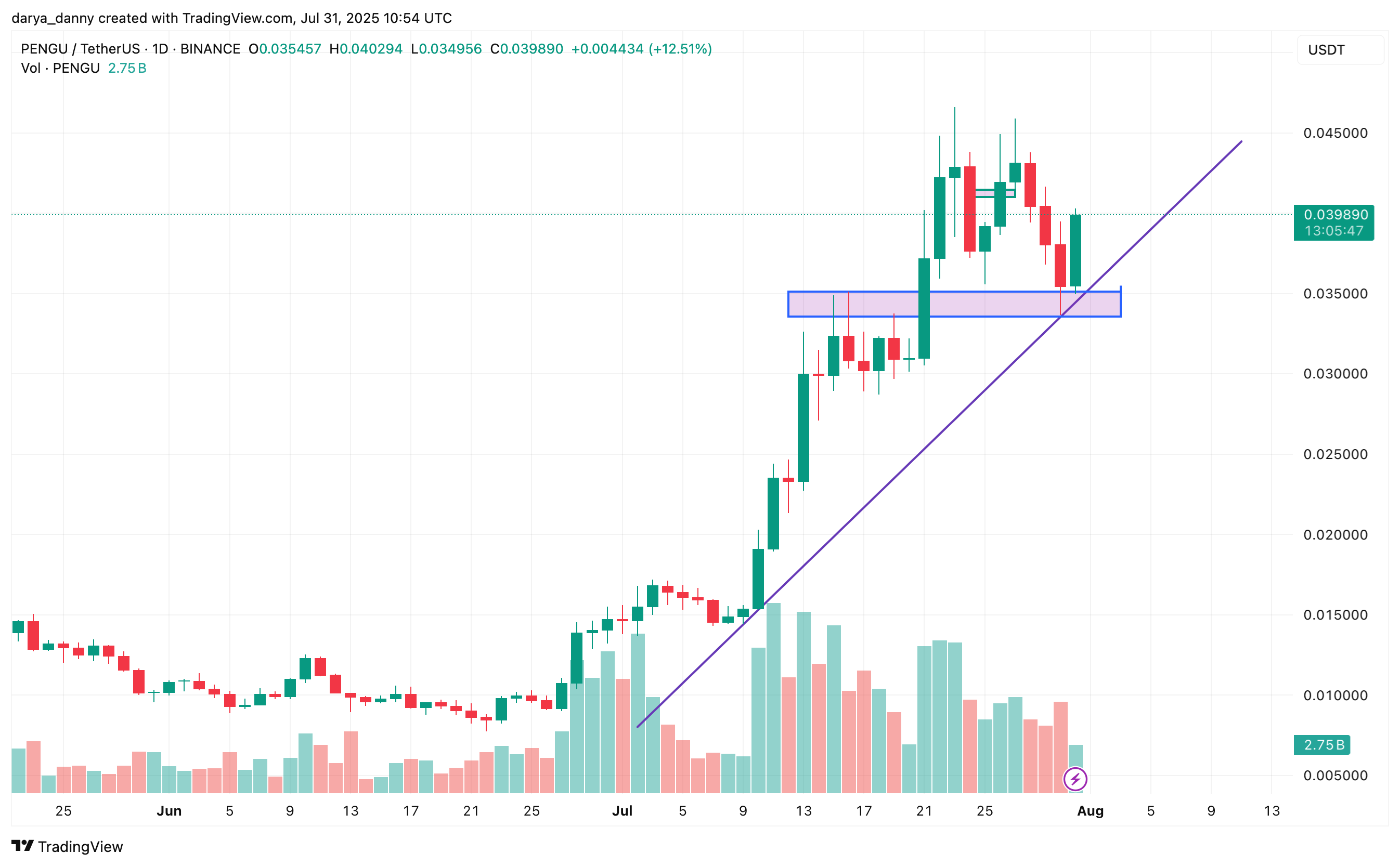
- The release comes as PENGU trades near critical support after a 500% rally since late June.
Play Solana has launched a limited edition gameboy in collaboration with Pudgy Penguins ( PENGU ), with each unit sold triggering a buy-and-burn of the PENGU token to reduce its circulating supply.
The collaboration follows Pudgy Penguins’ recent entry into Web3 gaming with the launch of Pengu Clash , a skill-based game hosted on The Open Network.
Both initiatives are part of Pudgy Penguins’ broader efforts to expand its brand and engage new audiences beyond the Web3 space. They follow the recent launch of Pudgy Records , a community-driven music label focused on growing its cultural presence through original music.
PENGU price at a key turning point
The Gameboy release comes at a pivotal moment for PENGU token price. Since June 22, PENGU has surged more than 500% , climbing from $0.0077 to a peak of $0.0466 on July 27. However, the price has since retraced to around $0.0398.
The daily chart now shows signs of hesitation, with a potential double top forming near the $0.046 level. This pattern is often considered a bearish reversal signal, as it indicates that buyers were unable to push the price beyond a key resistance level on two separate attempts.
If confirmed—typically by a break below the interim support between the two peaks—it could suggest that upward momentum is fading and increase the likelihood of a deeper pullback. That being said, today’s candle is up 12% from that support, so there’s a chance PENGU price will rebound and invalidate the bearish pattern.
 Source: TradingView
Disclaimer: The content of this article solely reflects the author's opinion and does not represent the platform in any capacity. This article is not intended to serve as a reference for making investment decisions.
You may also like
Over $10 billion in market value evaporated in four trading days as CoreWeave (CRWV.US) debt risks trigger sell-off, but Deutsche Bank sees it as a buying opportunity
Deutsche Bank believes that the recent sell-off of CoreWeave lacks sufficient company fundamentals to justify it, and the sharp price correction has instead created a buying opportunity for investors.

Overnight US Stock Market | Inflation Pressure Continues to Rise, All Three Major Indexes Up, Dell (DELL.US) Down 6.8%
At the close of trading, the Dow Jones Industrial Average rose 557.51 points, or 1.08%, to 52,178.99 points; the S&P 500 Index gained 25.18 points, or 0.33%, to 7,744.12 points; and the Nasdaq Composite Index increased by 20.16 points, or 0.08%, to 26,713.03 points.
Interactive Brokers (IBKR.US) Q3 revenue increased by 16% year-on-year, announces over 70% increase in quarterly dividend
Driven by growth in net interest income and commission income, Interactive Brokers' Q3 net revenue increased by 16% year-on-year, with adjusted earnings per share rising by approximately 18% year-on-year.
CoreWeave default probability exceeds 60%! Jensen Huang "puts out the fire": Financing costs are declining, no need for NVIDIA to backstop
After Jensen Huang's speech, CoreWeave's stock price, which had fallen by as much as 9.5% in early trading, turned positive. The company's five-year CDS rose above 1,190 basis points during Thursday’s session, a historical high reflecting the cost of debt default protection, while yields on some of its corporate bonds have climbed above 15% to 16%. The five-year CDS spreads for Oracle, Amazon, Google’s parent company, and Meta are all at historically high levels. Deutsche Bank analysts believe that as the AI capital expenditure cycle is increasingly supported by debt rather than free cash flow, investors must place greater emphasis on signals from the credit market. Overall, while AI-related financing costs are not yet excessively high, worrying signs have begun to emerge.

Crypto prices
More


