
NFT Sales Surge to $574 Million in July as Ethereum Collections Lead Market Rally

Non-fungible token (NFT) sales climbed to more than 574 million dollars in July, marking the second-highest monthly volume this year, according to data from CryptoSlam.
Non-fungible token (NFT) sales climbed to more than 574 million dollars in July, marking the second-highest monthly volume this year, according to data from CryptoSlam.
The figure represents a 47.6 percent increase from June’s 388.9 million dollars, though it remains below January’s peak of 678.9 million dollars.
While total transactions fell 9 percent from 5.5 million to five million, the average sale value rose to 113.08 dollars, the highest in six months. This indicates growing demand for higher-value digital assets . The number of unique buyers declined 17 percent to 713,085, while unique sellers increased 9 percent to 405,505, suggesting a market shift toward fewer but larger purchases.
 Source
:
NFT Price Floor
.
Source
:
NFT Price Floor
.
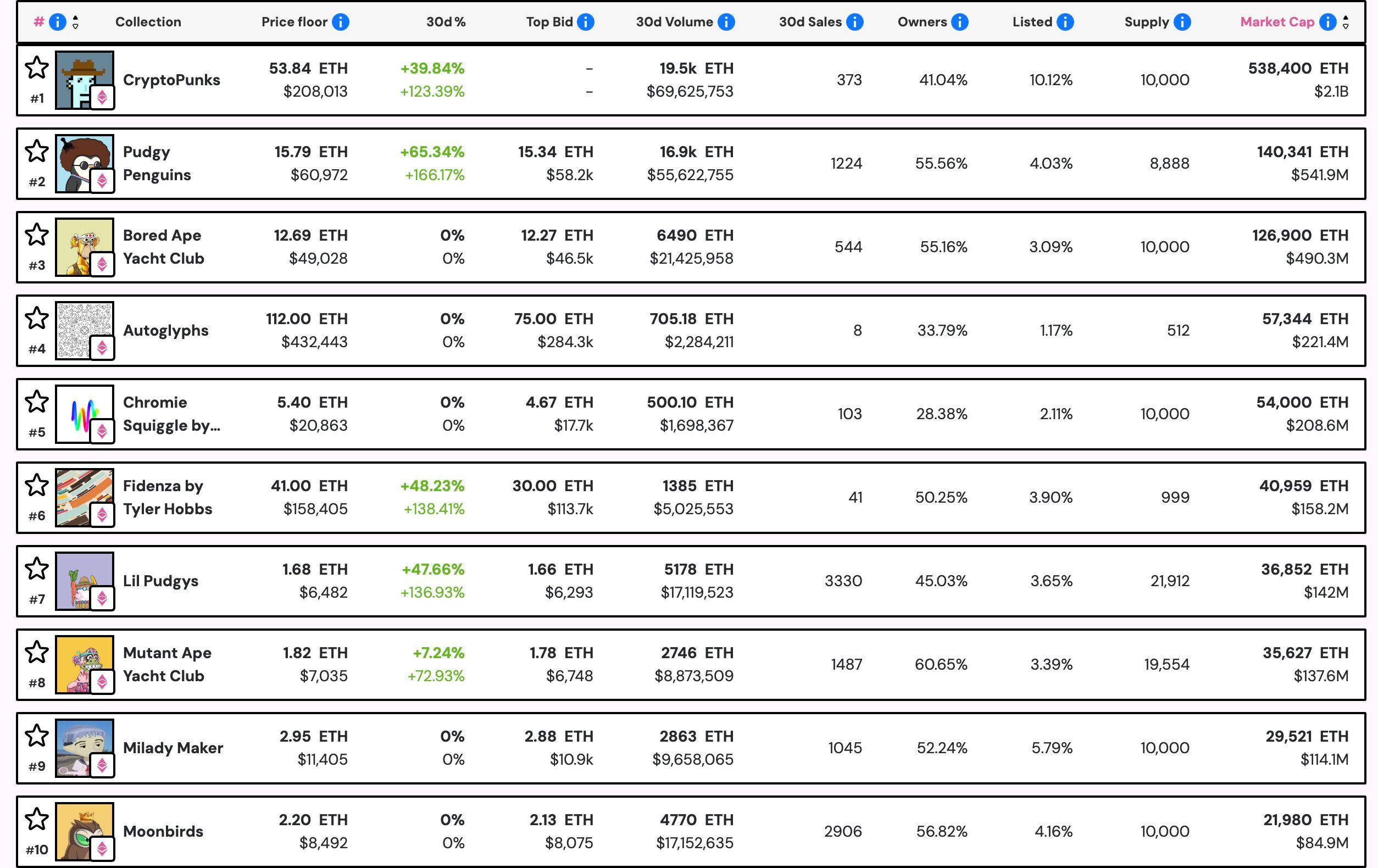
NFT Price Floor data shows the sector’s total market capitalization has surged 21 percent since late July, reaching more than 8 billion dollars. Ethereum’s price rally has played a key role, with the asset trading above 3,800 dollars after jumping 62 percent from early August levels of around 2,400 dollars.
Ethereum-based collections dominated the market in July. CryptoPunks led trading with more than 69.2 million dollars, followed by Pudgy Penguins with 55.5 million dollars. Polygon’s Courtyard NFTs ranked third with 23.8 million dollars. Pudgy Penguins also posted the strongest growth, with floor prices rising 65.44 percent, outpacing other top collections such as Bored Ape Yacht Club and Mutant Ape Yacht Club.
Ethereum maintained its dominance in blockchain-based NFT sales with 275.6 million dollars in July, a 56 percent increase over the previous month. Bitcoin followed with 74.3 million dollars, while Polygon recorded 71.6 million dollars. Polygon’s sales volume dropped by 51.1 percent from June, while BNB Chain recorded a 54 percent decline, reflecting a growing consolidation of activity on Ethereum and a narrowing focus on premium NFT collections. Meanwhile, CoinGecko reported a 20% daily jump in total NFT market cap, from $5.1 billion to $6.3 billion, further signaling renewed interest in the space.
Disclaimer: The content of this article solely reflects the author's opinion and does not represent the platform in any capacity. This article is not intended to serve as a reference for making investment decisions.
You may also like
Over $10 billion in market value evaporated in four trading days as CoreWeave (CRWV.US) debt risks trigger sell-off, but Deutsche Bank sees it as a buying opportunity
Deutsche Bank believes that the recent sell-off of CoreWeave lacks sufficient company fundamentals to justify it, and the sharp price correction has instead created a buying opportunity for investors.

Overnight US Stock Market | Inflation Pressure Continues to Rise, All Three Major Indexes Up, Dell (DELL.US) Down 6.8%
At the close of trading, the Dow Jones Industrial Average rose 557.51 points, or 1.08%, to 52,178.99 points; the S&P 500 Index gained 25.18 points, or 0.33%, to 7,744.12 points; and the Nasdaq Composite Index increased by 20.16 points, or 0.08%, to 26,713.03 points.
Interactive Brokers (IBKR.US) Q3 revenue increased by 16% year-on-year, announces over 70% increase in quarterly dividend
Driven by growth in net interest income and commission income, Interactive Brokers' Q3 net revenue increased by 16% year-on-year, with adjusted earnings per share rising by approximately 18% year-on-year.
CoreWeave default probability exceeds 60%! Jensen Huang "puts out the fire": Financing costs are declining, no need for NVIDIA to backstop
After Jensen Huang's speech, CoreWeave's stock price, which had fallen by as much as 9.5% in early trading, turned positive. The company's five-year CDS rose above 1,190 basis points during Thursday’s session, a historical high reflecting the cost of debt default protection, while yields on some of its corporate bonds have climbed above 15% to 16%. The five-year CDS spreads for Oracle, Amazon, Google’s parent company, and Meta are all at historically high levels. Deutsche Bank analysts believe that as the AI capital expenditure cycle is increasingly supported by debt rather than free cash flow, investors must place greater emphasis on signals from the credit market. Overall, while AI-related financing costs are not yet excessively high, worrying signs have begun to emerge.

Crypto prices
More


