
Japan Explores Tougher Crypto Regulation For Market Growth

Japan’s crypto regulation is evolving, with proposed changes that aim to better protect investors and address market growth. Key reforms include stricter oversight for fundraising tokens and a focus on transparency.
Japan advances tougher crypto regulation, transitioning oversight from the Payment Services Act to investment-focused Financial Instruments Exchange Act.
The move aims to enhance investor protection as crypto markets expand rapidly.
FSA Initiates Strategic Regulatory Recalibration Amid Market Evolution
The Financial Services Agency (FSA) convened the first meeting of its Crypto Assets Working Group on July 31. Discussions centered around reclassifying crypto assets to treat them more comprehensively as investment products rather than merely payment tools.
Japan Crypto Business Association Vice Chairman Shiraishi documented a remarkable global crypto market expansion from $872 billion to $2.66 trillion. However, Japan’s domestic trading ecosystem demonstrates measured growth trajectories, advancing from $66.6 billion in 2022 to forecasted $133 billion levels.
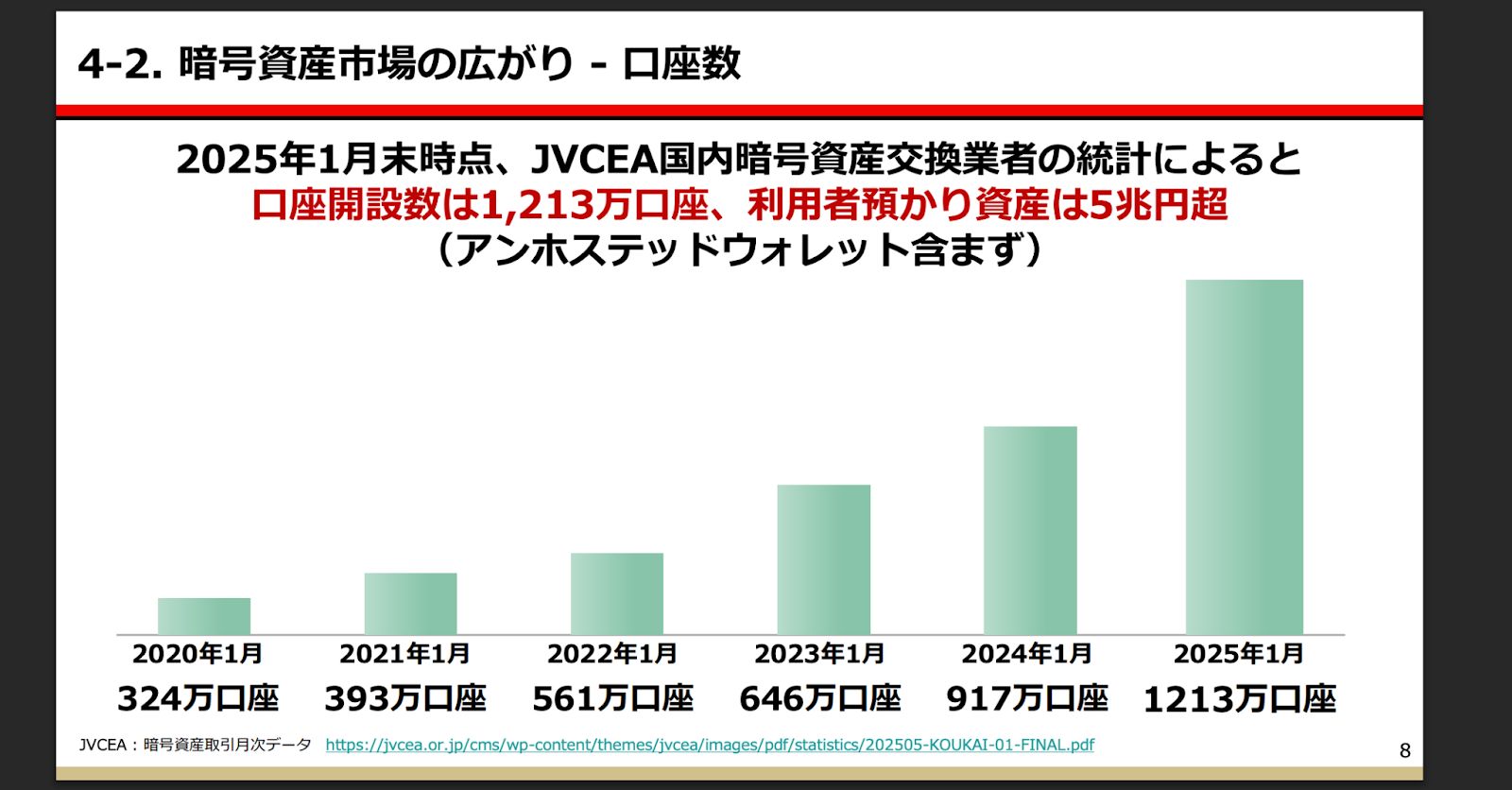
Despite holding 12.1 million accounts worth $33 billion, Japan’s crypto industry perceives diminishing global market influence.
Tougher Regulation and Investor Protection
Proposed regulatory frameworks establish a bifurcated classification system distinguishing fundraising tokens from established digital assets. Fundraising tokens would mandate comprehensive issuer disclosure requirements, while existing assets like Bitcoin maintain exchange-regulated oversight structures.
Tokyo University’s Yuichiro Matsui endorsed comprehensive regulatory reform initiatives, underscoring the critical necessity for updated crypto oversight frameworks. Georgetown University’s Shinichiro Matsuo advocated for multifaceted regulatory approaches emphasizing sustainability, security, adaptability, and strategic international alignment principles.
The complexity surrounding taxation also arose. Tax expert Yuichi Murakami dismissed industry calls for separate crypto wallet taxation, citing widespread fraud, security vulnerabilities, and inadequate calculation infrastructure.
“Claiming wallets need separate taxation for Web3 growth is nonsense unless clear tax reporting and investor protection measures are in place,” Murakami argued on X.
The working group plans detailed regulatory development, addressing transparency, combating fraud, and potentially introducing insider trading laws. Concrete proposals are expected by year-end, with legislative action possible by early 2026.
Disclaimer: The content of this article solely reflects the author's opinion and does not represent the platform in any capacity. This article is not intended to serve as a reference for making investment decisions.
You may also like
Risk aversion outweighs inflation concerns, US and European government bonds rise across the board, US Treasury yields plunge more than 10 basis points intraday
Investors concerned about rising inflation are shifting their focus to the potential impact of high borrowing costs on economic growth. Some commentators have linked the recent decline in U.S. Treasury yields to surging financing costs for AI-related companies, suggesting that pressure in the technology stocks and AI infrastructure sectors is driving funds toward safe-haven assets such as government bonds.

Google Quantum Computing Achieves Breakthrough: Error Rate Reduced by 40 Times, Overcoming Key Resource Bottleneck
Google has validated a technology called "motaic cultivation" on its Willow processor, reducing quantum error rates by about 40 times and achieving a T-state logical fidelity of 99.99%, setting a new record in the field. If this breakthrough can be successfully scaled, it will greatly reduce the hardware requirements for building fault-tolerant quantum systems, which holds significant implications for the commercialization of quantum computing.


Goldman Data: Hedge Funds Sell AI Stocks at Second-Fastest Pace in a Year

Crypto prices
More


