
Ethereum’s OG Meme Coins Rally in July as the Network Clocks 10

In July, Shiba Inu and FLOKI recorded impressive price gains, spurred by whale activity and retail excitement. However, both tokens now face bearish signals, hinting at potential declines.
Ethereum marked its 10th anniversary on July 30. This was a major milestone that brought renewed momentum across its ecosystem during the month. The network’s native token, ETH, nearly doubled in value over the past two months, climbing from around $1,500 in April to a local peak of $3,800 in July.
This rally coincided with a broader resurgence in Ethereum’s on-chain activity, growing stablecoin volumes, and institutional demand for the ETH coin. Amid all this, some of Ethereum’s earliest memecoins recorded gains driven by whale speculation and retail hype.
Shiba Inu
Shiba Inu, one of the original meme coins on Ethereum, saw a dramatic price surge in July as Layer-1’s (L1) broader ecosystem rallied around its 10th anniversary.
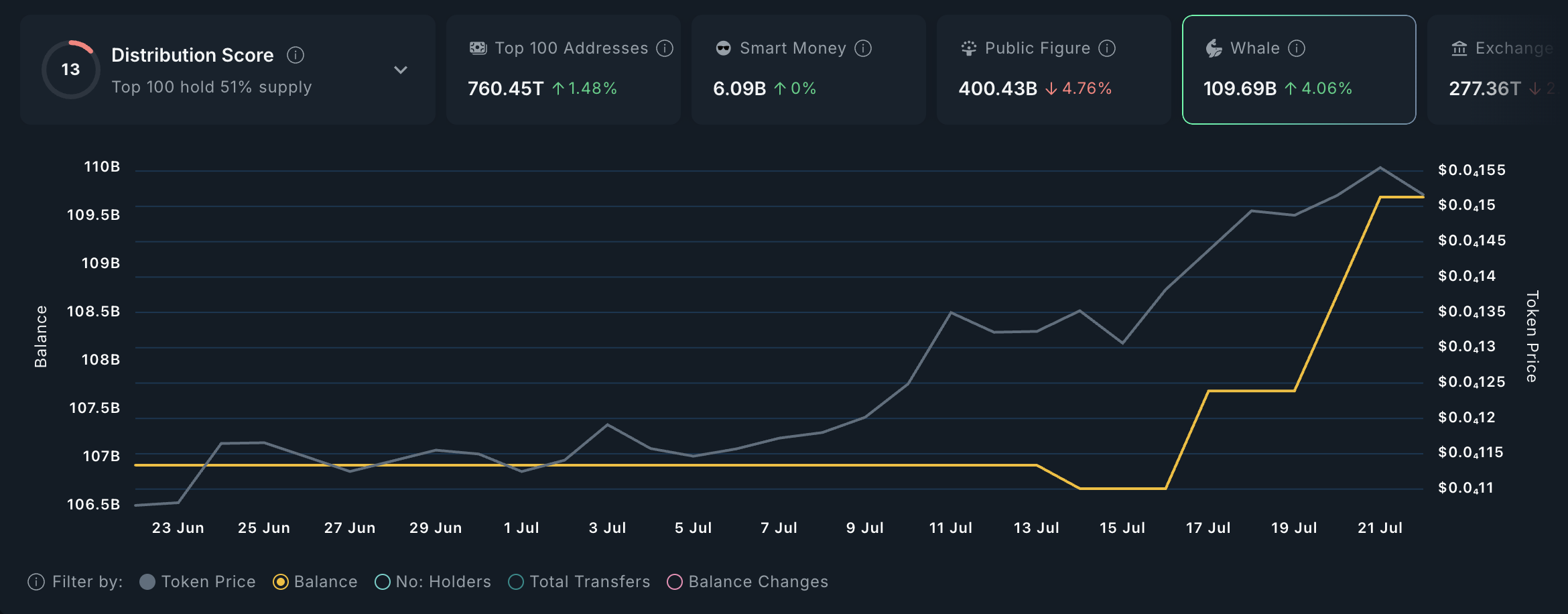
Between June 22 and July 21, SHIB’s price jumped nearly 50%, riding the wave of renewed optimism and increased on-chain activity tied to the resurgence in the meme market.
This rally was fueled by a sharp rise in whale accumulation—wallets identified by Nansen as holding more than $1 million worth of coins. According to Nansen data, these investors ramped up their SHIB holdings by 4% during this one-month window, helping drive the price surge.
As of this writing, this cohort of SHIB investors holds 109.69 billion tokens.
 SHIB Whale Holding. Source:
SHIB Whale Holding. Source:
SHIB Whale Holding. Source:
The accumulation trend among these key holders pushed SHIB to a cycle peak of $0.00001597 on July 22.
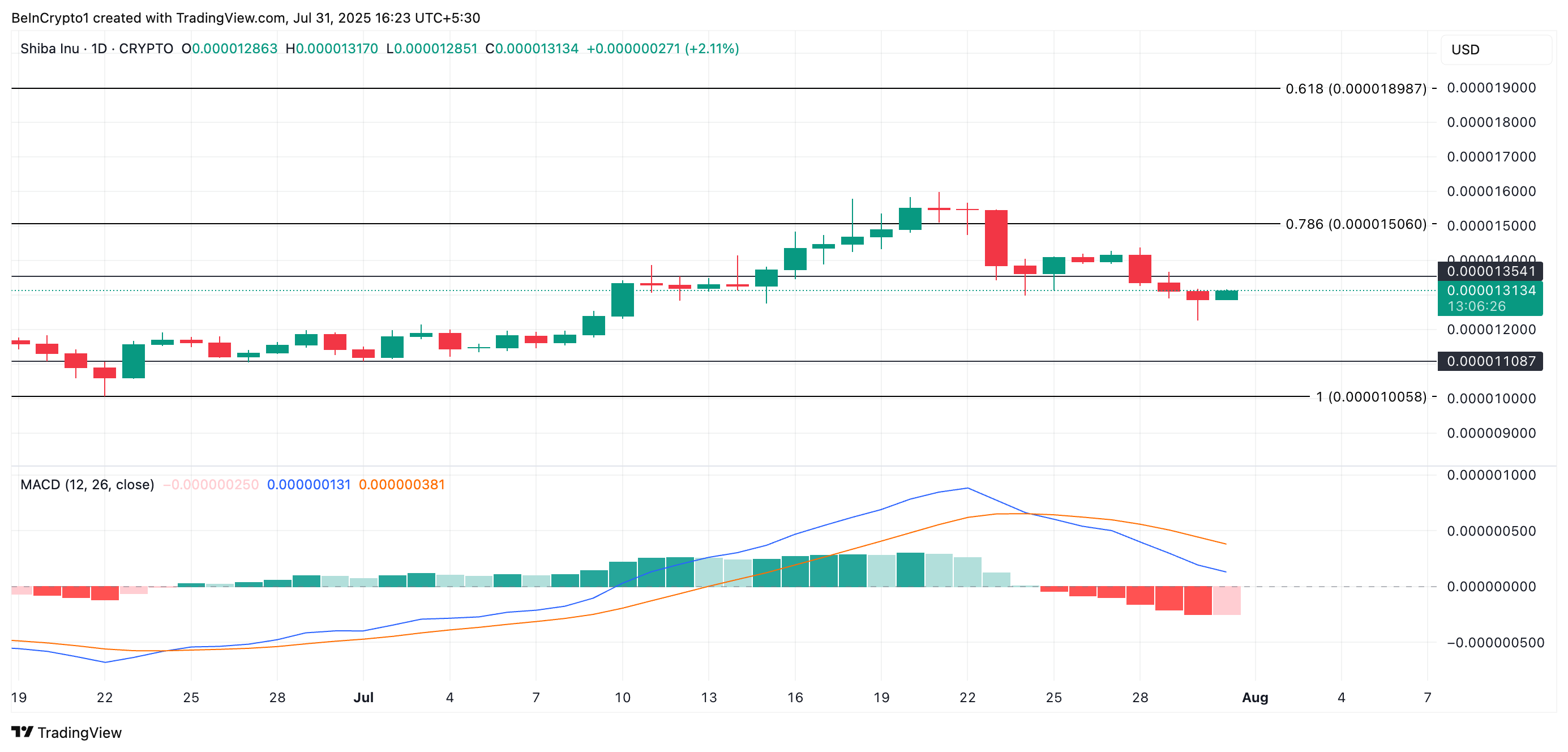
However, as market-wide bullish sentiment cooled, the meme coin frenzy began to fade. SHIB currently trades at $0.00001313, down 16% from its recent peak.
SHIB Faces August Slump? Indicator Warns of Downturn
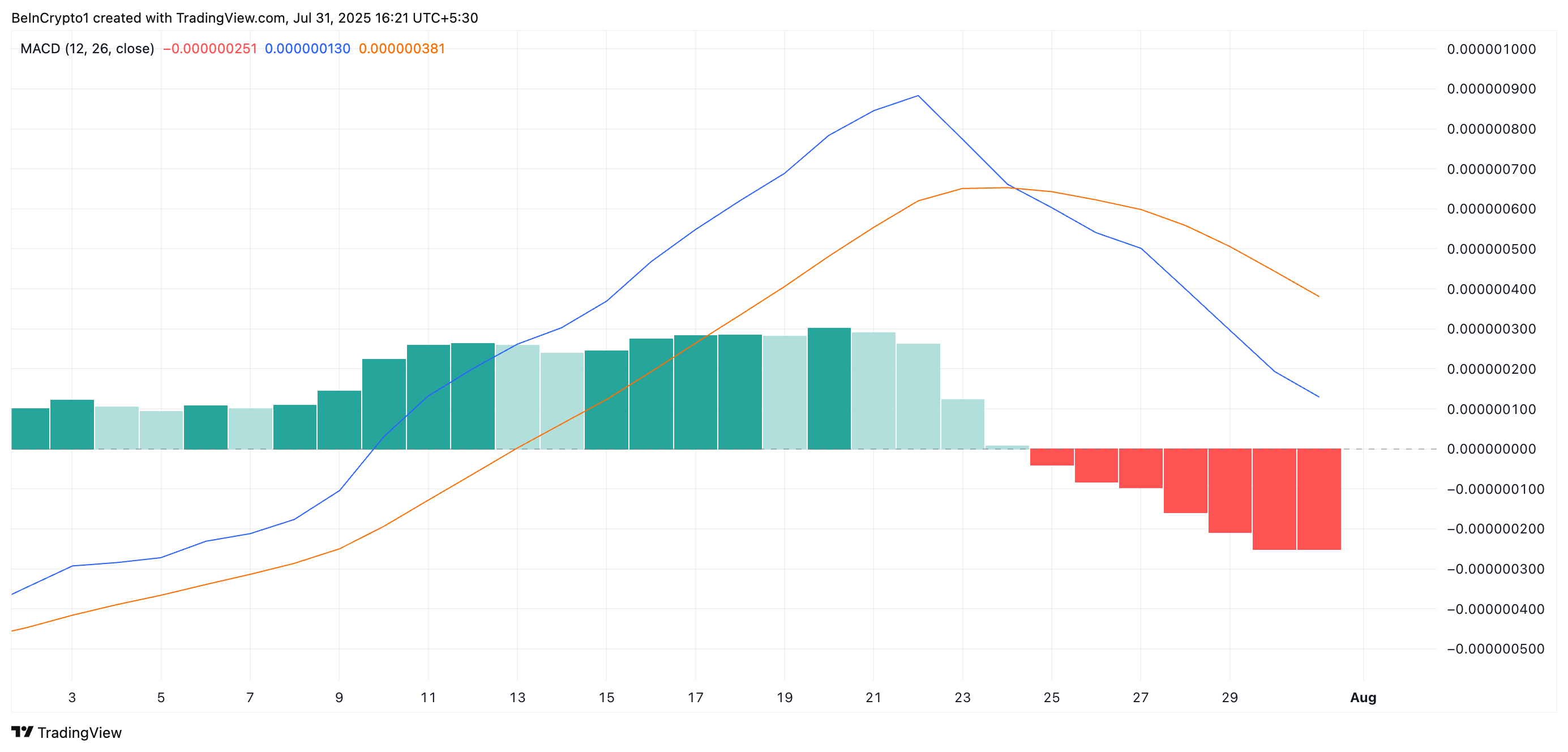
Readings from the token’s Moving Average Convergence Divergence (MACD) indicator confirm the bearish bias against the altcoin. At press time, SHIB’s MACD line (blue) rests below the signal line (orange), indicating waning buy-side pressure in its spot markets.
 SHIB Price Analysis. Source:
SHIB Price Analysis. Source:
SHIB Price Analysis. Source:
The MACD indicator identifies trends and momentum in its price movement. It helps traders spot potential buy or sell signals through crossovers between the MACD and signal lines.
As with SHIB, when the MACD line rests below the signal line, it indicates bearish momentum. Traders see this setup as a sell signal. Hence, it could exacerbate the downward pressure on the meme coin as August commences.
In this scenario, its price could plunge to $0.00001108
 SHIB Price Analysis. Source:
SHIB Price Analysis. Source:
SHIB Price Analysis. Source:
Conversely, if August brings renewed demand for the meme coin, it could reverse its current downward trend and climb above $0.00001354
FLOKI
Launched in June 2021, FLOKI is another early Ethereum-based meme altcoin that rode the bullish wave in early July to record gains.
According to readings from the FLOKI/USD one-day chart, the token began climbing steadily on June 23, eventually reaching a local peak of $0.0001577 by late July.
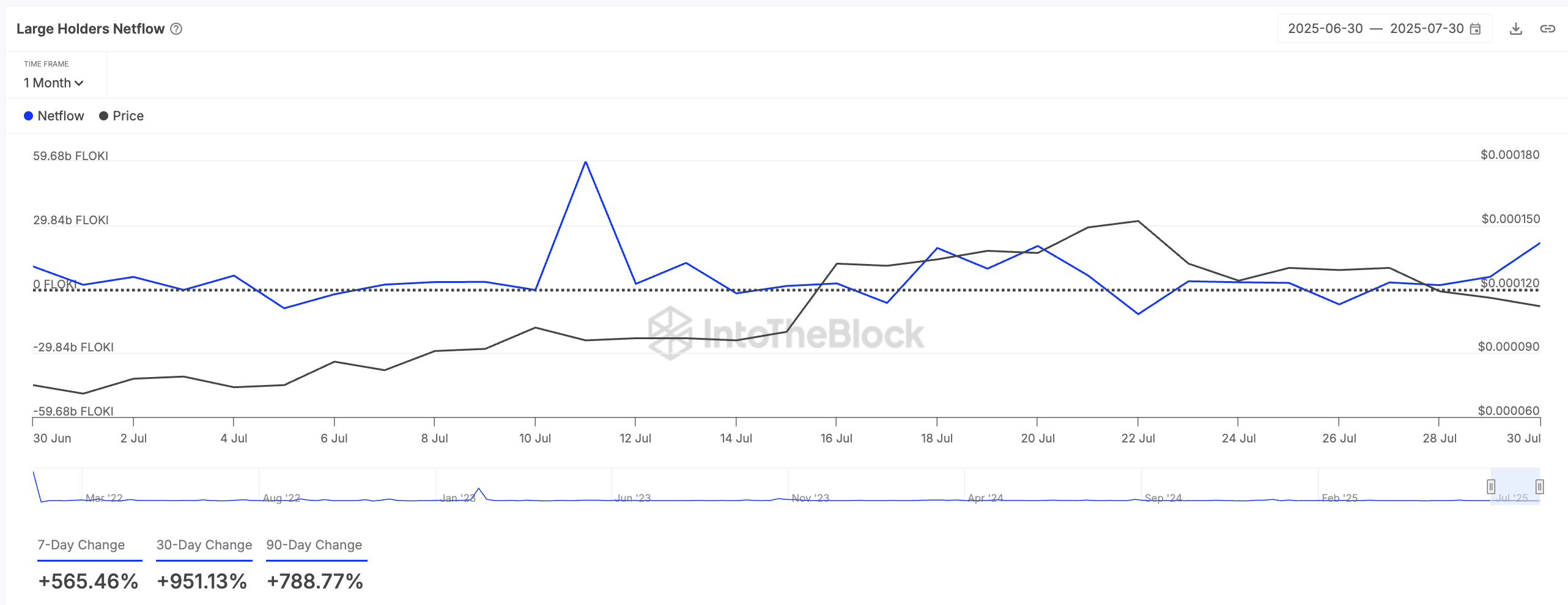
This rally was largely driven by intense whale accumulation, evidenced by its large holders’ netflow, up 951% in the past month.
 FLOKI Large Holders Netflow. Source:
FLOKI Large Holders Netflow. Source:
FLOKI Large Holders Netflow. Source:
The large holders’ netflow measures the difference between the amount of tokens that whales buy and sell over a specified period. When it surges like this, it signals strong accumulation by whales. This indicates growing confidence or a bullish outlook on the asset.
Although a wave of profit-taking has since pulled the price down by 21%, whale activity has not slowed. Instead, big players appear to be treating the dip as a buying opportunity, with large holder netflow spiking by over 500% in the past seven days alone.
If this trend continues, FLOKI could rally toward $0.0001399.
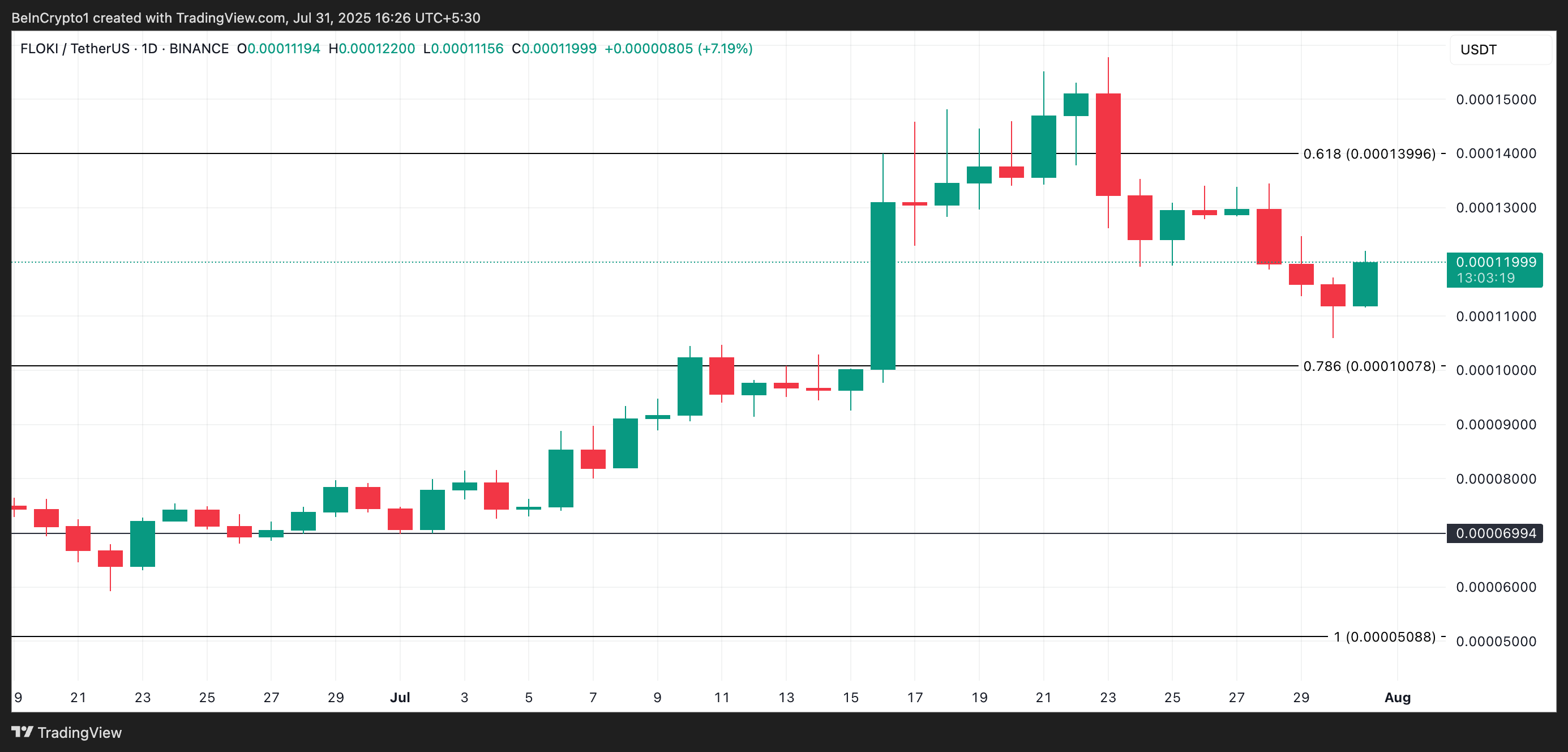 FLOKI Price Analysis. Source:
FLOKI Price Analysis. Source:
FLOKI Price Analysis. Source:
However, once whale accumulation stalls, and they begin to take profit, FLOKI’s price could fall further to $0.0001007.
Disclaimer: The content of this article solely reflects the author's opinion and does not represent the platform in any capacity. This article is not intended to serve as a reference for making investment decisions.
You may also like
Wall Street is wary of Bessent making another move to suppress yields; key clues may emerge this Friday
This Friday, major primary dealers of government bonds will receive the U.S. Treasury's routine survey before the refinancing announcement is released. Citigroup expects the survey may hint at a reduction in long-term bond issuance, or even the cancellation of 20-year U.S. Treasury bonds. Morgan Stanley emphasizes: "The next two refinancing announcements will be crucial, especially the one in November, which comes right after the midterm elections."
Risk aversion outweighs inflation concerns, US and European government bonds rise across the board, US Treasury yields plunge more than 10 basis points intraday
Investors concerned about rising inflation are shifting their focus to the potential impact of high borrowing costs on economic growth. Some commentators have linked the recent decline in U.S. Treasury yields to surging financing costs for AI-related companies, suggesting that pressure in the technology stocks and AI infrastructure sectors is driving funds toward safe-haven assets such as government bonds.

Google Quantum Computing Achieves Breakthrough: Error Rate Reduced by 40 Times, Overcoming Key Resource Bottleneck
Google has validated a technology called "motaic cultivation" on its Willow processor, reducing quantum error rates by about 40 times and achieving a T-state logical fidelity of 99.99%, setting a new record in the field. If this breakthrough can be successfully scaled, it will greatly reduce the hardware requirements for building fault-tolerant quantum systems, which holds significant implications for the commercialization of quantum computing.


Crypto prices
More


