
Hong Kong's First RWA Industry Whitepaper Released: The Notion of Everything Being RWA is a False Proposition

Hong Kong Releases RWA Report, Proposing Tokenized Asset Selection Criteria and Industrialization Path
With the rapid development of Real-World Assets (RWA) tokenization, the market has been buzzing with the narrative of "RWA Everything." However, the "RWA Industry Development Research Report · Industry Chapter 2025" (hereinafter referred to as the "Report") was released in Hong Kong on August 7, breaking this blind optimism and systematically laying out asset selection criteria and frameworks.
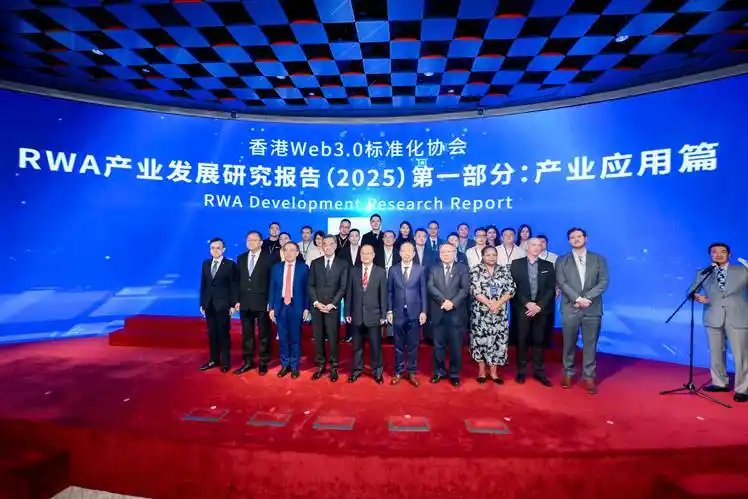
The Report points out that not all assets are suitable for RWA tokenization, and "RWA Everything" is a false proposition. Assets that successfully achieve scalable implementation need to meet three major thresholds: value stability, legal clarity of ownership, and verifiability of off-chain data.
Currently, the RWA industry is at a critical juncture in transitioning from concept validation to practical application. According to Defillama data, as of June 2025, the Total Value Locked (TVL) in RWA has reached $12.5 billion, a 124% increase from 2024. RWA tokenization has become a key focus of global financial and blockchain industries, leading to a collaborative effort among traditional institutions, financial entities, tech companies, and crypto projects.
Entities across various sectors are accelerating the advancement of RWA from concept validation to scalable application through cross-industry collaboration, regulatory pilots, and underlying technological innovation. For example, top global banks such as Citi and Standard Chartered are exploring RWA's application in payment settlement, asset management, and cross-border transactions; Ant Group has launched the blockchain platform Jovay designed for institutional-level RWA transactions, significantly increasing throughput and reducing user response time.
As different asset types are gradually tokenized on-chain, RWA application scenarios continue to expand, with several representative directions emerging in practice. These include mainstream assets such as financial assets like gold, bonds, receivables, and funds; new energy assets like charging stations and photovoltaics; real estate assets like hotels and properties; intangible assets like carbon credits, data, and intellectual property; and computational power assets like GPU hardware. Among these, new energy RWA represents a "Chinese characteristic," showcasing the immense potential of green finance in the real economy financing scene. Computational power assets like GPUs, driven by AI industry demands and trustworthy "digital DNA," have become ideal anchor assets for RWA. While real estate RWA in areas such as commercial properties is also being explored, it faces challenges such as property registration differences, inconsistent valuation, and local regulatory compliance.
The Report also highlights that the deep integration of RWA with stablecoins signifies a paradigm shift in "on-chain finance," addressing the issues of "transactional idleness" and "rootless tokens" in the crypto ecosystem, promoting the transition from mere "crypto speculation" to the "on-chain value internet."
Facing the new opportunities brought by RWA, regulators have gradually formed the principle of penetrative supervision and a sandbox testing mechanism at the regulatory level, aiming to provide a clear compliance path for industry innovation. Regulatory bodies around the world generally employ the principle of penetrative supervision and establish market barriers through the implementation of a licensing admission system, while also setting up a regulatory sandbox mechanism to provide a controlled testing environment for innovative applications.
The report emphasizes that the rise of RWA is not accidental but the result of the combined effect of various factors, including the lack of liquidity in traditional assets, the maturity of blockchain technology, and the transformation of market demand. However, the development of RWA still faces significant risks, such as substantial regulatory differences among countries, insufficient off-chain data transparency, and poor liquidity of some assets. In addition, technological security vulnerabilities and contract complexity are also potential risks. Therefore, while pursuing technological innovation, it is essential to pay attention to the importance of risk management and compliance construction.
It is understood that the "RWA Industry Development Research Report · Industry Section 2025" was initiated by the Hong Kong Web3.0 Standardization Association, The Hong Kong Polytechnic University, the Greater Bay Area International Information Technology Association Digital Economy Research Center, and the IEEE Computer Society Blockchain and Distributed Ledger Standards Committee.
Disclaimer: The content of this article solely reflects the author's opinion and does not represent the platform in any capacity. This article is not intended to serve as a reference for making investment decisions.
You may also like
Quarterly Revenue Hits 16.8 Billion for IPO Push—Can Anthropic’s Profits Support a $2 Trillion Valuation?
Anthropic disclosed Q3 revenue of $16.8 billion and achieved adjusted profitability. Compared to OpenAI's expectations and projected massive losses in 2025, the analysis covers Anthropic's enterprise growth logic, competitive landscape, and the rationality of its $2 trillion valuation.
"Bullish" Burry Issues Another Warning for US Stocks: If the "Magnificent Seven" Join the Drop and Bond Yields Fall, Wall Street May Face a "Bloody October"
Burry warns that the painful trading in the market may continue. He proposes a bearish "Red October" scenario: if the "Magnificent Seven" U.S. tech stocks follow semiconductor stocks in a decline, and bond yields simultaneously fall, his conviction in this scenario will become even stronger.

Tesla (TSLA.US) to Host Roadster Launch Event This Friday: Elon Musk Promises "Greatest Product Demo Ever," Debut of the Nine-Year-Teased "Flying Sports Car"
On the eve of the Roadster launch event, Elon Musk promised to deliver "the greatest product demonstration in history."

Tech Stocks Plunge, Safe-Haven U.S. Treasury Trades Return? 10-Year U.S. Treasury Yield Drops to Three-Week Low
If AI capital expenditure slows down, a sudden halt in computing power construction will severely impact the supply chain while lowering market expectations for demand in electricity, commodities, and high-end hardware. This not only leads to a correction of overvalued assets, but also undermines growth expectations and inflation premiums, ultimately benefiting bonds. This logic is highly similar to the macroeconomic landscape during the bursting of the internet bubble in 2000, when the Nasdaq collapsed and the yield on 10-year US Treasury bonds dropped from a high of 6.5% to the 4% range.
Crypto prices
More


