
AI Coins Surge After $9 Billion CoreWeave Deal Faces Pushback

CoreWeave’s attempt to acquire Core Scientific is met with resistance from Two Seas Capital, Core Scientific's largest shareholder, who believes the deal undervalues the company. The dispute is causing a rally in AI tokens and shining a light on the scarcity of centralized AI infrastructure, driving more interest in decentralized AI solutions.
CoreWeave’s $9 billion plan to acquire Core Scientific is facing growing resistance, and crypto markets are paying attention.
The unexpected shareholder pushback has coincided with a sharp rally in AI tokens, suggesting that investors see deeper implications beyond the boardroom.
CoreWeave Builds Out AI Infrastructure
CoreWeave is one of the largest AI infrastructure providers in the United States. In June, it proposed an all-stock acquisition of Core Scientific, a Bitcoin mining firm now repositioning itself as a data center player for AI workloads.
But that plan is seeing pushback. The deal seemed to be going smoothly, until Two Seas Capital, Core Scientific’s largest shareholder, objected.
Two Seas Capital has a 6.3% stake in Core Scientific. Today, the firm announced it would vote against the deal. The firm believes the offer dramatically undervalues Core Scientific and exposes shareholders to unnecessary risk.
“We invested in Core Scientific because we believe in [its] ability to create value in building…infrastructure at scale. We are therefore disappointed that the Board of Directors has chosen to sell the Company to CoreWeave. From our perspective as a shareholder of Core Scientific, the proposed sale materially undervalues the Company and unnecessarily exposes its shareholders to substantial economic risk,” Two Seas’ statement read.
On the surface, Core Scientific has plenty of good reasons to sign this AI development deal with CoreWeave. The firm’s revenues fell dramatically in early 2025, and CoreWeave is preparing to pay $9 billion for it.
However, this offering consists of CoreWeave stock, not fiat currency.
This deal is also uncollared. So, Core Scientific shareholders like Two Seas won’t receive a share adjustment if CoreWeave’s stock price drops. Simply put, the firm needs more assurances than that.
While CoreWeave is a major player in AI cloud services—reportedly one of OpenAI’s preferred GPU providers—it faces its own vulnerabilities.
The firm heavily depends on a handful of high-profile clients, and its valuation is tethered to volatile market sentiment around AI.
Any pullback in demand, shift in regulatory environment, or funding shortfall could impact Core Scientific’s stock price.
So, Two Seas’ position is clear. It’s not rejecting the merger outright, but it wants a deal with more guarantees or a higher asking price.
CoreWeave's first contract with Core Scientific dates back to 2018, when both were crypto mining companies.CoreWeave ("Atlantic Crypto") contracted Core Scientific for GPU hosting to mine Ethereum while Core Scientific mined Bitcoin.Simple: tenant and landlord.
— Soti
But why would the crypto market care about this?
AI Tokens React as Investors Sniff Out Scarcity Narrative
Shortly after Two Seas’ letter went public, the crypto market’s AI sector surged. The total market cap of AI coins jumped over 6% in a matter of hours, according to CoinGecko data.
The market’s reaction reflects a deeper narrative. CoreWeave’s aggressive $9 billion offer and Two Seas’ firm resistance both point to the rising strategic value of data centers and power capacity in the AI era.
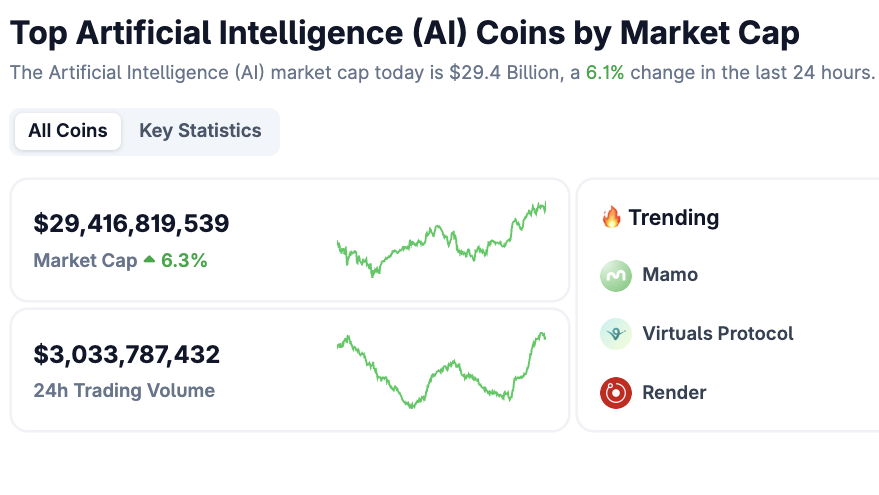 AI Tokens React to CoreWeave. Source:
CoinGecko
AI Tokens React to CoreWeave. Source:
CoinGecko
With centralized AI infrastructure constrained and contested, investors may be rotating into decentralized AI platforms that promise scalability without single points of failure.
In crypto, narratives drive flows. The public friction between CoreWeave and Two Seas became a narrative trigger—reinvigorating interest in the AI token space.
While this shareholder dispute may resolve through a revised deal or protracted negotiation, the message is already out that AI infrastructure is valuable, limited, and contested.
Overall, the traders should expect more capital rotation into AI-native tokens as narratives shift toward long-term infrastructure plays.
Disclaimer: The content of this article solely reflects the author's opinion and does not represent the platform in any capacity. This article is not intended to serve as a reference for making investment decisions.
You may also like
Approaching the "Death Cross"! Korean stocks hit "Black Thursday", KOSPI continuously falls below the 200-day moving average, is a prolonged bear market coming?
Hit hard by rising US inflation and concerns over AI profitability, Korean stocks plummeted 7.57% in a single day on October 15, with two major indices triggering circuit breakers for the first time in two and a half months. Foreign investors have cumulatively sold over 16 trillion won ($12 billion) in eight days. Technical indicators are flashing warnings: the KOSPI has fallen more than 8% below its 200-day moving average, and if it cannot recover within two weeks, the probability of a prolonged bear market is as high as 43%; a "death cross" is expected to form after 16 trading days. The Q3 earnings season will serve as the final validation point.

A glimmer of hope amid the AI winter? TSMC (TSM.US) power orders are fully booked and price hikes are on the way—"self-sustaining capability" offsets financing cost risks
In the same week that global AI stocks suffered heavy losses due to inflation and interest rate hike expectations, TSMC delivered an almost flawless report card.
US Treasury yields surge: How much longer can the US economy and stock market hold out? AI may be the most vulnerable link
Global bond yields have risen to high levels, driven by both fundamental and technical factors. Goldman Sachs believes that banks, the US stock market, and credit markets still show resilience, with only mild economic drag, while Moody’s economist Zandi warns that the US economy is actually "fragile." High interest rates continue to suppress consumption and investment, and the AI boom fueled by high leverage and cyclical investment is seen as the most vulnerable potential risk under the high interest rate environment.
Crypto prices
More


