
BTC Market Pulse: Week 33
Bitcoin rebounded from last week’s drop below $114K to $121K, with on-chain activity and derivatives sentiment improving. However, falling spot volumes and high profitability suggest caution. This week’s Market Pulse breaks down key BTC market signals across spot, futures, ETFs, and on-chain.
Overview
After a sharp retest of the sub-$114k air gap, Bitcoin’s spot price staged a strong rebound over the past week, climbing back toward $121k. This recovery brought momentum back into the market, with several sectors showing signs of renewed activity, though conditions warrant close monitoring.
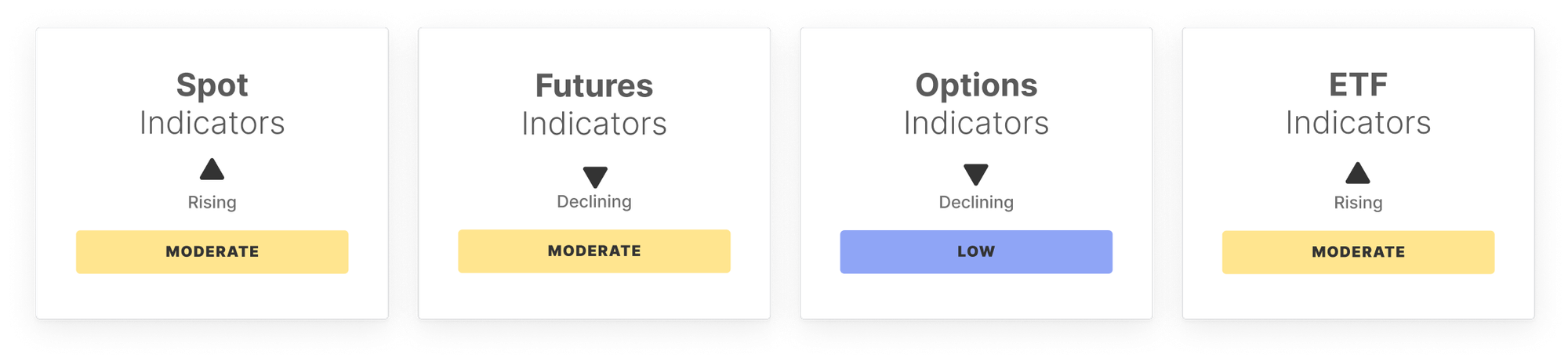
In the Spot Market, RSI rose from 41.5 to 47.5, bouncing from oversold territory, while Spot CVD improved sharply from heavy selling to near-neutral levels. However, spot trading volume dropped 22% to $5.7B, indicating that the recovery has yet to be matched by broad participation.
The Futures Market saw Open Interest ease slightly to $44.1B, with long-side funding slipping marginally yet remaining elevated. Perpetual CVD jumped to -$0.2B, signaling a notable shift toward buy-side aggression and renewed confidence among leveraged traders.
In the Options Market, Open Interest rebounded 6.7% to $42.4B, showing growing participation. The volatility spread contracted sharply to 10.45%, near its low band, suggesting complacent volatility pricing, while the 25 Delta Skew eased but stayed above its high band, reflecting lingering demand for downside protection.
The ETF Market recorded a sharp improvement in net flows, with outflows narrowing by over half, though trading volume fell 27.7% to $13.7B, near its low band. ETF MVRV rose above its high band to 2.43, signaling strong unrealized profits and potential profit-taking risk.
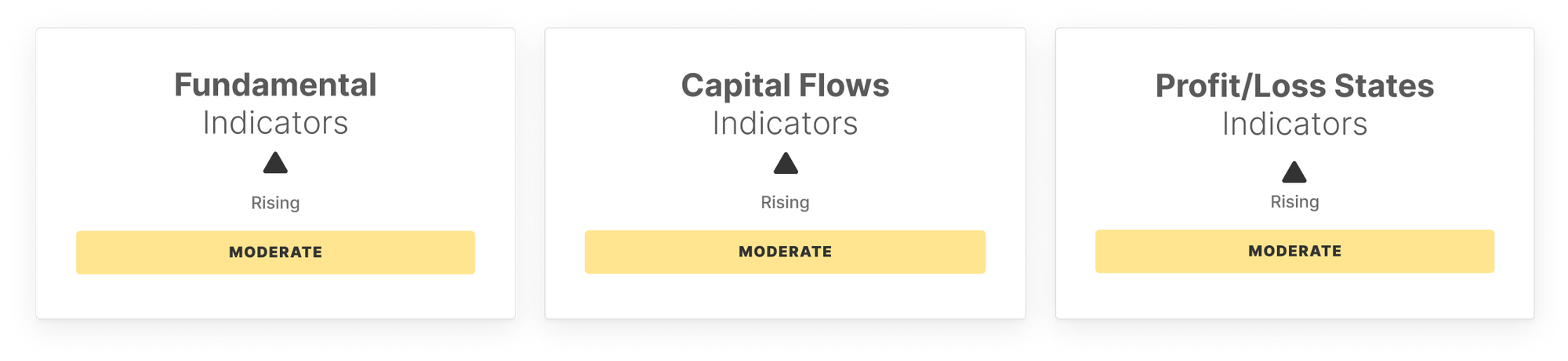
On-Chain Fundamentals strengthened, with active addresses climbing above their high band to 793k. Transfer volume held steady at $8.5B after prior declines, and fee volume rose 10.3%, reflecting increased demand for transaction inclusion.
Capital Flows moderated slightly as Realized Cap Change dipped to 5.2% but stayed above its high band. The STH/LTH ratio and Hot Capital Share remain stable, showing a balanced market structure and liquidity.
Profitability metrics improved, with Percent Supply in Profit at 94.1% and NUPL up to 8.5%. The Realized P/L Ratio rose to 1.9, highlighting profit-taking dominance.
In sum, the market has shifted from seller exhaustion to a strong rebound near recent ATHs. While momentum has returned, the move should be monitored closely, as elevated profitability and profit-taking potential could quickly alter sentiment.
Off-Chain Indicators
On-Chain Indicators
 \
\

Don't miss it!
Smart market intelligence, straight to your inbox.
Subscribe nowPlease read our Transparency Notice when using exchange data .
Disclaimer: The content of this article solely reflects the author's opinion and does not represent the platform in any capacity. This article is not intended to serve as a reference for making investment decisions.
You may also like
GMO executive: Oversupply of stocks and slowdown in AI infrastructure will jointly trigger this round of the AI bubble
GMO executive Inker warns that the largest IPO wave in history—SpaceX, OpenAI, and Anthropic combined—will inject an additional supply of shares equivalent to 6% to 7.5% of the U.S. stock market capitalization, far exceeding the historical record set during the peak of the internet bubble. He points out that if this is combined with the turning point of AI computing power shifting from scarcity to surplus, the market decline could reach 35% to 50%.
BNY completes first tokenized US Treasury repo on major triparty platform

No one wants to hold this market, but Goldman Sachs believes this is exactly the entry signal: three major rescues are about to return
Market sentiment has dropped to the lows last seen on “Parity Tariff Day” in April, but Goldman Sachs’s flow team believes that technical conditions in US equities are quietly shifting. The corporate buyback window will reopen on a large scale from the end of October to November, mutual fund year-end selling pressure will dissipate after Halloween, and historical seasonal buying from retail and foreign investors will take over. Buybacks, retail investors, and foreign capital will all return almost simultaneously.
Crypto prices
More


