

The Monero chain is undergoing a successful 51% attack, with chain reorganization detected. One entity, the Qubic project, has managed an expensive takeover of more than half the hashrate, and has allegedly turned into a bad actor by changing block history.
The Monero network may be undergoing a successful 51% attack, after one entity took over the hashrate. The Qubic mining pool is the main entity with the ability to rewrite on-chain history. Analysts have already noted Monero may have undergone a block reorg, changing the history and potentially setting up double-spending.
 On-chain observers claim Qubic mining has taken over the Monero network. Source: @evilcos via X
The confidential chain had a relatively low hashrate compared to other entities. However, due to its CPU and GPU mining, the chain was considered difficult to attack due to the distributed hashrate.
In 2025, an entity still managed to recruit enough hardware to take over the network, though running at this rate may be expensive and unsustainable. 51% attacks usually last for a few hours, and not all events make economic sense.
Double-spending or reversing XMR transactions may have a limited effect, since XMR is barely traded on exchanges. Some markets are also using token-based synthetic versions of XMR , instead of the real coin.
Qubic announced its intention regarding Monero
The takeover of the Monero hashrate is not random or the work of a rogue actor or a botnet. The 51% attack would cost up to $75M in a single day based on rough estimates, since Monero mining is still dependent on CPUs with low individual capacity.
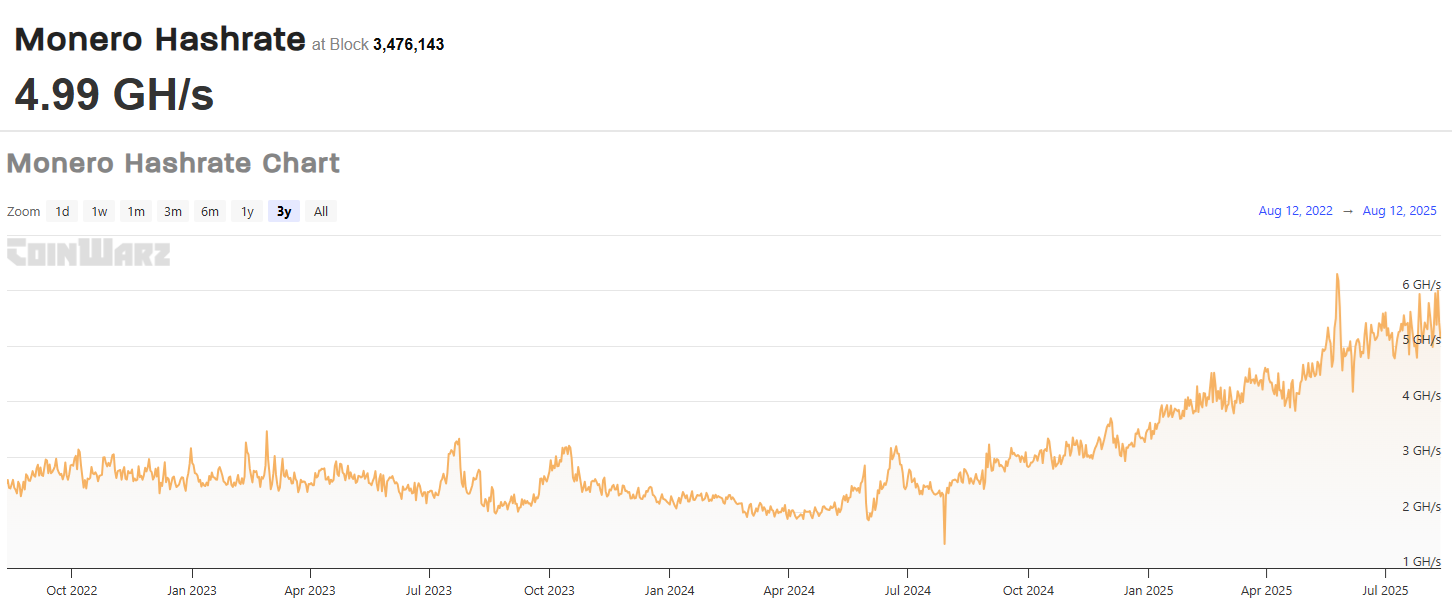 The Monero hashrate is at an all-time high, but most miners were incentivized to join Qubic due to the higher guaranteed rewards. | Source: Coinwarz
Quibic is a project mixing tokenized incentives with mining, founded by Sergey Ivancheglo, also the co-founder of IOTA and a legend in the crypto space. Ivancheglo, known on X as ComeFromBeyond, showed no concern for the event, instead discussing AI issues.
At the time of the attack, the Monero network had a total hashrate of 4.99 GH/s , requiring thousands of CPUs and less efficient GPUs.
Qubic was capable of gathering and coordinating enough network participants, generating new interest in Monero mining, where organic participants were rarer. The current attack follows days and weeks of a “Monero siege,” where Qubic’s influence grew gradually.
The recipe for Qubic was to incentivize Monero mining by giving guaranteed higher block rewards to its miners, while also boosting its native QUBIC tokens. Over time, the higher probability of block rewards drew in more miners, making Qubic the only profitable pool.
Qubic itself exerted selling pressure on XMR by directly liquidating half the rewards. The project used the USDC proceeds to boost the QUBIC token , which traded at $0.000002.
The end goal of Qubic is to orphan all blocks mined by other entities, refusing them propagation. Thus, the entire status and history of Monero would be in the hands of a single entity, with the sole authority to create and overwrite blocks.
The final stage would be for Quibic to become the de facto Monero miner, performing the first chain takeover, where a $300M project gains control of a $6B Monero network.
However, this approach goes against the main philosophy of proof-of-work, where no single miner can control the network.
XMR price drops as network takeover looms
The price of XMR responded negatively to Qubic’s plan of taking over the network, even with the intent to improve it.
XMR crashed by 10.4% in the past 24 hours, to a three-month low of $246.98. XMR was already down following another episode of exploiting the market price to launder stolen BTC .
Most of the XMR activity is still locked on KuCoin, with smaller markets on Kraken. At this point, no exchange has announced double-spending to its wallets and attempts to sell XMR, then reverse the transaction.
Qubic’s plans may change the nature of the Monero network, even doing away with the current type of mining or merging the chain with another network’s infrastructure. The event shows proof-of-work chains are also attackable, especially in the case of sufficiently low hashrate.


