
How SUI (SUI) Benefits From the Launch of Grayscale’s Two New Products

Grayscale’s DeepBook and Walrus Trusts could accelerate Sui blockchain adoption, driving institutional confidence and attracting more developers and users to the ecosystem, increasing network activity.
The Sui (SUI) blockchain has seen a substantial increase in user engagement and adoption, and this momentum could gain further traction.
Grayscale recently launched two new single-asset investment trusts, which could contribute to the growth of the Sui network.
Sui Blockchain Grows Stronger with Grayscale’s New Investment Trusts
On August 12, Grayscale, a leading digital asset investment platform, announced the launch of the Grayscale DeepBook Trust and Grayscale Walrus Trust. These trusts operate similarly to Grayscale’s other single-asset investment products.
Thus, they are exclusively invested in the DEEP and WAL tokens, respectively, offering investors direct access to these tokens. The firm revealed that the trusts are now available for daily subscription to eligible individual and institutional accredited investors.
But how does this benefit Sui? Well, DeepBook and Walrus are two core protocols within Sui’s ecosystem. The former is a decentralized central limit order book (CLOB). It serves as the liquidity backbone for Sui’s decentralized finance (DeFi) applications.
Walrus is a decentralized storage platform built on the Sui blockchain. It provides a system for developers to store and manage large data files, such as videos, images, and PDFs, in a resilient, scalable, and programmable manner. Notably, Walrus is chain-agnostic and capable of handling data from any blockchain, making it a versatile tool.
“DeepBook and Walrus provide infrastructure designed for high-performance on-chain liquidity and data, helping power the next wave of scalable, real-world blockchain applications,” Rayhaneh Sharif-Askary, Head of Product & Research at Grayscale, noted.
Since they’re built on the Sui blockchain, the launch of these trusts will benefit the ecosystem in several ways. Grayscale’s involvement brings heightened visibility to Sui’s ecosystem, leading to heightened appeal. The trusts also signal institutional confidence in Sui’s infrastructure, boosting legitimacy.
Furthermore, this may attract more developers and users. As they join the Sui network, the ecosystem benefits from the network effect, where each new participant adds value to the others, accelerating growth.
“We believe these two product launches are a seminal moment in the journey of the Sui ecosystem. With Grayscale DeepBook Trust and Grayscale Walrus Trust, investors will now have direct exposure to two core protocols within the Sui ecosystem,” Adeniyi Abiodun, Co-Founder and CPO at Mysten Labs, said.
Lastly, the trusts could likely drive increased transaction volume on the Sui blockchain, uplifting network activity. Meanwhile, these positive catalysts come amid a broader trend of growth and development within the ecosystem.
Artemis data showed that the daily active addresses on Sui have reached a new all-time high. This growth in active addresses highlights the increasing interest in the blockchain.
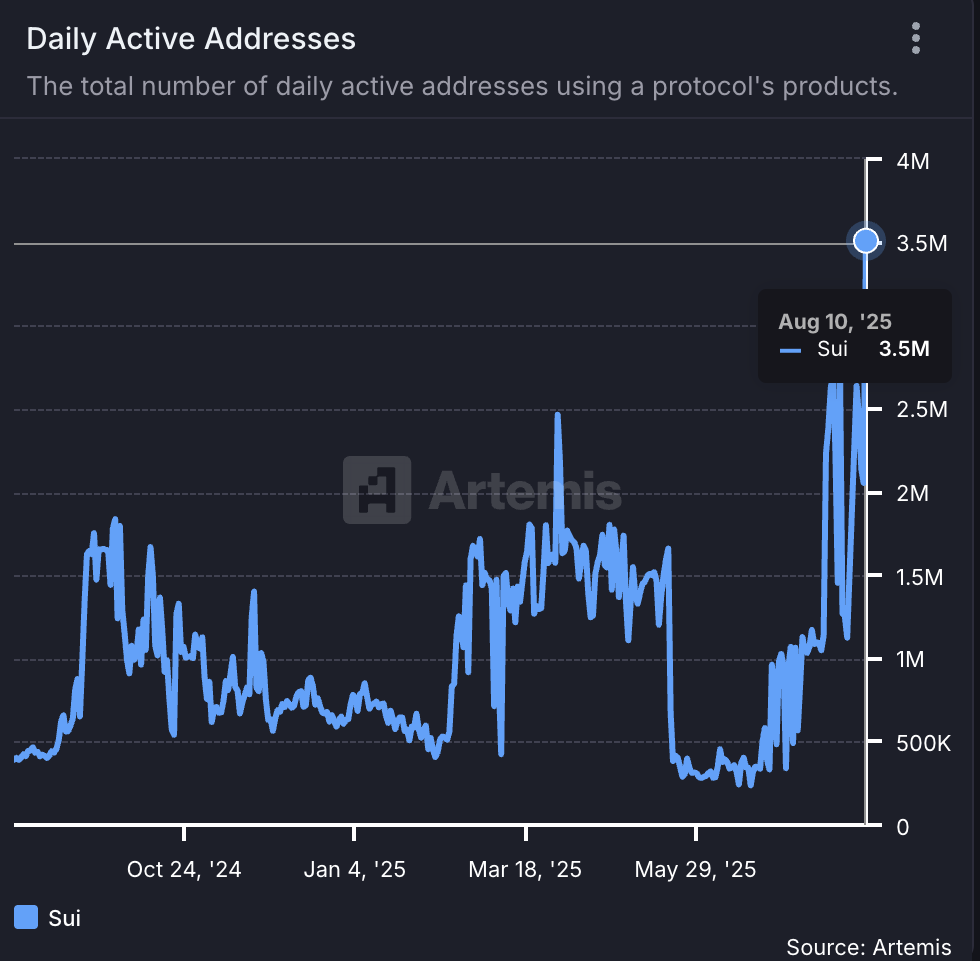 Sui Daily Active Addresses. Source:
Moreover, the surge in SUI code commits in 2025 further reinforces this momentum, reflecting strong developer activity and a commitment to continuous improvement.
Disclaimer: The content of this article solely reflects the author's opinion and does not represent the platform in any capacity. This article is not intended to serve as a reference for making investment decisions.
You may also like
US chip stocks plunge, evaporating over $1 trillion in market value! Inflation exceeds expectations, reigniting rate hike prospects; AI infrastructure financing bottlenecks trigger valuation reassessment
With the September inflation data exceeding expectations and further strengthening the Fed's rate hike outlook—coupled with rare warnings from the CEOs of Broadcom and Intel about financing bottlenecks in AI infrastructure—the global AI-themed trade, centered on semiconductors, experienced a massive sell-off in the past week.
Defying the Market Downturn! Apple Joins the $5 Trillion Club
On Wednesday, the S&P 500 fell more than 1%, but Apple defied the trend, with its market capitalization officially surpassing $5 trillion, becoming the second company worldwide to reach this milestone after Nvidia. This market value breakthrough coincides with Cook stepping down and new CEO Ternus taking over. However, challenges such as Apple's shortcomings in AI and OpenAI's ambitions in hardware are creating undercurrents at the top of this $5 trillion summit.
CoreWeave Dilemma for Nvidia: Forced to Rescue or Stand By?
As both a shareholder of CoreWeave and its sole GPU supplier, Nvidia now faces a dilemma after the sharp decline in CoreWeave's stock price. If it intervenes, each rescue strengthens expectations of a safety net, raises the threshold for future rescues, and risks getting further entangled in this high-leverage game. If it does not intervene, CoreWeave's liquidity crisis will directly cut off demand for GPU purchases, simultaneously devaluing Nvidia's equity investment and severely damaging its market reputation.
US CPI Heats Up Across the Board, Triggering "Inflation Spiral" Alert; October Rate Hike Odds Once Hit 50%. "New Fed News Agency": Watch Waller's Speech This Week
After the CPI was released, the market-implied rate hike probability first rose to 50% before falling back to 40%. Wall Street generally believes that whether action will be taken in October still depends on how the Federal Reserve assesses inflation trends. "The New Fed News Agency" noted that, unlike in August when price increases were concentrated in certain items, the stronger-than-expected performance of September's core CPI was more broad-based, further reinforcing the case for a December rate hike. The speech by Waller on Friday morning Beijing time is his last public statement before the Fed's blackout period ahead of this month's meeting. Economists are warning about an "inflation spiral," with real purchasing power and midterm election pressures interweaving.
Crypto prices
More


