
Meme Coin Dominance Falls to 18-Month Low – What’s Behind the Drop?

Meme coin dominance drops as Ethereum absorbs liquidity, but experts predict a rally in meme coins as part of a 4-phase market cycle, with Phase 4 driving altseason.
Meme coin dominance has reached its lowest level in 1.5 years, reflecting a shift in market dynamics amid what analysts describe as an ‘Ethereum season.’
Despite this, experts remain optimistic about meme coins’ prospects. They point to a 4-phase market cycle, which could lead to an explosive rally in meme coins as money trickles down.
Why is Meme Coin Dominance Dropping?
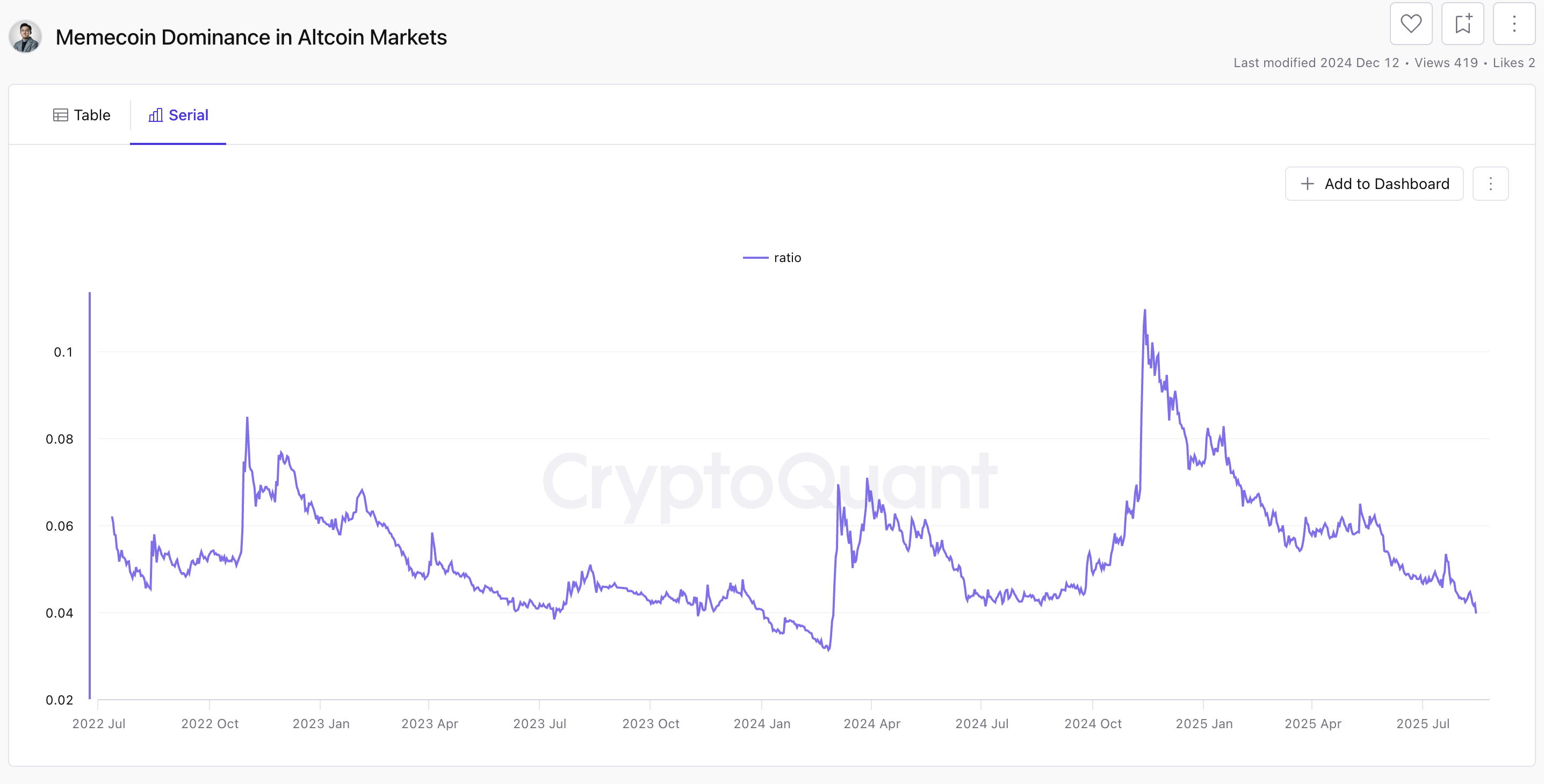
According to the latest data from CryptoQuant, meme coin dominance in the altcoin market dropped to 0.039, a level last seen in February 2024.
 Dropping Meme Coin Dominance in The Altcoin Market. Source:
CryptoQuant
Dropping Meme Coin Dominance in The Altcoin Market. Source:
CryptoQuant
In a recent post on X, an analyst pointed to Ethereum (ETH) as the key driver behind this dip. The analyst explained that ETH continues to dominate the altcoin market by absorbing a large portion of the liquidity.
This means that a significant amount of investment and capital is flowing into ETH, leaving less available for other altcoins, including meme coins.
“It’s clearly not meme coin season right now, and even though a few manage to perform, it remains very anecdotal,” the post read.
This shift aligns with observations from other market commentators who argue that the current cycle is characterized by an ‘Ethereum season’ rather than a full altcoin season, with Ethereum outperforming Bitcoin (BTC) and overshadowing other altcoin categories.
“We are in the Ethereum Season, as the majority of liquidity is flowing into ETH. For Altseason, we need more retail liquidity which won’t come until ETH hits a new ATH,” Cas Abbé noted.
The data support this narrative. While the meme coin market cap has surged 79.5% from April lows—rising from $39.93 billion to over $71 billion, the gains pale compared to Ethereum’s performance.
The second-largest cryptocurrency’s market value has jumped 215.91% in the same time frame from $177.49 billion to $560.7 billion. A similar trend emerges when comparing the performance of the top three meme coins to Ethereum in August.
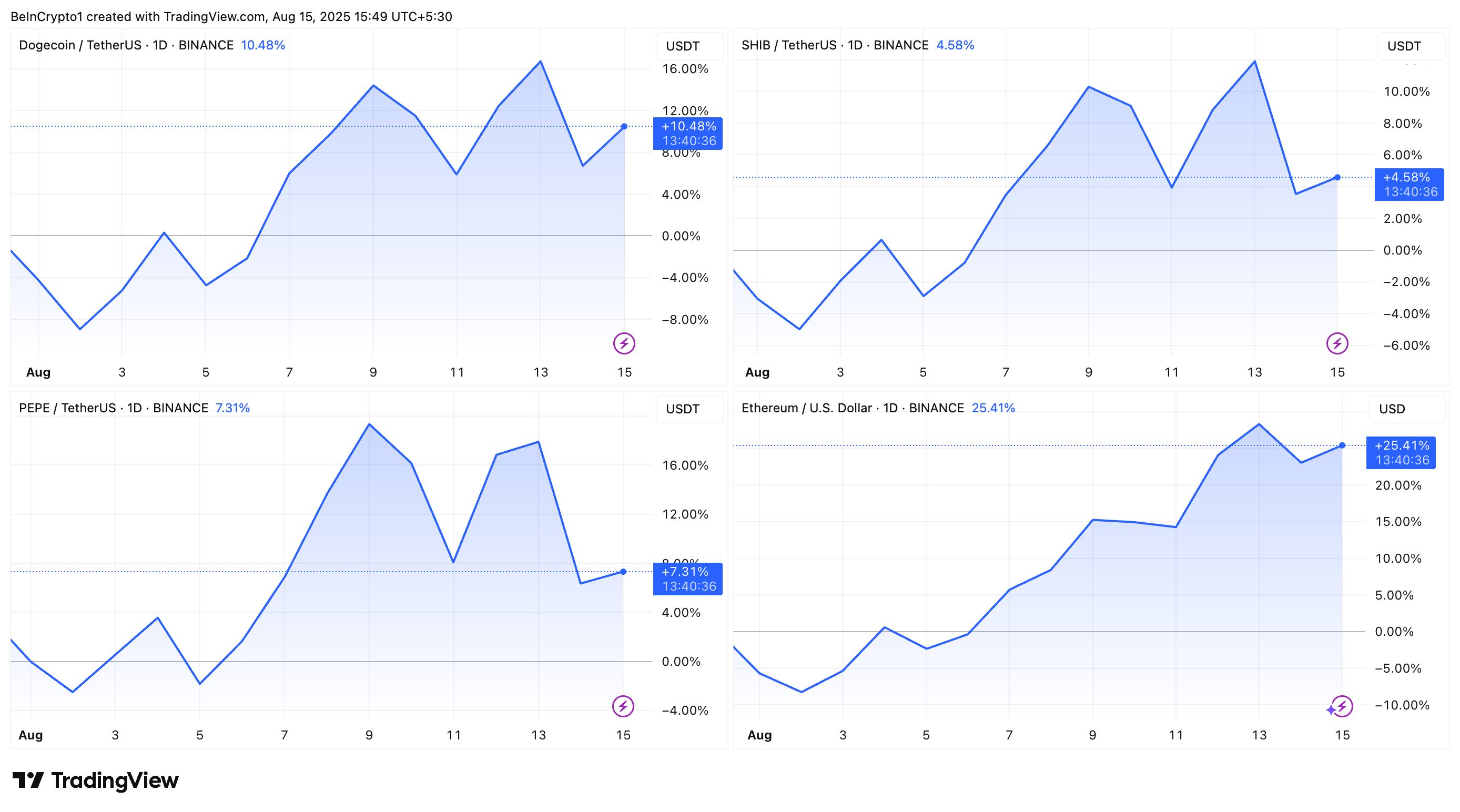
So far this month, Ethereum has recorded a 25.41% increase. Meanwhile, Dogecoin (DOGE) has risen by 10.48%, Shiba Inu (SHIB) by 4.58%, and Pepe (PEPE) by 7.31%.
This disparity suggests that Ethereum’s dominance is siphoning liquidity from meme coins, contributing to their reduced market share.
 Ethereum Vs. Top Three Meme Coins. Source:
TradingView
Ethereum Vs. Top Three Meme Coins. Source:
TradingView
Meme Coin Season: When Will It Start?
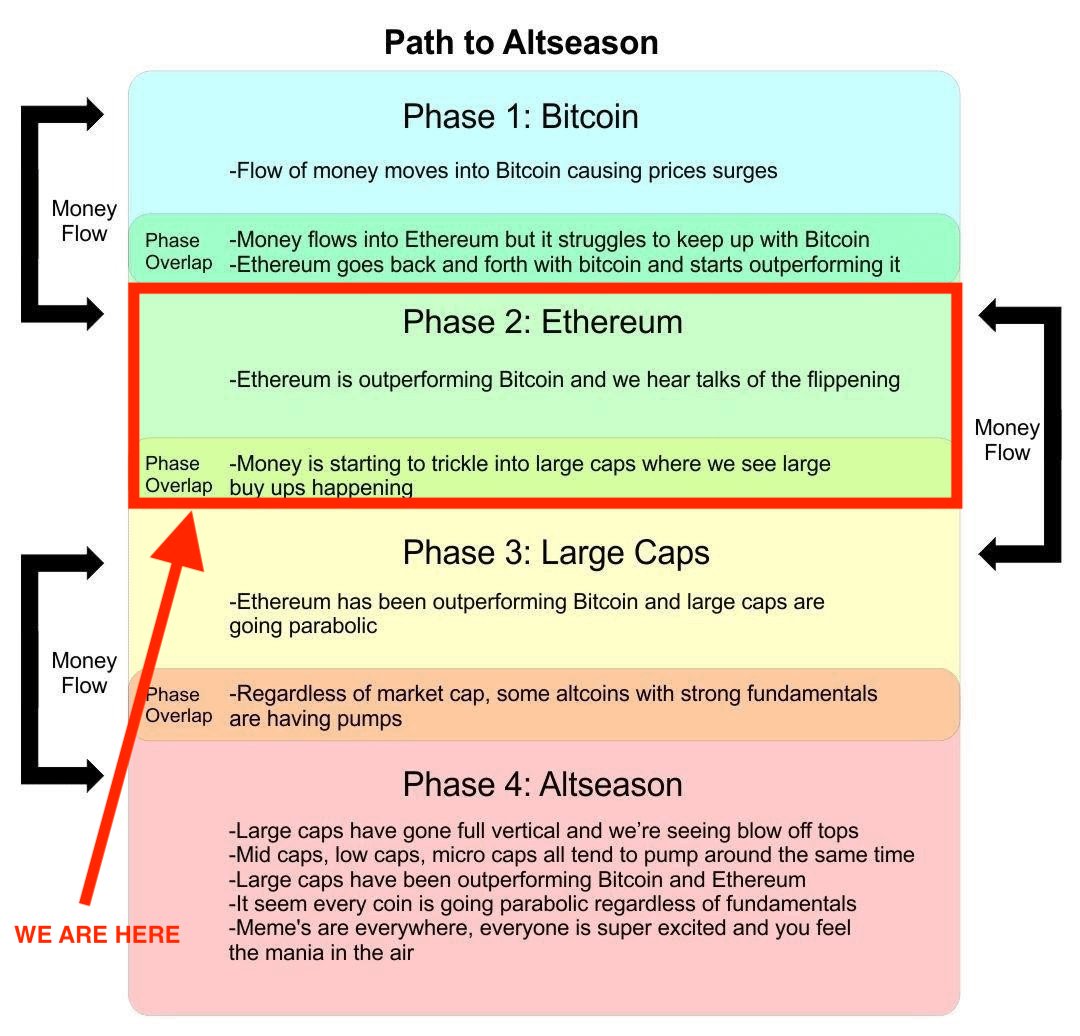
However, the story may not be over for meme coins. Experts have highlighted a four-phase cycle that could signal a future rally. According to them, the market is currently in Phase 2, where Ethereum dominates.
“We waited years for this moment. Now it’s here. ETH just entered Phase 2: Ethereum season. The best runs in history started right here,” Merlijn The Trader posted.
 Altcoin Season Cycle. Source:
X/0xNonceSense
Altcoin Season Cycle. Source:
X/0xNonceSense
This will be followed by Phase 3, during which Ethereum continues to outperform Bitcoin and large-cap altcoins start to experience significant growth.
Finally, Phase 4, termed ‘altseason,’ represents the peak of the market cycle. This features surges in large-cap altcoins, followed by mid, low, and micro-cap coins, including meme coins, fueled by widespread euphoria.
“Altcoins are just starting to take off, and meme coins always run last,” another analyst added.
Thus, despite the decline in dominance, the growth of the meme coin market and the cyclical nature of altcoin seasons indicate a potential for recovery. Whether this potential will materialize or if institutional involvement has fundamentally altered the market remains to be seen.
Disclaimer: The content of this article solely reflects the author's opinion and does not represent the platform in any capacity. This article is not intended to serve as a reference for making investment decisions.
You may also like
The S&P 500 ends its longest calm period in over six years, falling more than 1% for the first time in 53 trading days as AI trading loses momentum
The main reason for the decline in US stocks on Wednesday was the combination of higher-than-expected US September CPI and AI credit risk shocks. This downturn was particularly unfavorable for quantitative funds, as these funds have continued to increase their positions during a period of extremely low volatility, and the breaking of the calm period triggered adjustment pressure on their holdings. Currently, the decline remains moderate, with the VIX hovering around 17, below the typical 20 threshold indicating market stress.
Australia Unemployment Rate set to remain at a five-year high of 4.6% in September

Blackstone's AirTrunk Postpones $1.5 Billion REIT IPO: Yield Raised to 6% but No Takers, AI Infrastructure Financing Faces 5.2% US Treasury Yield
AirTrunk, a data center operator under Blackstone, has decided to postpone the listing of its $1.5 billion Singapore Real Estate Investment Trust (REIT) to the first or second quarter of 2027. Rising U.S. Treasury yields and increased market volatility have made investors more cautious; even raising the yield from 5.5% to around 6% has not boosted demand. High capital costs are becoming a major constraint on the expansion of AI infrastructure.
Crypto prices
More


