
Bitcoin’s $117,400 CME Gap Closure Sparks Euphoria — and Caution

Bitcoin fills $117,400 CME gap, leading to mixed reactions—some see a breakout ahead, while others warn of a potential pullback and market turbulence.
Bitcoin (BTC) quietly closed a long-watched CME futures gap at $117,400. While some traders see the technical milestone as the final step before a breakout, others warn of turbulence ahead.
The CME gap phenomenon refers to price differences that appear between the Friday close and Sunday open on the Chicago Mercantile Exchange’s Bitcoin futures market.
Traders Split as Bitcoin Closes CME Futures Gap
Bitcoin filled the $117,400 CME futures gap between August 14 and 15, when it dipped into the $117,425 to $119,100 order block.
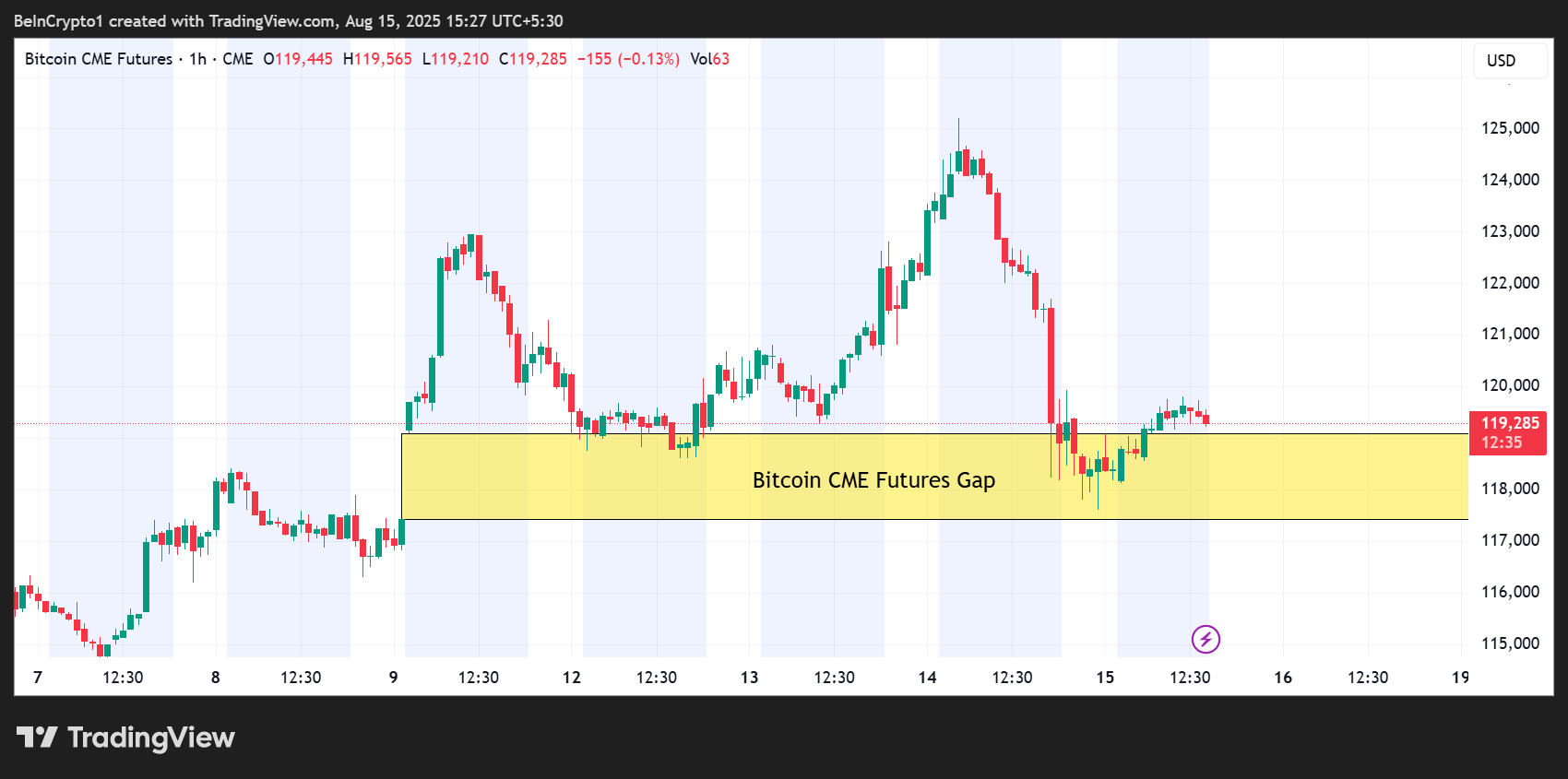 Bitcoin CME Futures Gap. Source:
Many traders believe these gaps tend to fill, meaning the spot price eventually revisits the gap level. The expectation is much like what happens with the fair value gap (FVG), which represents an inefficiency or imbalance in the market.
An FVG stems from inefficiencies in spot price action, resulting from liquidity imbalance in spot charts. Meanwhile, a CME gap arises from weekend futures market closures as prices skip levels.
Price often returns to fill both. However, while CME gaps have higher historical fill rates, FVG fills depend more on trend and liquidity.
According to analyst Mike Alfred, closing the CME futures gap may be a symbolic turning point for the Bitcoin price.
“Quietly, with zero fanfare, Bitcoin closed the CME gap at $117,400. This was the final step. The captain has cleared us for takeoff… Valhalla is here,” he stated.
While some see the gap closure as a bullish springboard, others note that the price action was slower and more drawn-out than usual.
Daan Crypto Trades pointed out that most CME gaps close within a day, but this one took three to four days.
“It can be a good level to keep an eye on, in case the price decides to do one more drive lower to take out those lows,” Daan wrote.
An analyst who goes by the pseudonym The Lord of Entry also urged restraint, highlighting macroeconomic pressures after disappointing PPI data.
“Danger zones ahead from $120,000 onwards — I’m anticipating some kind of lower high for now and a bit of chop for a while,” they said.
Skepticism Over the CME Gap Theory
However, not everyone believes in the significance of gap closures. Analyst and investor Sunny Decree openly challenged this premise, saying that it is not a guarantee that CME gaps will be filled.
CME Gap: If you can find a person who can explain, with pure logic, why a CME gap should be filled, I’ll give you $500. But save your time – you won’t find anyone. It’s complete BS. (Self-fulfilling prophecy doesn’t count as an argument.)
— sunnydecree (@sunnydecree) August 14, 2025
That skepticism mirrors a broader market debate on whether the CME gap is a reliable predictive tool or simply a pattern traders believe in strongly enough to make it happen.
Meanwhile, some analysts are focusing on immediate price action, noting that the next move could be a bounce toward testing resistance with the gap now closed. However, they cautioned that no clear low has been formed yet.
Similarly, Ash Crypto, a renowned analyst, suggested that the post-gap environment may offer near-term upside:
“Bitcoin CME gap is now closed after yesterday’s market dump. We should see a bounce from here,” he shared.
Therefore, while the $117,400 close for traders presents as a technical checkbox, it is also a psychological inflection point.
For some, it signals a potential go-ahead for a powerful rally, perhaps toward the mythical “Valhalla” of sustained price discovery. For skeptics, however, this milestone is just another narrative in Bitcoin’s volatile and rumor-driven market.
With immediate resistance looming near $120,000, the coming sessions could reveal whether this gap closure marks the start of the next leg higher.
Alternatively, as some warn, the market may first need to shake out weaker hands before attempting new highs.
Disclaimer: The content of this article solely reflects the author's opinion and does not represent the platform in any capacity. This article is not intended to serve as a reference for making investment decisions.
You may also like
The S&P 500 ends its longest calm period in over six years, falling more than 1% for the first time in 53 trading days as AI trading loses momentum
The main reason for the decline in US stocks on Wednesday was the combination of higher-than-expected US September CPI and AI credit risk shocks. This downturn was particularly unfavorable for quantitative funds, as these funds have continued to increase their positions during a period of extremely low volatility, and the breaking of the calm period triggered adjustment pressure on their holdings. Currently, the decline remains moderate, with the VIX hovering around 17, below the typical 20 threshold indicating market stress.
Australia Unemployment Rate set to remain at a five-year high of 4.6% in September

Blackstone's AirTrunk Postpones $1.5 Billion REIT IPO: Yield Raised to 6% but No Takers, AI Infrastructure Financing Faces 5.2% US Treasury Yield
AirTrunk, a data center operator under Blackstone, has decided to postpone the listing of its $1.5 billion Singapore Real Estate Investment Trust (REIT) to the first or second quarter of 2027. Rising U.S. Treasury yields and increased market volatility have made investors more cautious; even raising the yield from 5.5% to around 6% has not boosted demand. High capital costs are becoming a major constraint on the expansion of AI infrastructure.
Crypto prices
More


