
Fed Policy Outlook Clouded By Inflation Surprise

While the majority anticipated a Fed rate cut in September, a key indicator casts doubt. The latest Producer Price Index (PPI) release rekindles inflation fears and cools hopes for monetary easing. This subtle but meaningful reversal reshuffles the deck in a context where Fed policy dictates the rhythm of risky assets, and more than ever, that of the crypto market.
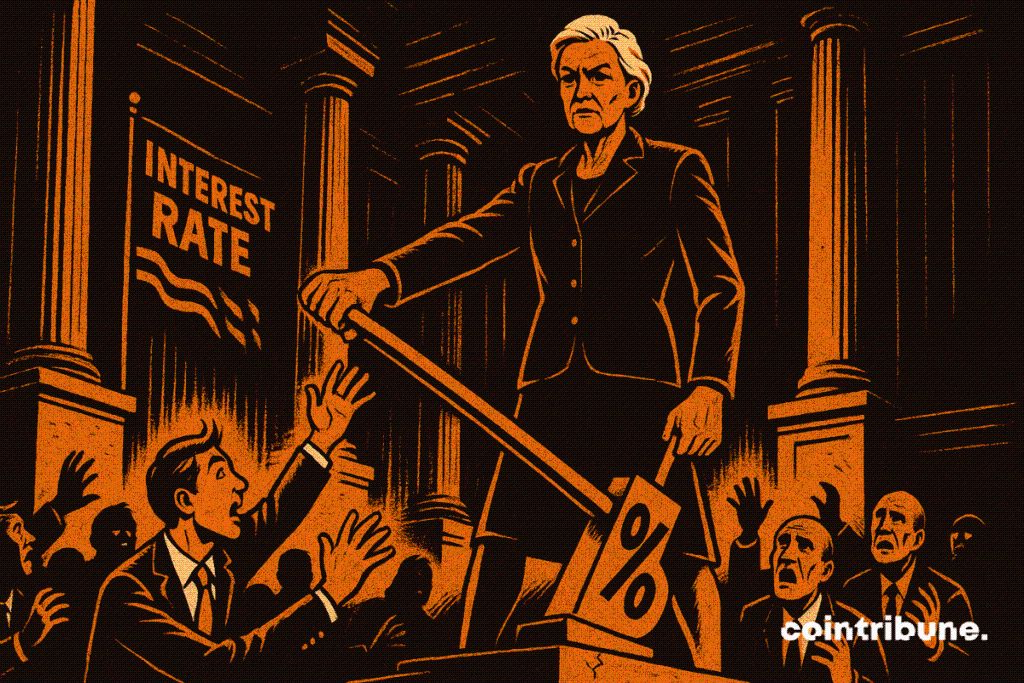
In Brief
- Financial markets, which largely anticipated a Fed rate cut in September, are starting to doubt.
- The release of the latest Producer Price Index (PPI) rekindles tensions around more persistent inflation than expected.
- Prediction platforms like CME, Kalshi, and Polymarket show a subtle but real shift in investor expectations.
- The probability of a 25 basis point cut remains majority, but the status quo scenario is gaining ground.
The Momentum of a Monetary Pivot Questioned
Until recently, a rate cut in September seemed almost certain, as Goldman Sachs had anticipated . The CME futures market (Chicago Mercantile Exchange), via its FedWatch tool, still assigned a 96 % probability to a key rate cut to 4.00–4.25 %.
However, the tide has shifted. Following the July PPI release, this probability slipped to 92.8 %. A modest correction in appearance, but revealing a change in perception. The market is beginning to doubt. And these doubts also extend to other prediction platforms.
On Kalshi, a 25 basis point cut in September remains the most likely scenario with 76 %, but the status quo rate rises to 21 %, signaling growing caution.
Market platforms reflect this shift in expectations numerically and without ambiguity :
- CME FedWatch Tool : 92.8 % probability of a cut to 4.00–4.25 % (compared to 96 % previously) and 7.2 % probability of rate hold ;
- Kalshi : 76 % of bettors expect a 25 basis point cut, 21 % foresee a status quo, and 4 % bet on a larger cut (>25 bps);
- Polymarket : 72 % probability of a 25 basis point cut, 23 % for status quo, 5 % for a 50 bps cut, and 1 % for a hike.
These gaps, although narrow, reflect a slow but tangible reconfiguration of expectations. The PPI release served as a reminder that inflation is not under control, complicating the argument for a rapid monetary pivot.
Even if the majority of the market still leans towards easing, operators adopt a more measured tone, reflecting an increased awareness of latent macroeconomic risks.
Inflation Resurges and Clouds Prospects
The inflection observed on Polymarket illustrates the magnitude of the situation. Indeed, the probability of a monetary status quo in September now reaches 23 %, a notably higher level than at the beginning of the month.
At the same time, the scenario of a 25 basis point cut loses some points and falls to 72 %, while the scenario of a more marked reduction (50 basis points) remains marginal at 5 %. If the Fed adopts a data-dependent approach, as it has repeated for several months, the issue becomes clear: each macroeconomic indicator, inflation, employment, growth, is now likely to reshuffle the cards.
This nervousness results from an indicator, the PPI, which, although less publicized than the CPI, is watched for its leading signals on inflationary pressures. An unexpected rise at this level fuels the scenario of more entrenched inflation than expected.
It places the Fed in a delicate position : keep rates unchanged despite slowing risks, or cut them while risking fueling a new wave of price increases. No scenario is simple, and it is precisely this complexity that is reflected in the current volatility of monetary expectations.
In this suspended monetary environment, bitcoin does not escape the turbulence. Long considered a safe haven against inflation, the asset has progressively adjusted to the pace of rate policies. The more rate cut expectations retreat, the more flows to cryptos slow down.
The current uncertainty about the Fed’s trajectory thus fuels latent volatility in the crypto market, hindering the bullish momentum observed in recent weeks. Operators remain on the lookout for a clear monetary signal before repositioning their strategies.
In the longer term, this uncertainty could have broader consequences on markets, notably crypto markets. A hesitant Fed, perceived as less predictable, could increase volatility on bitcoin and altcoins, already sensitive to rate movements. Upcoming CPI releases, employment figures, and speeches from FOMC members will therefore be decisive.
Disclaimer: The content of this article solely reflects the author's opinion and does not represent the platform in any capacity. This article is not intended to serve as a reference for making investment decisions.
You may also like
Australia Unemployment Rate set to remain at a five-year high of 4.6% in September

Blackstone's AirTrunk Postpones $1.5 Billion REIT IPO: Yield Raised to 6% but No Takers, AI Infrastructure Financing Faces 5.2% US Treasury Yield
AirTrunk, a data center operator under Blackstone, has decided to postpone the listing of its $1.5 billion Singapore Real Estate Investment Trust (REIT) to the first or second quarter of 2027. Rising U.S. Treasury yields and increased market volatility have made investors more cautious; even raising the yield from 5.5% to around 6% has not boosted demand. High capital costs are becoming a major constraint on the expansion of AI infrastructure.
CoreWeave Faces Dual Shock in Stocks and Bonds! Share Price Plummets 15%, Bonds in Trouble, Musk Exclaims "Scary"
Analysts point out that the company borrows at an interest rate of about 9%, but its investment returns are less than 5%. With total debt and lease obligations amounting to $52 billion, there is a risk that its equity value could go to zero. Rising inflation has pushed up long-term U.S. Treasury yields, leading to systemic doubts about the financing logic of capital-intensive AI companies. Prediction platforms now estimate the company's probability of bankruptcy before 2027 at 17%.

Federal Reserve Beige Book Warns of "Fierce" Oil Prices: Half of Districts Face Strong or Intensifying Price Pressures, Businesses Confront Price Increases and Profit Squeeze
The Beige Book shows that all 12 Federal Reserve districts reported the impact of rising oil prices. Businesses generally indicated that high diesel prices and fuel surcharges are passing additional costs down the entire supply chain. Since the previous Beige Book report just over a month ago, the U.S. economy has experienced moderate growth, with manufacturing serving as the main support. The labor market continues to see low hiring and low layoffs, and firms in nearly half the districts reported that AI investment is impacting employment.
Crypto prices
More


