
DAT Companies Exposed In Sharp Bitcoin Pullback

Less than 48 hours after hovering near a peak at 124,000 dollars, bitcoin falls below 117,000 while ether drops to 4,400. This brutal but seemingly classic correction exposed a weak link in the ecosystem: publicly traded companies exposed to cryptos. Thus, this segment long supported by bullish euphoria takes the reversal full on. The market, meanwhile, reminds that it never rewards excess for long.
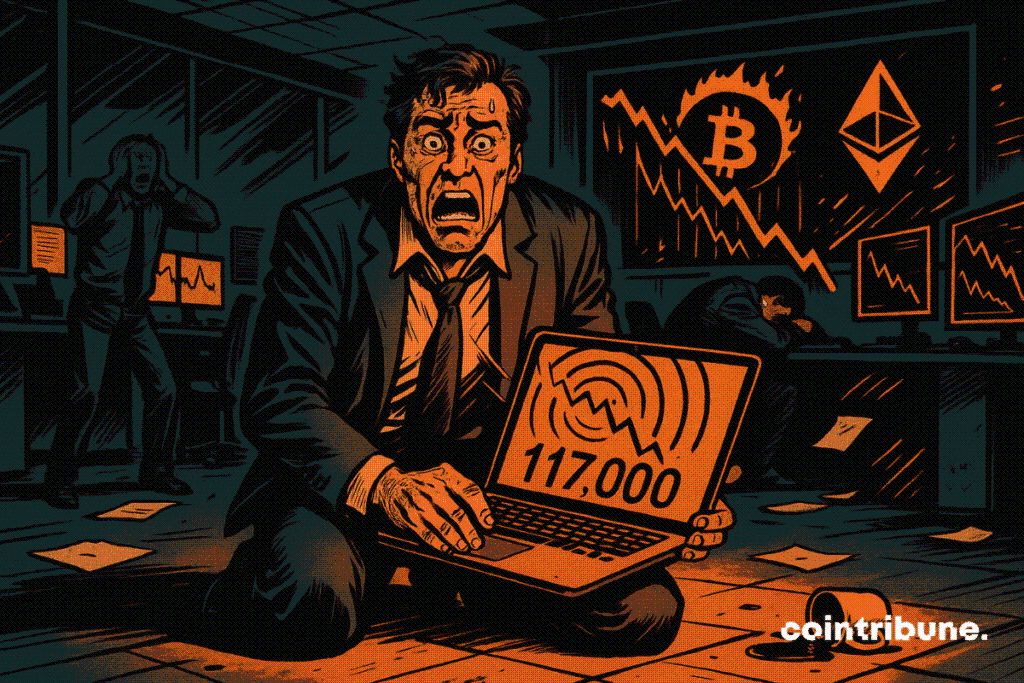
In brief
- Less than 48 hours after hitting a record at $124,000, Bitcoin plunges sharply below $117,000; Ether slides to $4,400.
- This sudden correction put several listed companies heavily exposed to cryptos in difficulty.
- Strategy, Metaplanet, Nakamoto and other DAT companies record losses of up to 14 % in a single session.
- This decline may not be just a passing episode, but a strong signal on the structural fragility of a model seeking rebalancing.
Crypto treasury companies collapse
The recent crypto market drop following Scott Bessent’s statement immediately triggered a massive decline in the stocks of publicly traded companies heavily exposed to these assets. These Digital Asset Treasury Firms (DAT), known for having made crypto accumulation a treasury strategy, were among the hardest hit by investors.
Leading the pack, Strategy, whose stock lost 3 % on Friday, adding to a 20 % drop since its July peak, and 33 % compared to its November 2024 high. One of the most closely watched indicators, the MSTR/IBIT ratio, fell to 5.43, its lowest level since March, signaling a growing disinterest from investors in Michael Saylor’s ultra-exposed strategy, a bitcoin maximalist.
Other companies, though less emblematic, also saw their market capitalization melt away in a few hours . Here are the main recorded changes :
- Metaplanet (3350) : drop of 9 % during the session ;
- Nakamoto (NAKA) : decline of 12 %, impacted by its recent merger with KindlyMD ;
- Bitmine Immersion Technologies : decrease of 7 %, due to its exposure to Ether ;
- SharpLink Gaming (SBET) : fall of 14 %, the steepest decline among companies exposed to ETH ;
- Upexi (UPXI) : loss of 9 %, a company strongly aligned with the Solana ecosystem ;
- DeFi Development (DFDV) : drop of 5 %.
Only the company KULR Technology (KULR) stands out in this landscape, with a gain of 5 %. A performance attributed to the publication of quarterly revenue up 63 %, driven by its strategy primarily focused on bitcoin.
This resilience contrasts with the general trend and highlights how much DATs depend on the immediate performance of the cryptos they bet on. In the middle of summer, this unexpected correction acts as a large-scale stress test for these structures highly correlated to the market, especially bitcoin.
The speculative leverage of DAT questioned
Beyond the immediate losses recorded on the stock market, this correction raises questions about the solidity of the business model of Digital Asset Treasury Firms. These companies built their strategy on massive crypto accumulation, often financed by debt or by issuing shares.
Such a mechanism works as long as prices rise. However, in a downturn phase, leverage becomes a trap. Asset depreciation leads to a stock decline, worsened by doubts about the financing structure. The DAT model relies on an implicit promise of continuous market growth, making it particularly vulnerable to any sharp correction phase.
The MSTR/IBIT ratio illustrates this growing fragility. While it once reflected the premium investors gave to Strategy’s proactive approach, it now reflects a form of disillusionment.
As crypto ETFs like BlackRock’s gain legitimacy and liquidity, DATs appear increasingly as speculative vehicles, less efficient and riskier. Some analysts begin to anticipate a structural arbitrage of capital. Investors prefer the simplicity and liquidity of an ETF over the financial complexity of a DAT company.
While the DAT model may have deceived during bullish phases, it now seems confronted with its own structural limits. This correction could accelerate the migration of institutional investors toward more regulated and transparent instruments such as crypto ETFs. It could also force DATs to rethink their approach: portfolio diversification, deleveraging, or adopting hybrid models.
Disclaimer: The content of this article solely reflects the author's opinion and does not represent the platform in any capacity. This article is not intended to serve as a reference for making investment decisions.
You may also like
Australia Unemployment Rate set to remain at a five-year high of 4.6% in September

Blackstone's AirTrunk Postpones $1.5 Billion REIT IPO: Yield Raised to 6% but No Takers, AI Infrastructure Financing Faces 5.2% US Treasury Yield
AirTrunk, a data center operator under Blackstone, has decided to postpone the listing of its $1.5 billion Singapore Real Estate Investment Trust (REIT) to the first or second quarter of 2027. Rising U.S. Treasury yields and increased market volatility have made investors more cautious; even raising the yield from 5.5% to around 6% has not boosted demand. High capital costs are becoming a major constraint on the expansion of AI infrastructure.
CoreWeave Faces Dual Shock in Stocks and Bonds! Share Price Plummets 15%, Bonds in Trouble, Musk Exclaims "Scary"
Analysts point out that the company borrows at an interest rate of about 9%, but its investment returns are less than 5%. With total debt and lease obligations amounting to $52 billion, there is a risk that its equity value could go to zero. Rising inflation has pushed up long-term U.S. Treasury yields, leading to systemic doubts about the financing logic of capital-intensive AI companies. Prediction platforms now estimate the company's probability of bankruptcy before 2027 at 17%.

Crypto prices
More


