
Bitcoin to $144,000? BTC Faces Next Big Test at This Key Level

Bitcoin rose as high as $124,533 on Aug. 14 before taking a hit following July’s hotter-than-expected wholesale inflation data.
The July consumer price index was broadly in line with market expectations, though the core reading that excludes food and energy edged higher to 3.1%, slightly over Wall Street estimates. However, the July producer price index, which measures wholesale items, showed a surprise strong 0.9% monthly gain, the most in nearly three years.
Around the time of writing, BTC was trading down 0.77% in the last 24 hours to $117,741, following Friday's drop to a low of $116,859.
On what comes next, BTC’s average entry price for newer investors and its standard deviation bands can help to identify overheated zones.
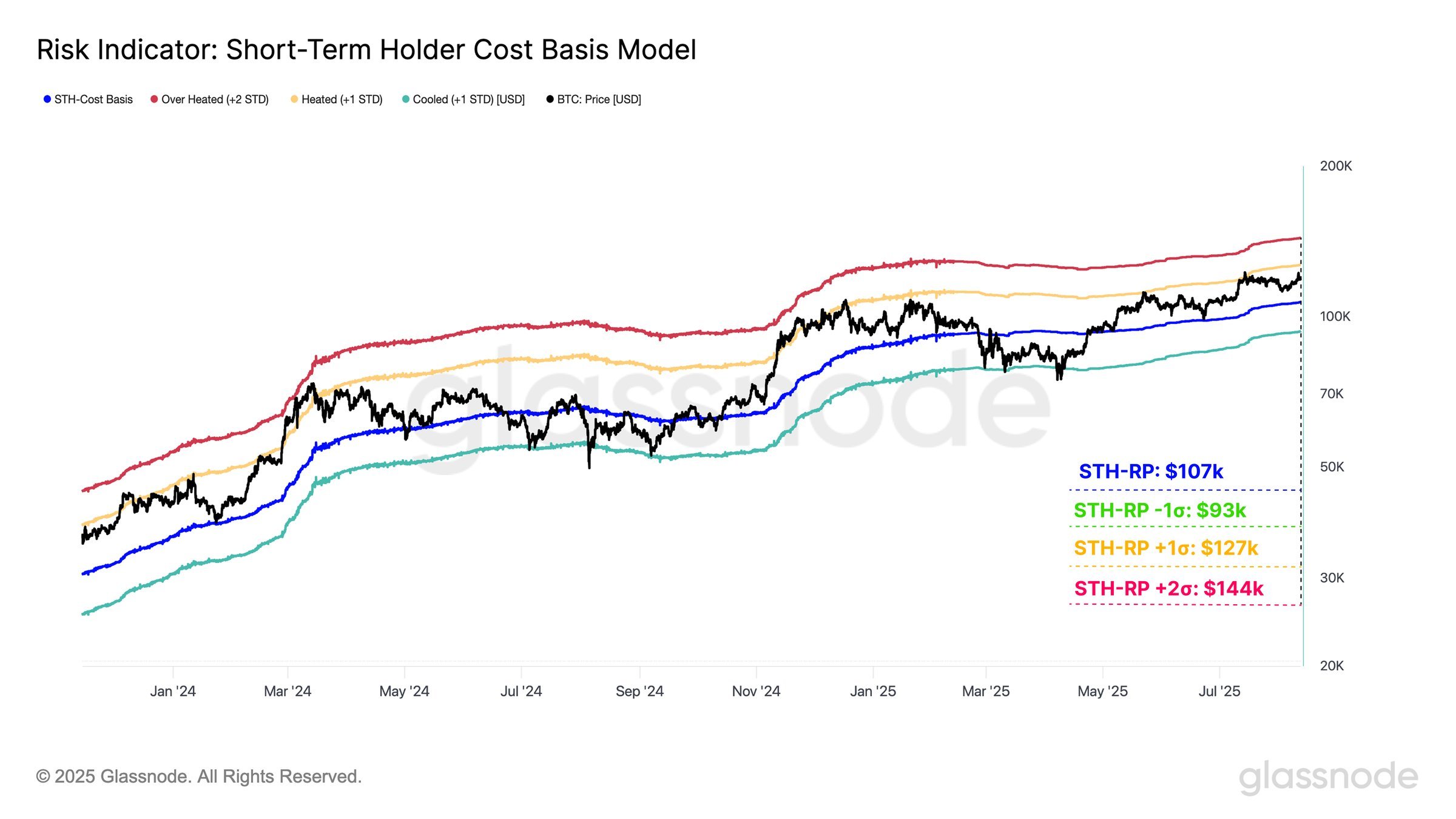
According to Glassnode data, the short-term holder realized price (STH RP) for Bitcoin (BTC) currently sits at $107,000, which represents the average on-chain acquisition price of Bitcoin (BTC).
The STH RP +1σ level is at $127,000, and it is a major key resistance for Bitcoin to surmount, with a breakout opening the path to $144,000, which coincides with the short-term holder realized price +2σ, a level where prior market tops saw increased selling pressure. Short-term holder realized price standard deviation bands +1σ and +2σ coincide with heated and overheated zones, respectively.
Bitcoin has not yet reached these levels, suggesting that the current rally might still have room to run.
Fed signals closely watched
Federal Reserve President Austan Goolsbee spoke on Friday about mixed inflation numbers, with the ongoing instability showing doubts for reduced rates.
The Fed’s annual meeting of the world’s central bankers in Jackson Hole, Wyoming, from Aug. 21-23, has historically been used for the Fed to signal policy shifts and will be watched closely by investors next week.
Markets expect the FOMC to vote to decrease the benchmark federal funds rate by a quarter percentage point in September, from 4.25% to 4.50%. However, there are concerns about what happens next, with 55% odds of another cut in October and only a 43% chance of a third move in December.
Disclaimer: The content of this article solely reflects the author's opinion and does not represent the platform in any capacity. This article is not intended to serve as a reference for making investment decisions.
You may also like
Federal Reserve Beige Book Warns of "Fierce" Oil Prices: Half of Districts Face Strong or Intensifying Price Pressures, Businesses Confront Price Increases and Profit Squeeze
The Beige Book shows that all 12 Federal Reserve districts reported the impact of rising oil prices. Businesses generally indicated that high diesel prices and fuel surcharges are passing additional costs down the entire supply chain. Since the previous Beige Book report just over a month ago, the U.S. economy has experienced moderate growth, with manufacturing serving as the main support. The labor market continues to see low hiring and low layoffs, and firms in nearly half the districts reported that AI investment is impacting employment.
Crypto market wipes out over $42 billion amid sticky U.S. inflation

Shiba Inu Forms First 4-Hour Death Cross Setup in October: Potential Scenarios
Crypto prices
More


