
Non-USD Stablecoins Surge with Rising Markets and Local Adoption

Non-USD stablecoins are booming in 2025, particularly in Brazil, powering crypto adoption with Polygon leading the blockchain market in this developing sector.
Non-USD stablecoins are a growing market in 2025, rebounding after a brief pause in March and April. These assets are powering genuine crypto adoption in several regions, which is often an elusive target.
Latin America, especially Brazil, is powering this trend, representing 55% of the total volume. Additionally, Polygon is by far the most popular blockchain, giving it a potential opportunity.
Non-USD Stablecoins on the Rise
Dollar-based stablecoins are highly prominent for obvious reasons; they represent the largest token platforms. President Trump even wants to include them in US fiscal policy, prompting new integrations.
Still, non-USD stablecoins have also been growing, and some new analysis illustrates this:
Non-USD stablecoins aren’t just a side story anymore.From Q4 2024 to August 2025, 23 different non-USD stablecoins across Southeast Asia, LATAM, and Africa pushed 20k+ weekly transactions, with peaks above 60k in early 2025.> The biggest drivers: SGD- and BRL-pegged… pic.twitter.com/cxMgHmP8u1
— Shann³ (@shannholmberg) August 25, 2025
Stablecoins based on the Euro have drawn a lot of attention and partnerships, especially due to MiCA regulations. Asia, too, has been growing as a region, and China is even considering a new stablecoin despite its anti-crypto policies.
Latin America, however, is currently the biggest adopter of non-USD stablecoins, thanks to Brazil leading the way.
On-chain data shows that non-USD stablecoins grew consistently in H1 2025; 23 such assets enjoy more than 20,000 weekly transactions. Latin America represents 55% of this entire market, representing more activity than Southeast Asia and Africa combined.
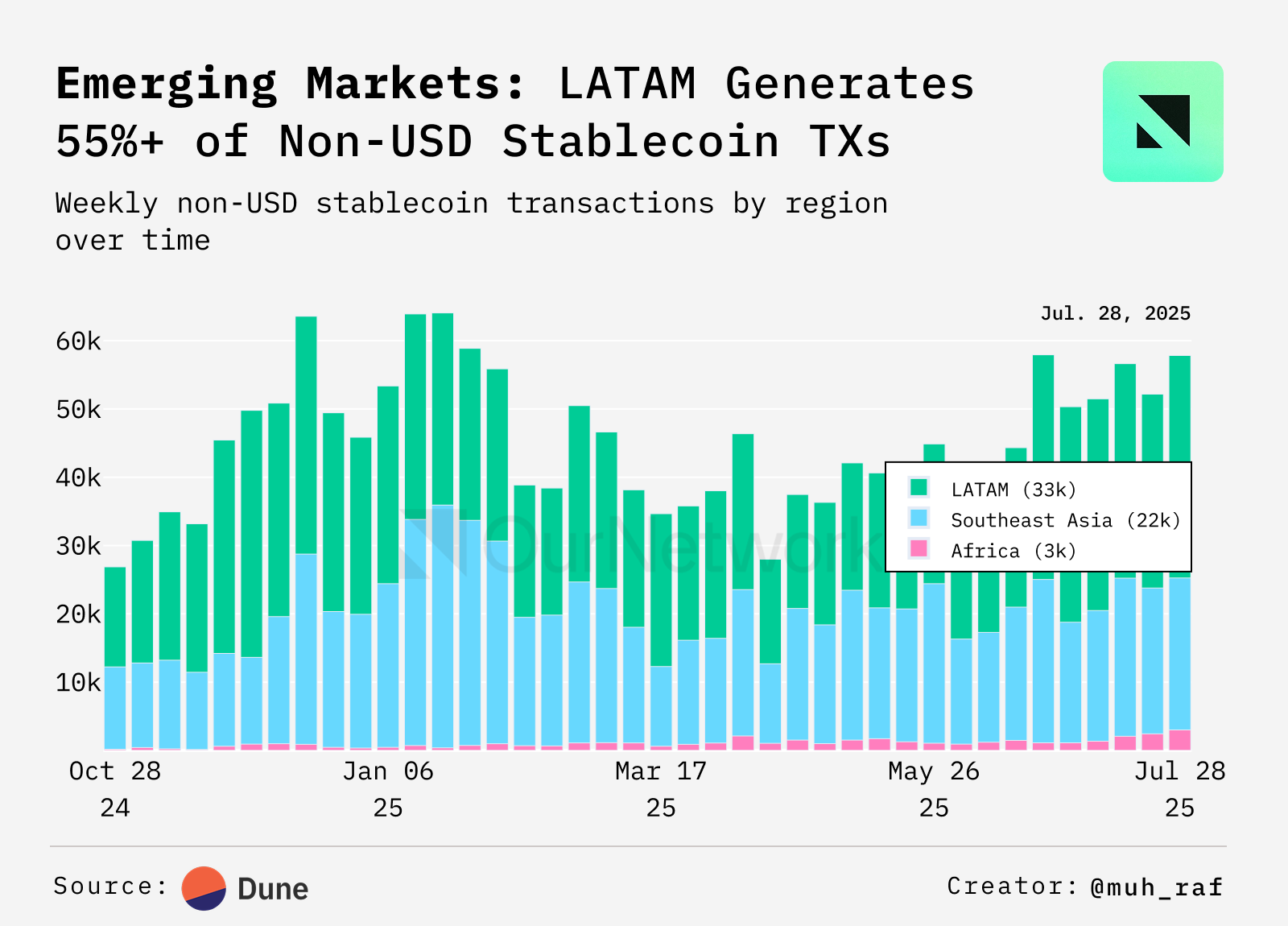 Non-USD Stablecoins in Developing Markets. Source:
ournetwork.xyz
Non-USD Stablecoins in Developing Markets. Source:
ournetwork.xyz
Multiple New Potential Opportunities
Additionally, Polygon is the preferred blockchain for these non-USD stablecoins, representing a whopping 70% of this market. For most of the last year, it has hosted more than 4,000 active addresses every week, blowing competitors like Base, BNB, and Ethereum out of the water.
If the market keeps growing, this niche could significantly boost Polygon.
There are some key reasons why this bullish scenario might play out. Over the years, the crypto community has put a lot of hope on practical use cases like cross-border remittance payments. Major cryptocurrencies like Bitcoin and Ethereum have transformed into store-of-value assets, rather than payment methods.
Although outreach programs repeatedly try to encourage local BTC adoption, regular usage remains low even in the most pro-crypto jurisdictions. Non-USD stablecoins, however, may have an advantage here.
These assets can’t have speculative value, and conducting everyday payments in local currency may be more practical than converting to USD.
Additionally, they take better advantage of crypto’s decentralized capabilities, bucking the overwhelming centralization trend in today’s market.
Still, compared to the gargantuan size of platforms like Tether and Circle, 20,000 weekly transactions seem very small. Non-USD stablecoins have a long way to go if they’re going to impact the broader markets.
However, this niche use case is powering practical adoption, which may give it a distinct advantage in the long run.
Disclaimer: The content of this article solely reflects the author's opinion and does not represent the platform in any capacity. This article is not intended to serve as a reference for making investment decisions.
You may also like
Will Bitmine outperform expected crypto bull market after acquiring another 12,532 ETH?

The Reserve Bank of India’s Efforts to Save the Rupee Deplete Reserves: $50 Billion Plunge in Forex Holdings, $200 Billion Forward Dollar Liabilities Become a Ticking Time Bomb
Foreign investors have made net sales of $31 billion in Indian stocks this year, and administrative controls are accelerating hedging demand towards the offshore NDF market, with the effectiveness of interventions continuously diminishing. The most critical risk lies in the fact that the yield spread between Indian and US 10-year government bonds has sharply dropped from 600 basis points in 2013 to just 200 basis points, with the traditional interest rate defense line nearly breached. India faces a dilemma: persisting on the current path will exhaust policy space, while relying on rate hikes to rebuild the yield spread would directly stifle economic growth.

As Starlink challenges telecom operators' pricing power, AT&T (T.US) sells its Mexico business for $2 billion, shifting focus to AI connectivity demand.
AT&T has agreed to sell its Mexico operations to Televisa and Fintech for $2 billion. The transaction is expected to be completed in the first quarter of 2027, pending approval from Mexican regulators.


Crypto prices
More


