
"Investor Confidence Drives MANTRA's $25M Token Buyback Signal"
- MANTRA initiates $25M OM token buyback, part of a $45M plan to boost institutional confidence in its RWA ecosystem. - Tokens will be transparently repurchased, staked on MANTRA Chain, and their addresses publicly disclosed via the OM dashboard. - The program targets ~10% of circulating supply, aligning with token scarcity goals and following Dubai's VASP license approval. - Complementing a $108M RWA fund, the buyback reinforces MANTRA's strategy to stabilize price dynamics and attract institutional liqui
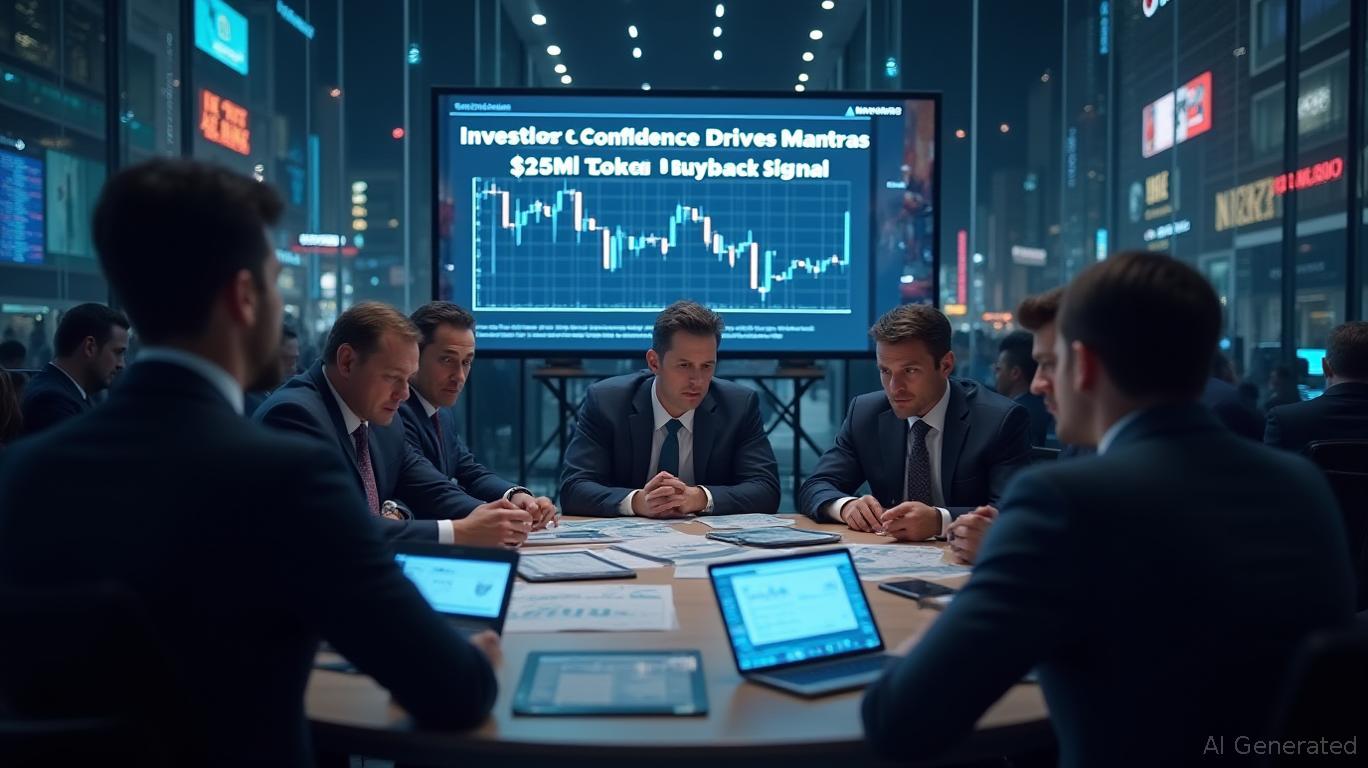
MANTRA has launched a strategic OM token buyback initiative, with an initial commitment of $25 million, backed by key investors and stakeholders. This move marks the beginning of a broader $45 million buyback plan, following Inveniam's recent $20 million investment into the project. The initiative aims to reinforce institutional confidence in MANTRA's real-world asset (RWA) ecosystem and demonstrate long-term belief in the utility and value of the OM token.
The buyback will be executed transparently over several months, with MANTRA AG—wholly owned by the MANTRA Chain Association—leading the effort. The company plans to place recurring buy orders at or near current market prices through reputable independent trading firms across public centralized exchanges. Once acquired, the OM tokens will be withdrawn as ERC20 tokens, migrated to the MANTRA Chain mainnet, and staked within the network's validator set. Wallet addresses storing the repurchased and staked tokens will be published via the OM token dashboard to ensure full transparency.
At current valuation, the buyback program is estimated to repurchase approximately 110 million OM tokens, representing around 10% of the token’s circulating supply. This initiative aligns with MANTRA’s broader strategy to enhance token scarcity, stabilize price dynamics, and reward long-term holders. The CEO and Founder of MANTRA, John Patrick Mullin, emphasized that the program is not merely a financial maneuver but a strategic signal of confidence from the project’s core stakeholders.
MANTRA has positioned itself as a purpose-built layer 1 blockchain for real-world asset tokenization, designed to comply with global regulatory frameworks. The platform recently obtained a Virtual Asset Service Provider (VASP) license from Dubai’s Virtual Assets Regulatory Authority (VARA), allowing it to operate as a virtual asset exchange and offer broker-dealer and investment management services. This regulatory milestone underscores MANTRA’s commitment to institutional-grade compliance and interoperability in the evolving RWA space.
The OM token, which serves as the native governance and utility token of the MANTRA ecosystem, has seen significant price volatility over the past year. As of August 2025, the token’s market capitalization stands at approximately $254.79 million, with a circulating supply of 1.1 billion OM tokens. The buyback announcement follows a period of mixed performance for the token, including a recent 46% price increase attributed to renewed investor interest and strategic institutional support.
MANTRA’s tokenomics model includes periodic token burns, which further aim to control supply and sustain token value. The company has also announced plans to launch a $108 million RWA fund to accelerate the tokenization of real-world assets, further strengthening its ecosystem. This initiative is expected to attract more institutional participation and deepen liquidity within the platform.
Progress on the buyback program will be shared periodically via MANTRA’s X account, and stakeholders are encouraged to monitor developments closely. The transparent execution of this buyback aligns with MANTRA’s broader governance model, which emphasizes community involvement and decentralized decision-making.
Source:
Disclaimer: The content of this article solely reflects the author's opinion and does not represent the platform in any capacity. This article is not intended to serve as a reference for making investment decisions.
You may also like
As tech stocks plummet, Goldman Sachs issued a bullish report on US stocks, but after reading it, people became even more worried...
Goldman Sachs strategist Tony Pasquariello released a bullish report, stating that market breadth is "not as bad as reported." However, the report references the internet bubble twice for comparison. Behind the tactical bullishness lie multiple concerns such as slowing profits, a surge in stock supply, and quarterly crowded positions among the "Magnificent Seven."
Apple (AAPL.US) launches wall-mounted hub HomeView to enter the smart home market; analysts: may generate new income for the services segment
Apple launches a wall-mounted hub to enter the smart home market. Analysts say it may bring new revenue to the services segment, and a paid Siri AI is on the horizon.
U.S. IPO Preview|Primagrove: Soaring Performance with a 17-Fold Increase, but the $17,000 Cash Pool Raises Concerns
From software outsourcing to integrated software and hardware.
60% of stocks have fallen into a bear market, the seven tech giants are holding up the S&P alone! BTIG: US stocks may be just a "gentle push" away from collapsing
The S&P 500 is just one step away from its all-time high, but under the surface, turbulence is brewing: 60% of its components have already entered a technical bear market, and only 30% have outperformed the index, the lowest since 1991. All of this is being supported solely by the seven major tech giants—which is, in fact, the biggest risk. With crowded positions and the semiconductor sector mirroring the path of the 2000 bubble burst, an accelerated decline could be triggered during the upcoming earnings season at the end of the month. When the market is standing on just one final leg, it doesn't take much force to topple it.

Crypto prices
More


