
Solana Treasuries Are Growing—But They’re Hardly Staking Any SOL

Most Solana DAT firms are barely staking their $1.73 billion in holdings, raising questions on strategy while Ethereum offers key lessons.
A new tracker of Solana DAT (digital asset treasury) firms shows a startling data point. These corporate holders are barely staking any SOL. The 13 firms that control over $1.73 billion in tokens are only staking around 7% of it.
ETH treasuries show that staking can provide much-needed solutions and new risks. Only two SOL firms are staking significant holdings, so their performance could be a useful market barometer.
Most DATs Won’t Stake Solana
Solana DATs are very trendy right now; in the last week, three firms announced plans to buy $1 billion SOL, and another company’s stock jumped after a $400 million treasury investment plan.
With this kind of acquisition, Strategic SOL Reserve has been building a tracker to assess these companies’ holdings and behaviors:
— Solana Reserve (@ReserveSolana) August 26, 2025
MAJOR UPDATE: 3 new institutional listings = 2.18M+ SOL tracked!
New verification sources⁰
Complete stock price history & charts⁰
Leadership profiles w/ career backgrounds⁰
Historical SOL purchase dataThe data is getting REAL.
pic.twitter.com/sbdRg1blCk
This tool isn’t exhaustive, but it’s currently observing 13 private SOL holders that collectively represent 1.44% of the entire token supply.
In collecting this data, the project discovered an interesting data point: these DATs are barely staking any of their Solana. Despite holding $1.73 billion in SOL, less than 7% of that is currently being staked.
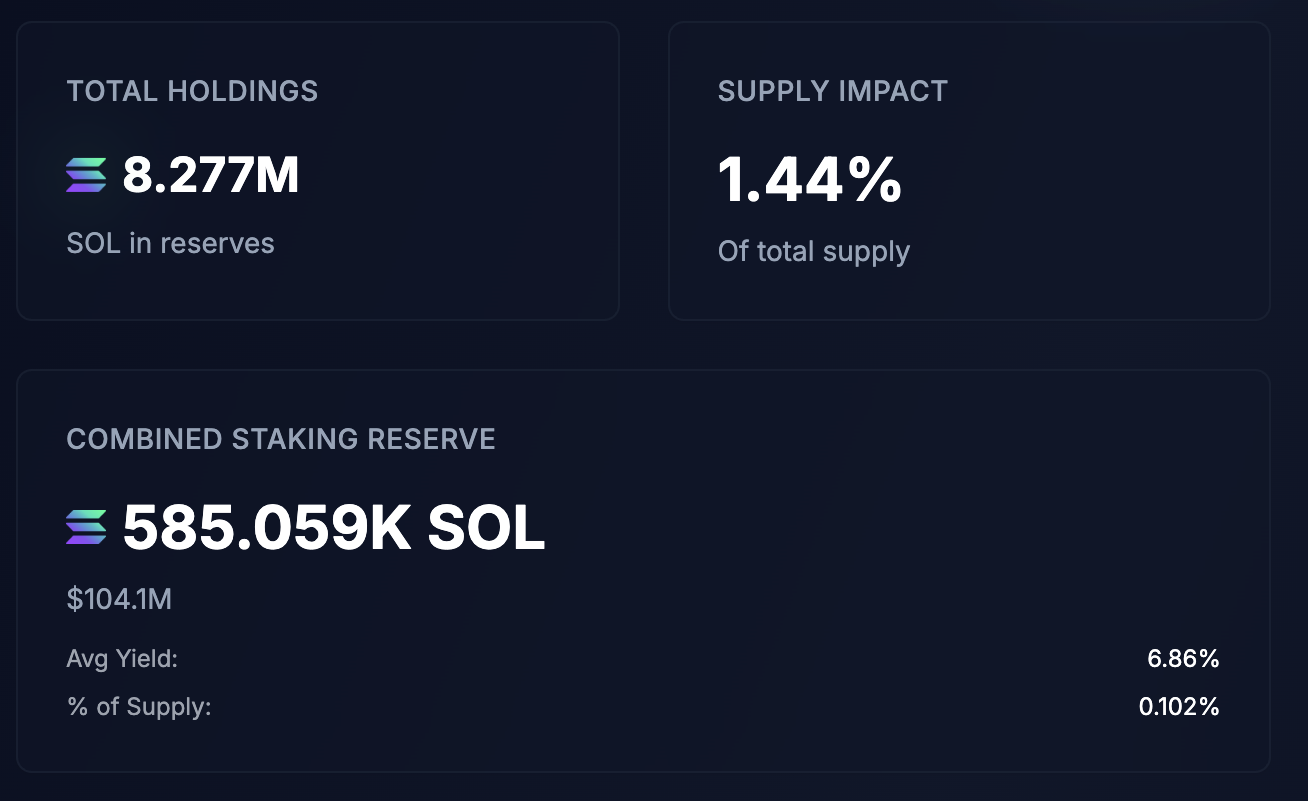 Solana DAT Staking. Source:
Strategic SOL Reserve
Solana DAT Staking. Source:
Strategic SOL Reserve
Moreover, only 2 of the 13 tracked DATs are staking any Solana at all. Both these companies, DeFi Development and SOL Strategies, began purchasing Solana well before corporate acquisition became a trend.
SOL Strategies began making purchases over a year ago, and it’s staking a huge share of its holdings.
So, why aren’t the other nine firms staking any Solana? Are they missing a huge opportunity, or is this a sensible business plan?
Comparisons With Ethereum
To gather more data, it might be useful to compare the token with Ethereum, which is seeing a huge influx of DAT staking.
On one hand, staking can alleviate some of the fundamental problems with a DAT strategy. An asset treasury needs constant cash inflows to buy more tokens, but they frequently fundraise exclusively via stock offerings.
Too many rounds of this can cause shareholder dilution worries, and this recently caused problems for ETHZilla. Staking generates passive income, which could ease this concern.
If DATs can raise funds through other methods, it’d give them more leeway to act freely. But this isn’t a risk-free proposition. Over the last few months, minor price changes have triggered major unstaking surges that ETH couldn’t handle.
Its blockchain wasn’t built for this corporate-level staking action, so technical congestion can mix with sell pressure and create a dangerous situation.
So, if token staking has pros and cons, what can Solana DATs learn from this? For the moment, the two biggest DAT stakers can serve as critical bellwethers.
However, these companies’ dealings with shareholder dilution or price downturns can inform the rest of the market.
That second issue, at least, should provide lots of data. Just yesterday, massive DAT acquisitions didn’t stop SOL from sliding 10%. Cryptoassets are very volatile, and Solana treasuries will need to tailor their staking plans accordingly.
For now, observers have trends to study before they decide if this plan is worthwhile.
Disclaimer: The content of this article solely reflects the author's opinion and does not represent the platform in any capacity. This article is not intended to serve as a reference for making investment decisions.
You may also like
As tech stocks plummet, Goldman Sachs issued a bullish report on US stocks, but after reading it, people became even more worried...
Goldman Sachs strategist Tony Pasquariello released a bullish report, stating that market breadth is "not as bad as reported." However, the report references the internet bubble twice for comparison. Behind the tactical bullishness lie multiple concerns such as slowing profits, a surge in stock supply, and quarterly crowded positions among the "Magnificent Seven."
Apple (AAPL.US) launches wall-mounted hub HomeView to enter the smart home market; analysts: may generate new income for the services segment
Apple launches a wall-mounted hub to enter the smart home market. Analysts say it may bring new revenue to the services segment, and a paid Siri AI is on the horizon.
U.S. IPO Preview|Primagrove: Soaring Performance with a 17-Fold Increase, but the $17,000 Cash Pool Raises Concerns
From software outsourcing to integrated software and hardware.
60% of stocks have fallen into a bear market, the seven tech giants are holding up the S&P alone! BTIG: US stocks may be just a "gentle push" away from collapsing
The S&P 500 is just one step away from its all-time high, but under the surface, turbulence is brewing: 60% of its components have already entered a technical bear market, and only 30% have outperformed the index, the lowest since 1991. All of this is being supported solely by the seven major tech giants—which is, in fact, the biggest risk. With crowded positions and the semiconductor sector mirroring the path of the 2000 bubble burst, an accelerated decline could be triggered during the upcoming earnings season at the end of the month. When the market is standing on just one final leg, it doesn't take much force to topple it.

Crypto prices
More


