
Sony’s Soneium Score Transforms On-Chain Actions Into Rewards

- Soneium Score rewards consistent blockchain use by turning activity into loyalty points.
- Leaderboards and Soulbound badges give users recognition for reaching higher scores.
- Projects gain a pool of actively engaged users, boosting retention and participation.
Sony’s Soneium blockchain has introduced Soneium Score, an Ethereum Layer 2 system that converts daily blockchain activity into gamified loyalty points. The initiative seeks to create an identity framework where on-chain participation is continuously recorded, tracked, and rewarded, reshaping how user engagement is measured across decentralized ecosystems.
Every onchain action should count
— Soneium
That’s why we built Soneium Score, a new way to reward your proof of contributions across the entire Soneium ecosystem.
One score. Multiple ways to earn.
Let’s understand how you can evolve your score(@soneium)


The proof-of-contribution model records regular actions, including staking, token swaps, and NFT minting, and allocates them with quantifiable points. Participation is recorded cumulatively on Soneium, but projects must integrate the system to verify users and award points.
By directly linking loyalty to blockchain actions, Sony is moving toward a future where consistent user activity becomes transparent, verifiable engagement within its digital ecosystem. This step raises a pivotal question: Can tokenised loyalty programmes redefine how corporations retain digital audiences across platforms?
Scoring System
Soneium Score measures engagement in four categories. Activity Score is awarded on frequent transactions and includes streaks of 28 days per season. The Liquidity Score is a reflection of protocols’ contributions to total value locked (TVL). NFT Score will award 12 to 18 points for holding approved collections. Lastly, the bonus score provides add-on points for rotating partner projects, which guarantees changing chances of involvement.
Contributors all play on seasonal leaderboards, and completing more than 80 points earns a Soulbound Token (SBT) badge. These non-transferable tokens leave permanent marks on the wallets of clients and can be viewed on OpenSea as a sign of present activity. Such SBTs may be reused later by developers to access control, curate projects, or other ecosystem incentives.
Authentic Engagement and Ecosystem Growth
Sony has identified the issues that Soneium Score aims to resolve in two main points. To begin with, actions such as swaps or staking rarely establish a continuity of transactions on blockchain ecosystems, resulting in an absence of persistent identity. To add to this, new ventures face an uphill battle in attracting loyal users without the use of overly complex incentives or technical hurdles.
The platform is incentivized to keep the user active and gives the developer a pool of actively engaged users by merging identity and activity. The system has better chances of being adopted in the future as an invaluable infrastructure tool within blockchain communities.
The initial phase of the program centres on Soneium’s internal ecosystem, including gaming, DeFi, and NFTs. Sony has, however, indicated their interest in future cross-chain integrations, which could facilitate greater reputation portability should the community’s interest persist.
Related:
Financial Metrics and Market Performance
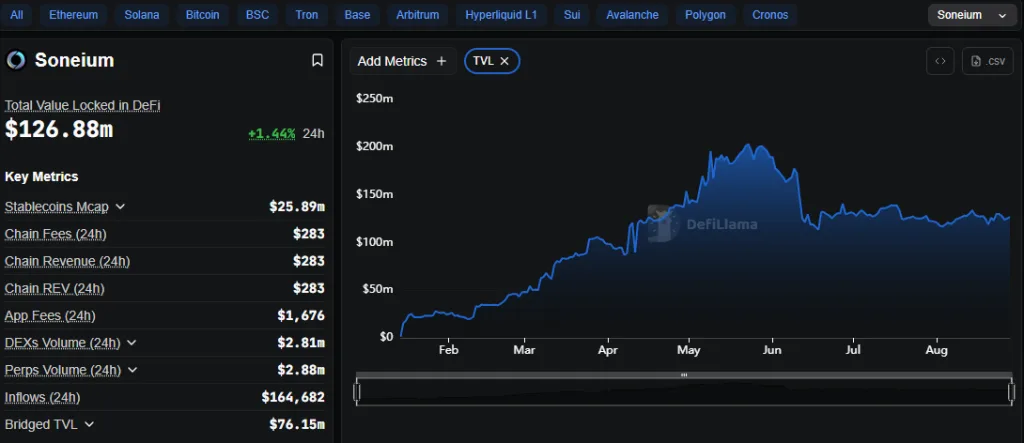
Current figures highlight Soneium’s resilience despite recent consolidation. The network’s total value locked stands at $126.88 million, a 1.46% increase in 24 hours. Its stablecoin market cap remains at $25.89 million, while chain fees and revenue both register $283 daily.
 Source:
DefiLlama
Source:
DefiLlama
Application fees stand at $1,676, DEX volume stands at $2.81, and perpetual volume stands at $2.88 million. The inflows are at $164.68K, which is backed by $76.15 million bridged TVL.
According to charts, the growth has been strongly observed since the beginning of 2025, with TVL values rising to over $200 million in May and then moderating. The liquidity and user participation are stable despite decreases, indicating a stable ecosystem demographic and well-established community interaction.
Disclaimer: The content of this article solely reflects the author's opinion and does not represent the platform in any capacity. This article is not intended to serve as a reference for making investment decisions.
You may also like
Risks to Middle Eastern energy facilities escalate as Saudi Aramco headquarters reportedly hit and set on fire by Houthi forces
According to reports, during a missile attack launched by Yemen's Houthi forces against Saudi Arabia on Tuesday, the headquarters of Saudi Aramco in Dhahran was hit, causing a fire in part of the complex, which was later extinguished. It could not be confirmed whether the fire was caused by a direct missile hit. The Saudi government and Saudi Aramco have not confirmed reports of an attack on the headquarters.

Metals weaken as front-end yields, Hormuz risk offset softer dollar - Kitco PM Report
Siri AI integration: Apple bets on new smart home entry! First display “brain” HomeView debuts, complete smart home accessory set unveiled
The HomeView is priced at $299, featuring a 7-inch square screen and powered by the A18 chip. It comes in both desktop and wall-mounted versions, supports facial recognition linked to Siri AI, and can recognize up to six users. It will not be released in the EU for now, as Siri AI is not available locally. Apple has teamed up with LG and Schneider to launch an Apple Home Collection smart home accessory series, including indoor and outdoor floodlight cameras, video doorbells, thermostats, and door locks. The new generation Apple TV 4K is equipped with the A19 chip, supports Siri AI voice interaction, and is priced at $299. The second-generation HomePod mini is priced at $149, featuring new interactive lighting effects, with both products seeing price increases from previous models. Analysts are optimistic about Apple’s opportunities in expanding its home business, while the foldable iPhone set to begin pre-sale on Friday remains the recent highlight.
Crypto prices
More


