
JPMorgan Says Bitcoin Is Undervalued: Could It Hit $126,000?

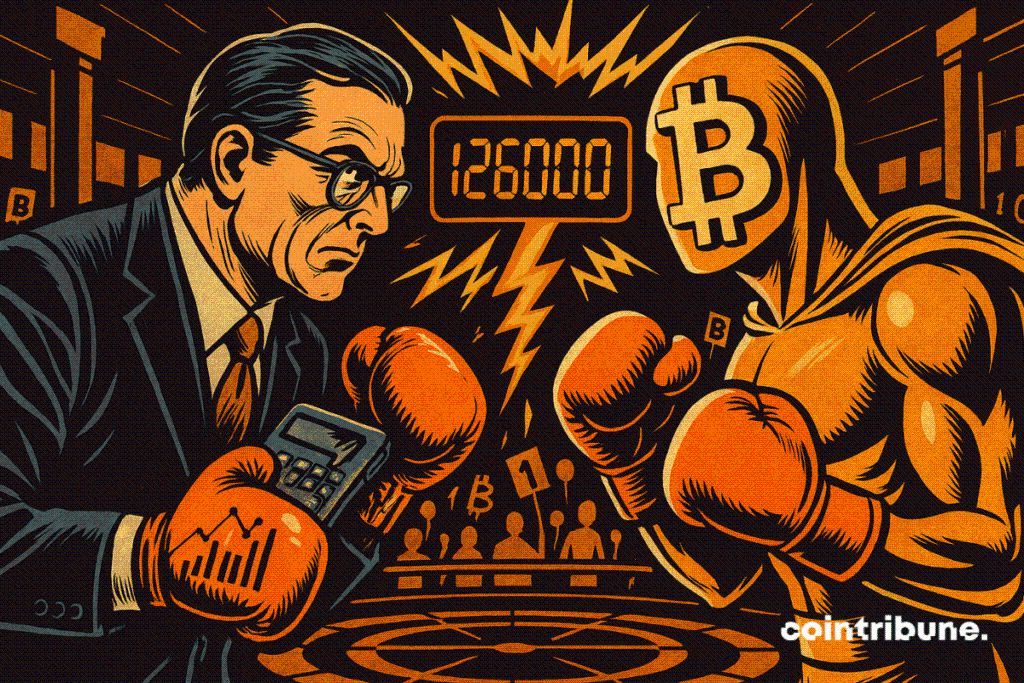
Bitcoin is currently undervalued according to JPMorgan. In a note signed by analyst Nikolaos Panigirtzoglou, the American bank estimates that BTC should reach 126,000 dollars by the end of the year, given its historically low volatility. As its risk-return profile approaches that of gold, bitcoin may be entering the most critical phase of its institutional adoption. This is a projection full of meaning for major capital allocators.
In brief
- JPMorgan estimates that bitcoin is currently undervalued compared to gold, due to historically low volatility.
- Bank analysts, led by Nikolaos Panigirtzoglou, set the “fair value” of BTC at 126,000 dollars by the end of this year.
- The drop in volatility makes bitcoin more compatible with capital allocation strategies of institutions.
- The volatility ratio between bitcoin and gold reaches a record level, reinforcing the comparison between the two assets.
A historically low level of volatility, catalyst for a reassessment
While its Bull run continues , JPMorgan analysts led by Nikolaos Panigirtzoglou believe that the current price of bitcoin is too low compared to gold, given the spectacular drop in its volatility.
According to them, bitcoin has seen its annual volatility drop from nearly 60% at the beginning of the year to about 30% today, a historic floor. This significant decline constitutes, according to the bank, a fundamental element in the reassessment of the asset.
“Yes, this is precisely the projection we presented in our note, which we expect to reach by the end of the year”, specified Panigirtzoglou, referring to their target of 126,000 $ by the end of the year.
In their analysis, JPMorgan experts emphasize the growing convergence between bitcoin and gold regarding the risk/return profile. This transformation is based on several key elements:
- The bitcoin/gold volatility ratio has fallen to 2.0, its lowest level ever recorded, which means that BTC consumes twice as much risk capital as gold in an institutional allocation;
- The volatility-adjusted valuation model indicates a “fair value” of $126,000 for bitcoin, if one wants to align its weight with private global investments in gold (estimated at about 5,000 billion dollars);
- Bitcoin’s total capitalization should grow by about 13% to reach this target.
This technical reading provides a tangible framework for JPMorgan’s projection, while highlighting a profound change in the perception of bitcoin within traditional finance.
Pressure is rising among corporate treasurers
Beyond the mere drop in volatility, JPMorgan reveals another key phenomenon in bitcoin’s bullish trajectory: the growing appetite of corporate treasuries for the asset. Now, more than 6% of the total BTC supply is held by public companies, a phenomenon that plays a central role in market stabilization.
Analysts compare this dynamic to what was observed after the 2008 crisis, when central banks’ quantitative easing neutralized bond market movements by absorbing a massive share of securities. “Accumulation by companies works the same way on the bitcoin market”, analysts say, referring to a “passive lock-up” effect of the available supply.
This movement is amplified by the domino effect of inclusions in global stock indices, a factor often overlooked but crucial. The addition of Strategy by Michael Saylor to several major benchmarks generated new passive flows, while Metaplanet, recently promoted to mid-cap status in the FTSE Russell indices, joined the FTSE All-World Index, triggering automated purchases.
Furthermore, KindlyMD, a Nasdaq-listed company, has just filed to raise up to 5 billion dollars, with a strategy firmly focused on bitcoin as the primary cash reserve. Finally, Adam Back and his company BSTR aim to compete with Marathon Digital to become the second-largest corporate holder of BTC, behind Strategy.
All these dynamics outline the contours of a structural change in bitcoin’s role in business. This rush to strategic accumulation, coupled with falling volatility, strengthens the argument that bitcoin is no longer just a speculative asset but a full-fledged balance sheet management tool. If this trend intensifies, companies could well become the arbiters of the next bullish cycle, a profound shift in the crypto market with its 4,000 billion $ capitalization , with long-term implications for its valuation, liquidity, and integration into global portfolios.
Disclaimer: The content of this article solely reflects the author's opinion and does not represent the platform in any capacity. This article is not intended to serve as a reference for making investment decisions.
You may also like
XRP Weekly Chart Blue Lines Point to These Long-Term Price Targets
The 10-year US Treasury yield approaches 5.4%, with the AI halo unable to hide the "inflated" risks of the S&P 500
Behind the S&P 500's record high, only 30% of its constituent stocks are above their 50-day moving average, marking the narrowest market breadth at a record high since 1990. The Russell 2000 has fallen for five consecutive weeks, and high-yield bond yields have soared to 15%. Societe Generale warns that if US Treasury yields rise to 6% and oil prices reach $150, the S&P 500 could fall by more than 20% next year. In addition, some top-performing fund managers have completely exited AI stocks in favor of energy, stating that once financing dries up, it will be "game over."
Oil tanker freight reaches a sixty-year high: shipping oil from the US to China is more expensive than launching a rocket!
The freight for a single barrel of crude oil has soared to $41, approaching half the oil price, and for a single trip, the freight was once enough to buy an oil tanker. The Middle East crisis has led to a structural shortage of shipping capacity in the Strait of Hormuz, coupled with ship-to-ship transfers extending turnaround times. VLCC freight rates have skyrocketed from an annual average of $9.2 million to $77 million—an increase of more than eight times. Refiners’ profits are being rapidly eroded, the average price of second-hand oil tankers has reached a historic high, and, unusually, surpassed the price of new vessels.

Following the Drop but Not the Rise! Silver Trapped in Difficulties
The logic of AI and solar energy demand continues to play out, yet prices are falling against the trend—macroeconomic forces such as a strengthening US dollar and rising real interest rates have completely suppressed fundamentals. Speculative funds offloaded $1.6 billion in a single week, marking a yearly peak, while CTA net short positions reversed by $2.6 billion to the highest level this year. However, Goldman Sachs analysts believe that the extreme short positioning itself is building reversal momentum, highlighting an asymmetry; once macro headwinds subside, a retaliatory rebound could be easily triggered. After a similar shakeout last time, silver surged 15% in six weeks.
Crypto prices
More


