
Tether’s grip on stablecoins slips below 60% for first time since 2023

USDT dominance is eroding as Circle and other stablecoin competitors fight for a share of the pie.
- USDT dominance fell below 60% for the first time since 2023
- Circle’s USDC is its primary competitor, nearing 30% dominance
- The passage of the US GENIUS Act is making the market more competitive
Competition among stablecoin issuers is growing. On Friday, August 29, USDT dominance fell to 59.45%, according to data from DeFiLlama. This was the first time the key figure fell to these levels since March 2023, indicating that Tether may be losing its grip on the market.
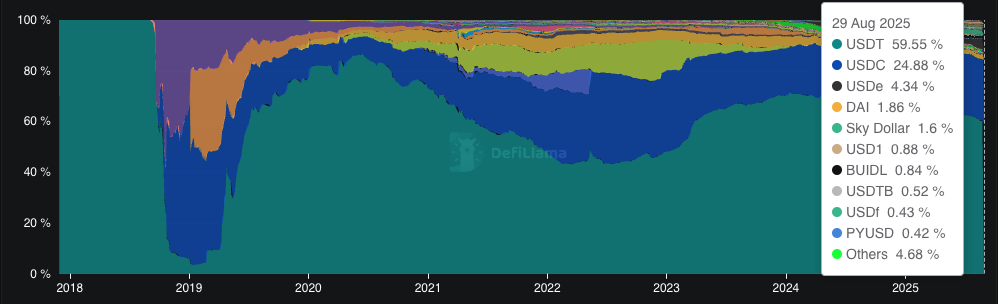
Notably, in the first half of 2024, USDT dominance hovered around 70%. At the same time, Tether’s main competitor, Circle’s USDC, controlled just 18% of the market, a figure which is now close to 30%. On the other hand, DAI’s dominance fell in that period, from around 3.5% to its current level of 1.86%.
One standout performer this year is Ethena’s USDe. Launched in December 2024, already reached 4.34% in dominance and a market cap of $12.275 billion. On the other hand, Trump World Liberty Financial’s USD1 controls 0.88% of the market.
Tether faces regulatory issues in Europe, the U.S.
Tether is not just facing increased competition. With more countries issuing stricter rules on stablecoins, its USDT is at a disadvantage. So far, Tether has declined to comply with Europe’s MiCA stablecoin framework, leading to its delisting on major exchanges.
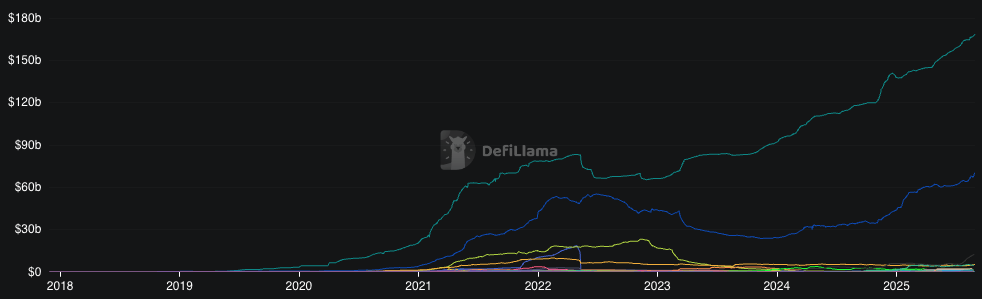
Tether may soon face the same issue in the United States, which recently passed the GENIUS Act, which requires more transparency from stablecoin issuers. Still, despite a shift in market positioning, major players, including Tether, are on the rise. Both USDT and USDC are at record levels, at $168.43 billion and $70.378 billion, respectively.
Disclaimer: The content of this article solely reflects the author's opinion and does not represent the platform in any capacity. This article is not intended to serve as a reference for making investment decisions.
You may also like
Neither a breakout nor a reversal: What OCBC, Commerzbank and ING expect from the US Dollar

Iran claims U.S. military forces have significantly withdrawn from sea, six ships attacked in Hormuz in one day, Houthi forces declare Saudi Aramco oil facilities as "legitimate targets"
The Iranian Navy Deputy Commander stated on Monday that U.S. military vessels, including destroyers and aircraft carriers, have significantly withdrawn. On the same day, the Iranian Foreign Ministry stated that Iran is reviewing the U.S. proposals, but the conditions for reopening the Strait of Hormuz remain unchanged. According to reports, with the rotation of U.S. aircraft carriers, only the USS Washington is currently deployed in the Middle East. As of last Sunday, a total of 24 vessels were attacked in the Strait of Hormuz and surrounding waters within two weeks, marking the most severe wave of incidents since the onset of the Iran conflict—far surpassing the previous two-week peak of 13 ships. Oil exports through the strait have dropped by more than 80% compared to the average daily level in September.


JPMorgan unleashes $1.5T push for US critical minerals
Crypto prices
More


