
Chicago mayor signs executive order to respond to crackdown threatened by Trump

On Saturday in August, Chicago Mayor Brandon Johnson signed an executive order prohibiting federal law enforcement officers from wearing masks or disguises; this move aims to counter President Donald Trump's threat to expand anti-crime operations to Chicago.
Trump called this Democrat-run city "a mess" and threatened to send the National Guard to the city to fight crime and clear homeless encampments, just as he did in Washington, D.C. Currently, federal agents have been conducting immigration raids in several cities across the United States, which has drawn strong criticism from Democratic mayors and governors.
Johnson stated that this new executive order is intended to protect the constitutional rights of Chicago residents, adding that the city will use all legal means to resist unilateral deployments by the federal government.
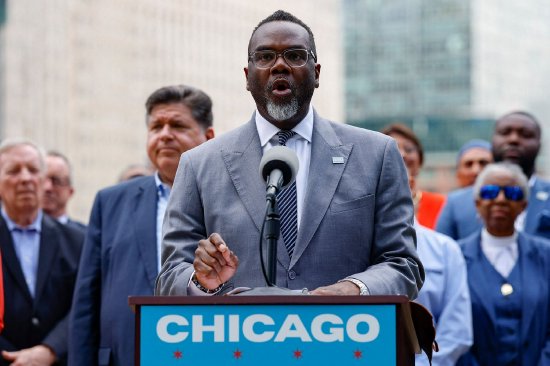
In a press statement, Johnson said: "We do not want to see military checkpoints or armored vehicles on our streets, nor do we want to see families torn apart. We will take all necessary actions to protect the rights of all Chicagoans."
Currently, Chicago's crime rate is on a downward trend. Police data shows that in the first half of this year, the number of homicides in the city dropped by 32% to 188 cases, the lowest level for the same period since 2014; violent crime cases fell by 23%, and vehicle theft cases dropped by 28%.
In addition, California lawmakers and Los Angeles County officials are considering new regulations to prohibit law enforcement officers (including federal immigration agents) from wearing masks. In June this year, Trump sent thousands of troops to the Los Angeles area to quell protests against the deportation of immigrants and to assist with raids by U.S. Immigration and Customs Enforcement.
Disclaimer: The content of this article solely reflects the author's opinion and does not represent the platform in any capacity. This article is not intended to serve as a reference for making investment decisions.
You may also like
Fed Voting Member Harker: Fighting Inflation Requires Faster, More Frequent Small Rate Adjustments, Be Vigilant Against Inflation Expectations Becoming Entrenched
Cleveland Federal Reserve President Loretta Mester believes that inflation pressures have spread beyond the energy sector, with AI investments and tariffs driving up costs. To prevent high inflation from becoming entrenched in the economy, she suggests that the Federal Reserve should consider smaller, quicker, and more frequent rate adjustments, rather than waiting for inflation pressures to accumulate and then taking larger actions. She did not explicitly support an interest rate hike in October, emphasizing policy transparency: explaining the response mechanism does not equate to committing to a specific rate path.
Will the US cancel 20-year Treasury bonds? BNP Paribas: It may trigger market panic; Citibank: Positioning 20-year bonds to outperform 10-year bonds
There are market rumors that the U.S. Treasury is considering cutting back or canceling the issuance of 20-year Treasury bonds, which were reinstated in 2020. The yield on 20-year bonds has long been higher than both 10-year and 30-year bonds, resulting in a "hump" in the yield curve and higher financing costs. The market is closely watching this Friday’s routine survey questionnaire, as well as whether a clear signal will be released in the quarterly refunding statement on November 4. Citi suggests positioning in advance, but BNP Paribas warns that such a move could be interpreted as a panic signal that policy tools have been exhausted.

Bitcoin price volatility accompanies a 6% drop as sentiment turns neutral
WF stock trades at $36, up 196.78%, with daily RSI at 97.86
Crypto prices
More


