
Fed to host Oct Summit on Stablecoins, DeFi, AI and Tokenization

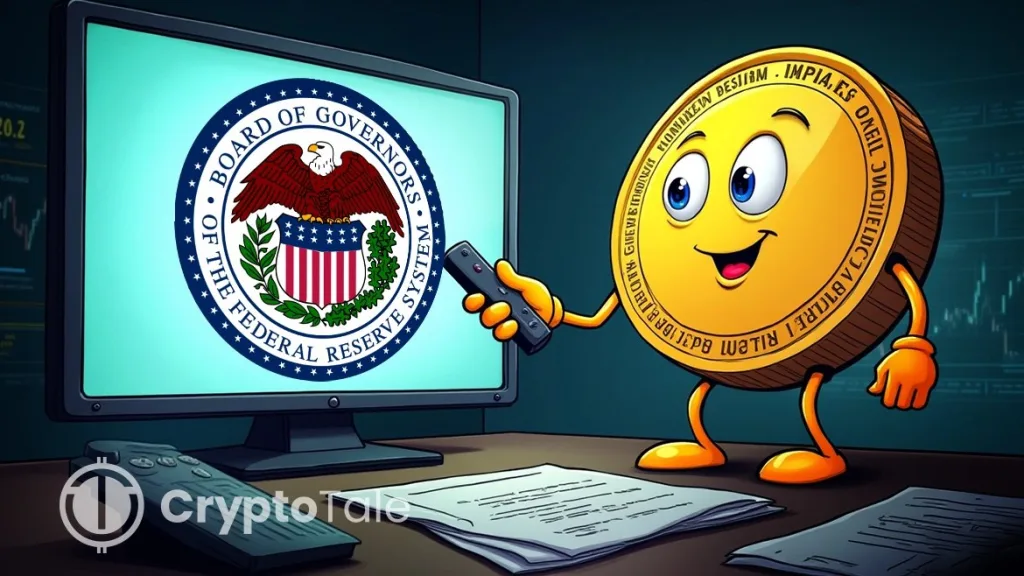
- Fed summit set for Oct 21 to spotlight stablecoins, tokenization, and AI in payments.
- Stablecoins now exceed $230B worldwide, pushing Fed to tighten oversight and debate risks.
- Event will unite regulators, banks, and tech leaders to shape the future of payments.
The U.S. Federal Reserve is going to host a big conference on October 21 on the future of payment innovations, with stablecoins at the center stage. The conference would bring together regulators, financial institutions, and technology leaders. The event was announced on Wednesday, and the Payments Innovation Conference would feature a panel discussion on stablecoin business models and developments in tokenization. It would also explore how artificial intelligence could be applied to payments.
The conference would also address the convergence of traditional and decentralized finance. All sessions would be offered live by livestream through the Fed’s website, with more program details to come soon.
Federal Reserve Governor Christopher J. Waller described the conference as part of the Fed’s ongoing effort to balance innovation with safety. He noted that payments have always adapted to changing consumer and business needs. However, he stressed that progress must not compromise stability. Waller said the Fed would be looking at both the opportunities and risks of emerging technology.
Stablecoin Growth, Regulation, and Fed’s Push
More than $283 billion worth of tokens are in circulation globally, with Tether’s USDT and Circle’s USDC leading the way. The tokens have surged on cryptocurrency markets and are becoming more popular as a way of bridging into mainstream finance. Policymakers believe faster payments have potential benefits but risks persist if stablecoins are used to displace banks or straighten out current financial infrastructure.
In July, Congress raised those stakes by passing the first federal stablecoin bill. The legislation provided greater clarity for banks to issue dollar-backed tokens. It was also a substantial shift in the way the U.S. has overseen digital assets. The October conference shows the Fed’s urgency about the need to respond to these regulatory shifts while considering the long-term role of stablecoins.
Fed Calls for Practical Approach to Blockchain and Stablecoins
Fed Vice Chair for Supervision Michelle Bowman has advocated for greater involvement with blockchain and digital assets. She proposed allowing Fed staff to hold small amounts of cryptocurrency in her speech on August 20 in Wyoming. Bowman argued that hands-on experience would enhance regulators’ understanding and aid in attracting top talent. She stressed that true insight comes through practical experience, not just theoretical knowledge.
An overly cautious approach could render the banking system less relevant, according to Fed officials. Regulators are encouraged to collaborate with industry leaders to better understand tokenized assets and blockchain technologies. Blockchain could reduce costs, speed up transfers, and simplify ownership processes.
The October conference is expected to further this important discussion. By targeting stablecoins, the Fed reflects its determination to grapple with challenges in one of the fastest-expanding areas of cryptocurrency. Regulation versus innovation would remain a focus.
Fed Scales Back Oversight of Banks’ Digital Asset Activities
The Fed has revised its approach to digital asset oversight by withdrawing supervisory letters. These letters previously required banks to notify regulators before engaging in stablecoin or crypto-related activities.
The Fed ended the Novel Activities Supervision Program, which tracked banks involved in stablecoin activities, crypto custody, lending, and fintech partnerships. This move marks a shift in regulatory approach. It reflects a continued relaxation of direct oversight over digital asset activities.
With the explosive growth of stablecoins, the October summit arrives at a critical time. Policymakers are faced with a dilemma to provide regulatory certainty without choking innovation. By convening regulators, banks, and technology leaders, the Fed seeks to direct the payments conversation. The conference could be instrumental in shaping the way digital assets are integrated into the mainstream financial system in the future.
Disclaimer: The content of this article solely reflects the author's opinion and does not represent the platform in any capacity. This article is not intended to serve as a reference for making investment decisions.
You may also like
XRP News Today : Ripple Expands Prime Brokerage Services for Brevan Howard
ROI - For the Trump-led Treasury, the "tail" of the auction is the most difficult part: McKeever
The views expressed in this article are solely those of the author, Reuters columnist Jamie McGeever. Reuters, Orlando, Florida, October 6 – U.S. Treasury auctions are typically dull, predictable, and not newsworthy. But these are not ordinary times, and the Trump administration now faces the risk of sluggish U.S. debt sales making headlines. The U.S. Treasury plans to issue nearly $120 billion in Treasuries this week, the first non-bill bond sales in two weeks: $58 billion in three-year notes on Tuesday, $39 billion in ten-year notes on Wednesday, and $22 billion in thirty-year bonds on Thursday. These auctions would usually be insignificant events, but due to the exceptionally weak performance of auctions from September 22 to 24—especially the five-year note auction on September 23, which triggered the largest spike in bond yields since April last year—they are attracting growing attention. Since then, yields have not only failed to retreat but have surged across most tenors to multi-decade highs. It's worth noting that the possibility of a U.S. Treasury auction "failing" is almost zero. Primary dealers—currently 26 Wall Street banks and institutions authorized by the New York Fed as market makers for Treasuries—are always involved. They effectively underwrite the sales, ensuring the smooth operation of the $30 trillion U.S. Treasury market, the most liquid market in the world. This, in turn, allows the entire global financial system to function, given that trillions of dollars in global debt, assets, and market derivatives are benchmarked against U.S. Treasuries. Treasuries are also the primary collateral for lubricating the financial “pipes” of the U.S. and global markets, including repo agreements, interbank loans, and financing. In short, as long as U.S. Treasuries remain the pillar of the global financial system, there will always be buyers at Treasury auctions. The question, as always, is at what price these bonds will be sold. Currently, borrowing costs in the secondary market are at their highest levels since the mid-2000s, so it's reasonable to expect that the Treasury will pay relatively high rates in the primary market as well. But as recent auctions have shown, negative surprises remain possible. "Too big to be absorbed by the market"? The $70 billion five-year auction on September 23 was among the most worrisome in years. Demand, as measured by the bid-to-cover ratio, was at a nine-year low. The Treasury ended up selling the notes at a yield of 5.033%, more than 3 basis points above the market yield at the close of bidding. Three basis points might not sound like much, but it's exceptional for a five-year note auction. This is the largest so-called "tail" since June 2022. According to JPMorgan analysts, the last time a five-year auction had a three-basis-point tail was back in 2011—amid the brewing debt ceiling crisis that eventually led to a U.S. credit rating downgrade in August that year. Currently, concerns over the U.S.'s daunting fiscal outlook are driving up long-term borrowing costs. As a result, markets generally expect the Trump administration to gradually shift the Treasury’s massive funding needs toward the lower-yield (and therefore lower-cost) short- and medium-term segments of the curve. That's why the five-year note auction two weeks ago sparked such concern. A three-basis-point tail is common in long bond auctions, but not in the "belly" of the yield curve. If the Treasury is forced to pay a higher premium to issue these bonds, then Houston, we have a problem. A large auction tail can be caused by many factors, including market volatility on the day of the auction or more concerning, fundamental issues that may erode demand over time. The two are often hard to distinguish because they are not mutually exclusive. On a brighter note, this unease has not yet spread to the short end of the yield curve. At least, not yet. Three-year and ten-year Treasury yields are up about 50 basis points from the last auction a month ago, hovering around 4.96% and 5.32%, respectively. The thirty-year yield is up roughly 35 basis points to 5.65%. These levels should be high enough to attract strong demand and ensure smooth sales, right? Maybe. But if surprises do occur, volatility and uncertainty could spill over across the market. Investors will be watching developments as closely as hawks. (The views in this article are solely those of the author, a Reuters columnist.) Like this column? Check out Reuters' "Unhedged" (ROI), your essential new source for global finance commentary. Follow ROI on LinkedIn and X. You can also listen to the daily "Morning Bid" podcast on Apple, Spotify, or the Reuters app—subscribe for in-depth market and finance news, seven days a week. US 5-year auction has biggest 'tail' since 2022 https://fingfx.thomsonreuters.com/gfx/mkt/dwpkmkzogpm/TAIL.png (For the convenience of non-English speakers, Reuters provides automated translations of its reports
Crypto prices
More


