
Waller Urges Fed To Cut Rates Before It’s Too Late

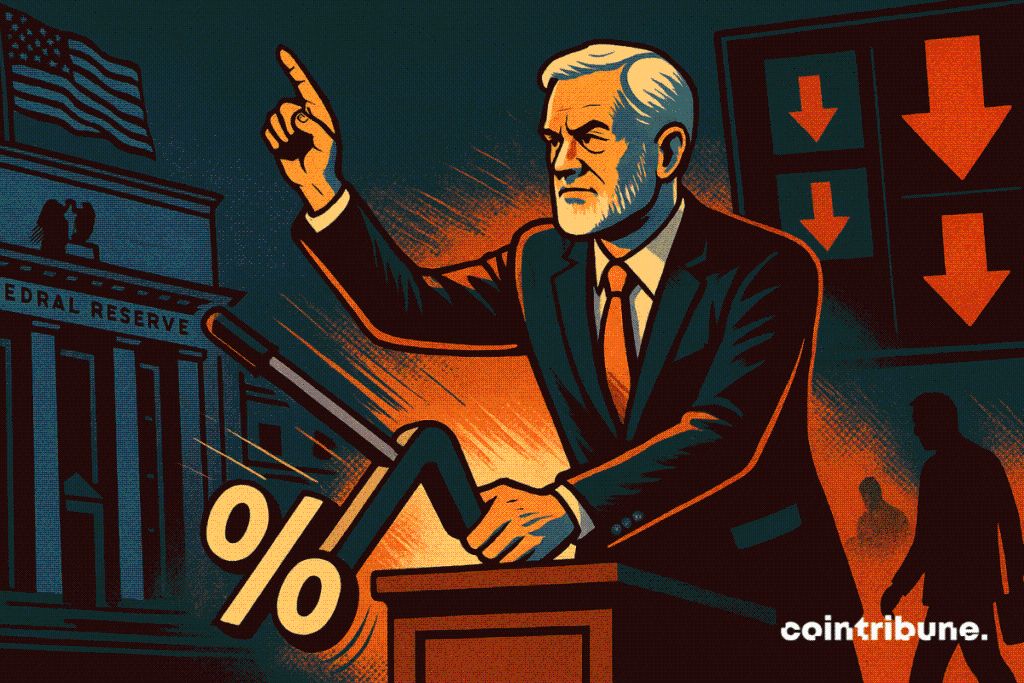
Two weeks before a crucial Federal Reserve meeting , the governor, expected to succeed Jerome Powell in 2026, stood out with an unambiguous statement. He wants a rate cut as early as September. In an interview granted to CNBC, he affirmed that the American economy demanded an immediate adjustment, thus breaking with the caution shown by other monetary officials.
In brief
- Christopher Waller, Fed governor and likely successor to Jerome Powell, advocates for an immediate rate cut.
- In an interview, he emphasizes that the labor market can deteriorate sharply, justifying preventive action.
- Waller calls for a flexible approach: cutting rates as early as September without entering an automatic sequence of cuts.
- His stance reveals divergences within the Fed, notably on inflation related to tariffs.
Waller wants to trigger the cut
While the Fed faces a dilemma : keep rates or cut them , Christopher Waller left no ambiguity about his position during his intervention.
“I think we need to start cutting rates at the next meeting“, he declared bluntly.
A member of the Fed Board of Governors, Waller carries significant political weight within the institution. His statement comes at a time when US economic indicators begin to show signs of slowing, especially in the labor market.
And for him, that is precisely where the urgency lies : “when the labor market turns, it does so sharply“, he emphasized, advocating for preventive action.
In his argument, Waller calls for a flexible approach, avoiding any rigid long-term commitment. He stresses the Fed’s ability to adjust the pace of cuts based on the evolution of on-chain data.
He specifies : “we don’t need to commit to a locked sequence of measures. We can observe how the situation evolves“. This positioning contrasts with the caution observed in recent meetings and highlights several key points :
- Anticipation rather than reaction : act before tensions in the labor market become critical ;
- Strategic flexibility : avoid an automatic downward trajectory in favor of an adaptable policy ;
- Distance from tariff-driven inflation : “I am not worried, but others still are“, he acknowledged, highlighting internal divergences ;
- Decisive timing : two weeks away from a key meeting, his comments aim to influence the internal Fed debate.
A stance that goes beyond the immediate situation
This media appearance by Waller is not just a simple economic opinion. It fits into a global political context, as his name is actively circulating among favorites to replace Jerome Powell as Fed chair in February 2026.
This prospect gives additional weight to his remarks. By positioning himself so clearly, Waller lays the groundwork for a medium-term strategic orientation : a potentially more proactive, even more flexible Fed, in a context of global macroeconomic uncertainty.
The man also nuanced the reasons usually invoked to maintain high rates, especially concerns related to inflation imported through tariffs. “People are still worried about tariff-related inflation. I am not, but others are“, he said, revealing a split within the central bank itself.
This internal disagreement could strengthen debates at the next monetary policy meeting, especially since geopolitical tensions and uncertainties about global growth leave little room for error.
For financial markets, this stance opens several hypotheses : either the Fed follows Waller and starts a loosening cycle, as anticipated by the banking institution Goldman Sachs , which could support risky assets, including cryptos, or it remains cautious for a while longer, risking to see some macroeconomic indicators deteriorate faster than expected.
Disclaimer: The content of this article solely reflects the author's opinion and does not represent the platform in any capacity. This article is not intended to serve as a reference for making investment decisions.
You may also like
SpaceX to Acquire Low-Band Spectrum Portfolio From Grain Management in Mobile Connectivity Push
06:50 AM EDT, 10/09/2026 (MT Newswires) -- SpaceX (SPCX) shares rose early Friday after the rocket and satellite company agreed to acquire a nationwide low-band spectrum portfolio from investment firm Grain Management as it seeks to establish Starlink Mobile as a major US mobile carrier. SpaceX will buy Grain Management's entire portfolio of up to 14 megahertz of paired spectrum in the 800 MHz band, the companies said in separate statements late Thursday. The deal is subject to the Federal Communications Commission's approval and other customary closing conditions. SpaceX's stock gained 3.7% in the most recent premarket activity. The companies did not disclose the financial terms, and neither immediately responded to MT Newswires' request for comment on the reported transaction value. SpaceX will pay about $8 billion in cash for the assets, The Wall Street Journal reported Thursday, citing people familiar with the matter. Grain Management, which specializes in digital infrastructure, acquired the 800 MHz spectrum portfolio from T-Mobile US (TMUS) in August in exchange for $2.9 billion in cash and all of Grain's 600 MHz spectrum licenses. "This prime low-band spectrum addresses one of the key remaining technical gaps that will pave the way for Starlink Mobile to become a major mobile carrier in the US," SpaceX said in its statement. Following regulatory approval, SpaceX intends to combine its satellite-to-mobile constellation in space with a terrestrial deployment that will enable Starlink Mobile's signals and services to reach customers from both the ground and space, according to the companies. SpaceX said most existing mobile devices already support the band. "Our spectrum expertise allows us to connect the strategic value of these assets with the technologies and operators that can realize their potential," Grain Management Chief Executive David Grain said in a separate statement. "This agreement with SpaceX brings that capability to bear at extraordinary scale." Shares of Verizon Communications (VZ), AT&T (T)
Delta Air Lines Lowers Profit Forecast as Fuel Cost Increase Outpaces Ticket Price Growth
Delta Air Lines lowers its annual profit forecast due to a $6 billion increase in fuel costs; sharply rising ticket prices test travelers’ willingness to pay. The company’s refinery business is expected to generate $700 million in profits to help offset the impact of fuel costs. Rajesh Kumar Singh, Reuters Chicago, October 9 – Delta Air Lines (DAL.N) lowered the midpoint of its annual profit forecast by nearly a quarter on Friday, as surging fuel costs offset the positive effects of strong travel demand and higher ticket prices. This downgrade highlights the increasingly severe challenges faced by U.S. airlines: if fuel prices remain high, will passengers be willing to accept further price hikes? Airlines have already increased ticket prices considerably this year, and analysts warn that further hikes could test travelers’ willingness to continue spending. The Atlanta-based airline expects its annual fuel spending to increase by about $6 billion compared to last year. Its third-quarter fuel expenses jumped 62% year-on-year to $4.1 billion, more than $500 million higher than July’s expectations. When asked about the reasons for the revised forecast, Delta CFO Erik Snell told reporters, “It’s entirely a fuel issue,” noting that crude oil and refined jet fuel prices have both increased since the summer. Delta now expects adjusted annual earnings per share of $5.10–$5.60, down from its July forecast of $6.50–$7.50. According to data from London Stock Exchange Group (LSEG), the new median of $5.35 is below analysts’ average forecast of $5.46. The company expects an adjusted pre-tax profit of $4.5 billion in 2026. According to LSEG, third-quarter adjusted earnings per share were $1.72, slightly below the average analyst forecast of $1.76. Its adjusted operating margin dropped from 11.1% to 9.4%. Delta is the first major U.S. airline to report third-quarter earnings; its competitors United Airlines (UAL.O), American Airlines (AAL.O), and Southwest Airlines (LUV.N) will release their results later this month. Ticket Price Increases According to the U.S. Bureau of Transportation Statistics, in the first eight months of 2026, U.S. airlines spent $42.9 billion on fuel for scheduled flights, nearly $13.2 billion more than in the previous year, despite a slight decrease in fuel consumption. Strong demand and limited seat growth have helped airlines pass higher fuel costs onto passengers. According to the U.S. Bureau of Labor Statistics’ Consumer Price Index, over the five months ending in August, average U.S. airfares increased about 25% year-on-year. With fuel prices remaining high and industry capacity growth set to further accelerate in the fourth quarter, analysts are closely watching whether airlines including Delta can raise ticket prices further without suppressing travel demand. Deutsche Bank analysts expect the industry’s proportion of fuel costs recouped through revenue to decline in the fourth quarter, with full recovery not expected until early 2027. Delta says demand remains strong. Snell noted that with fourth-quarter bookings already near 60%, the company expects revenue to increase by around 20% year-on-year. According to LSEG, Delta forecasts fourth-quarter adjusted earnings per share of $1.15–$1.65, with the median $1.40 roughly in line with analysts’ average expectation of $1.39. Refinery Advantage Delta holds an advantage over other major U.S. airlines: it owns a refinery near Philadelphia, which Snell expects will generate $700 million in profits this year. “We own a refinery, which gives us a hedge—part hedge—on fuel prices that no other airline has,” he said. Delta acquired the Monroe refinery in 2012, which processes crude oil into jet fuel and other products. While Delta must still pay market prices for fuel consumed by its airline operations, refinery profits remain within the company. When the price spread between crude oil and refined products widens, this helps offset fuel cost pressures for airlines sourcing externally. However, this protection depends on refinery margins; when margins fall, the refinery may also incur losses. Nevertheless, the refinery can only partially ease the impact of rising fuel prices. Even with an expected refinery benefit of 40 cents per gallon, Delta forecasts its fuel cost to rise from $3.61 per gallon in the third quarter to $4.25 per gallon in the fourth quarter. Snell said fuel costs are expected to remain high for some time. “Ultimately, fuel prices will come down. As to when, we’re not sure,” he said. (For the convenience of non-native English speakers, Reuters offers automated translations of its reports into several other languages. Due to possible errors or lack of context in automated translations, Reuters does not guarantee the accuracy of automated translation texts and provides them only for reader convenience. Reuters assumes no responsibility for any damages or losses from use of automated translation featur
SUI Price Pullback Sparks Debate: Correction or Next Buying Opportunity?
"SaaS Apocalypse" Debunked? Autodesk (ADSK.US) and Intuit (INTU.US) Lead Growth Against the Trend as Wall Street Reprices the "AI Eating Software" Narrative
This week, Autodesk and Intuit are expected to record their strongest weekly gains in months, defying pressure on the overall technology sector. This strong performance signals a renewed optimism in the market regarding the growth prospects of the SaaS (Software as a Service) industry.
Crypto prices
More


