
Bitcoin May Defy September Slump as Exchange Supply Hits Multi-Year Low

Bitcoin’s September weakness may continue, yet shrinking exchange reserves and potential Fed catalysts suggest a setup for a Q4 rebound.
September has traditionally been a difficult month for Bitcoin (BTC), with price charts often showing weakness. However, some experts predict a potential surge, pointing to falling exchange reserves as a signal of upward momentum.
The optimistic outlook comes despite Bitcoin’s recent struggles. The largest cryptocurrency has slipped 2% over the past week, reflecting broader market uncertainty.
Bitcoin Outlook: Seasonal Lows or Rally Ahead?
According to data from Coinglass, Bitcoin’s average return in September stood at -3.33%, making it the cryptocurrency’s worst month. BTC ended the month in red for six consecutive years between 2017 and 2022, making its prospects for this year also somber.
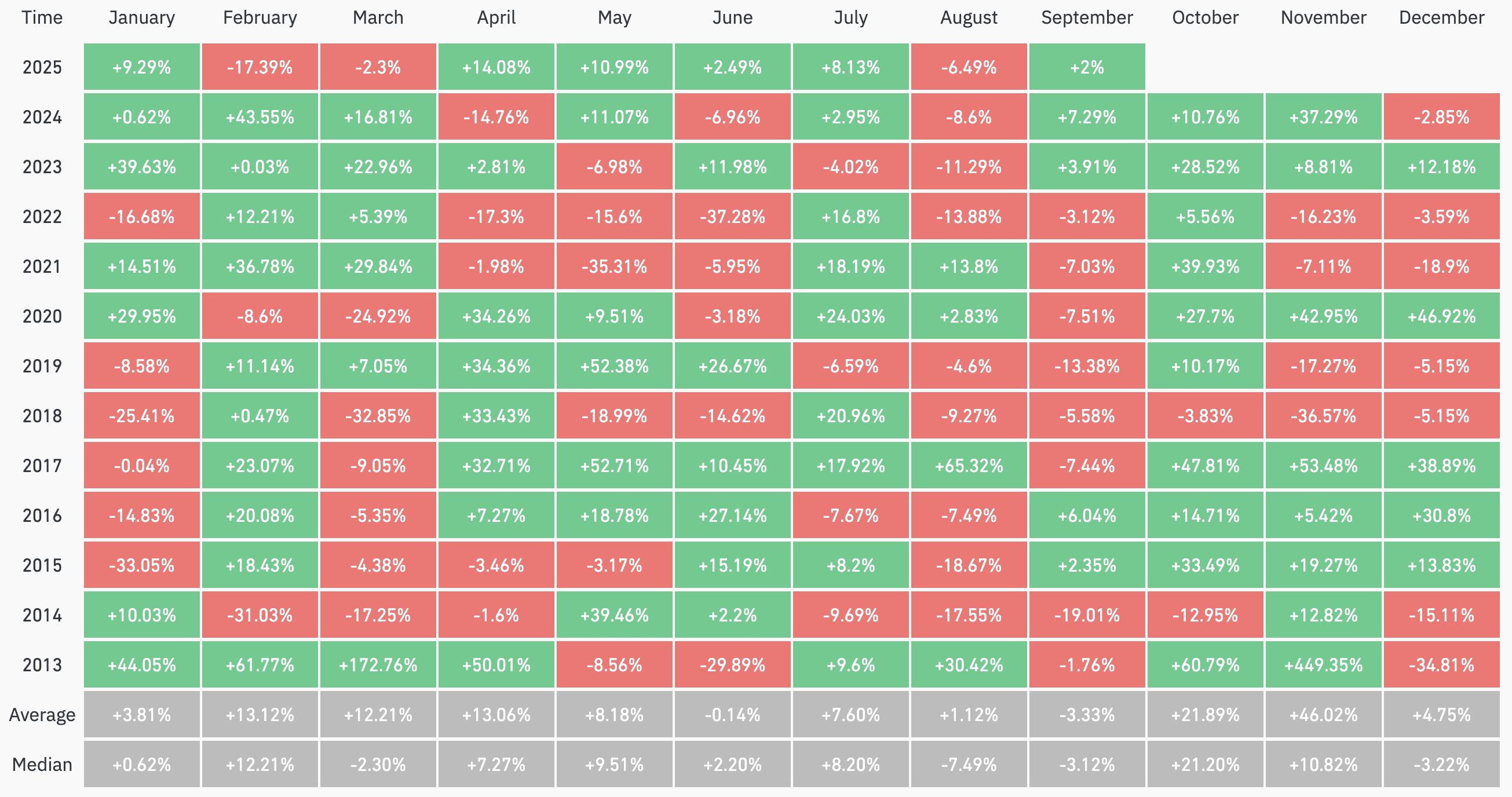 Bitcoin Monthly Performance. Source:
Coinglass
Bitcoin Monthly Performance. Source:
Coinglass
Notably, many experts agree on this perspective. An analyst has characterized the current market as resembling a ‘classic stock market top.’ This indicated potential vulnerability to further corrections.
Furthermore, analyst Timothy Peterson highlighted that Bitcoin’s value dipped 6.5% last month. The analyst predicted a price range of $97,000 to $113,000 by the end of September, reflecting a continuation of this trend.
‘It’s part of a seasonal pattern that has played out over many years,” Peterson added.
#Bitcoin – Two possible scernarios for BTC 1) Green: If 108k support holds, the price will soon continue heading higher.2) Red: If $108k support breaks, we might see a deeper retest of the upward-sloping trendline. pic.twitter.com/pyQTikXxfn
— Mags (@thescalpingpro) September 4, 2025
Meanwhile, many anticipate that while declines may come, the coin will bounce back next quarter. Based on past patterns, October and November are the strongest months for Bitcoin, so that could very well happen.
“Historically, Bitcoin has always bottomed out in September after the year of the halving. After that, it’s mostly smooth sailing. Despite me usually not looking at the past and using it as a signal for accuracy (I look at price action today). Looking at charts right now, this could actually very well play out again,” Crypto Nova wrote.
This view is supported by Benjamin Cowen, CEO of Into The Cryptoverse. He noted that September often marks a low point in post-halving years, typically followed by a rebound into a market cycle peak in the fourth quarter.
Nonetheless, some maintain a more optimistic view. Data shared by crypto analyst Rand showed a steady decline in BTC held on exchanges. Moreover, the exchange supply has plunged to a six-year low.
This signals reduced selling pressure. In addition, if demand increases, this shrinking supply can support a more bullish outlook for Bitcoin.
“Bullish supply shock,” Cade Bergmann added.
Rand also emphasized that momentum appears to be reversing from negative to positive, signaling a potential shift in market sentiment. With just under two weeks until the market expected Fed rate cuts, the analyst suggested the policy shift could provide the catalyst for a stronger recovery in September.
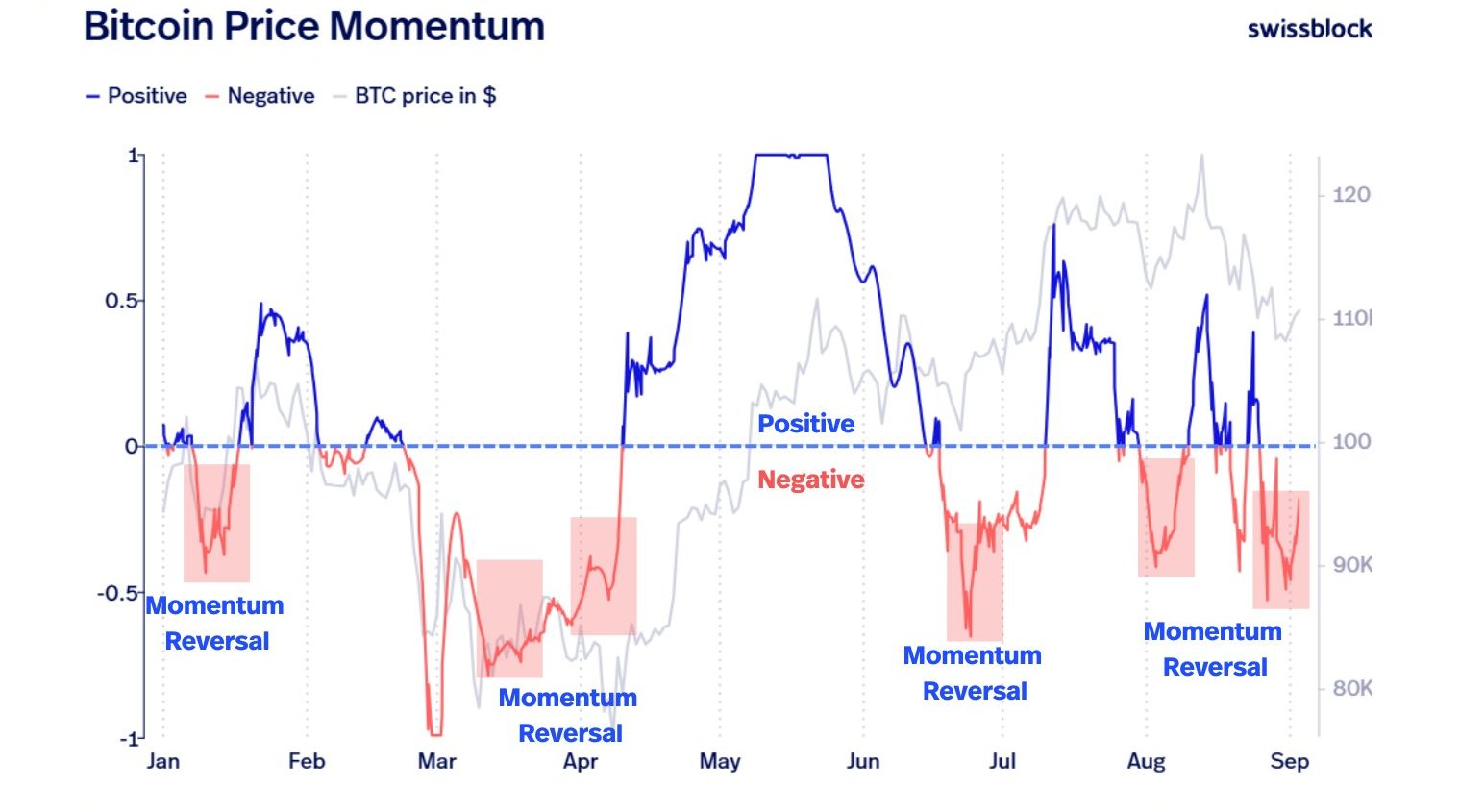 Bitcoin Momentum. Source:
X/CryptoRand
Bitcoin Momentum. Source:
X/CryptoRand
Lastly, market watchers are also eyeing key dates. Analyst Marty Party pointed to September 6 as a potential trigger, tied to market maker activity.
“Bitcoin market makers have cooked on the 6th of each month. IMO: Sept 6th is a move. That’s the event window till Sept 17th FOMC,” he said.
#Bitcoin is only 1.7% of global unbacked fiat. That means 98.3% of the currency supply is still waiting to be disrupted. WE ARE SO EARLY. pic.twitter.com/Bh2Zi2v89p
— Carl ₿ MENGER
(@CarlBMenger) September 3, 2025
Now, Bitcoin’s price remains under pressure, with experts divided on whether September will mark a bottom or a continued decline. The coming weeks, particularly around the forecasted Fed decision, will be critical in determining whether the cryptocurrency can defy its seasonal weakness and capitalize on the current supply dynamics.
Disclaimer: The content of this article solely reflects the author's opinion and does not represent the platform in any capacity. This article is not intended to serve as a reference for making investment decisions.
You may also like
XRP News Today : Ripple Expands Prime Brokerage Services for Brevan Howard
ROI - For the Trump-led Treasury, the "tail" of the auction is the most difficult part: McKeever
The views expressed in this article are solely those of the author, Reuters columnist Jamie McGeever. Reuters, Orlando, Florida, October 6 – U.S. Treasury auctions are typically dull, predictable, and not newsworthy. But these are not ordinary times, and the Trump administration now faces the risk of sluggish U.S. debt sales making headlines. The U.S. Treasury plans to issue nearly $120 billion in Treasuries this week, the first non-bill bond sales in two weeks: $58 billion in three-year notes on Tuesday, $39 billion in ten-year notes on Wednesday, and $22 billion in thirty-year bonds on Thursday. These auctions would usually be insignificant events, but due to the exceptionally weak performance of auctions from September 22 to 24—especially the five-year note auction on September 23, which triggered the largest spike in bond yields since April last year—they are attracting growing attention. Since then, yields have not only failed to retreat but have surged across most tenors to multi-decade highs. It's worth noting that the possibility of a U.S. Treasury auction "failing" is almost zero. Primary dealers—currently 26 Wall Street banks and institutions authorized by the New York Fed as market makers for Treasuries—are always involved. They effectively underwrite the sales, ensuring the smooth operation of the $30 trillion U.S. Treasury market, the most liquid market in the world. This, in turn, allows the entire global financial system to function, given that trillions of dollars in global debt, assets, and market derivatives are benchmarked against U.S. Treasuries. Treasuries are also the primary collateral for lubricating the financial “pipes” of the U.S. and global markets, including repo agreements, interbank loans, and financing. In short, as long as U.S. Treasuries remain the pillar of the global financial system, there will always be buyers at Treasury auctions. The question, as always, is at what price these bonds will be sold. Currently, borrowing costs in the secondary market are at their highest levels since the mid-2000s, so it's reasonable to expect that the Treasury will pay relatively high rates in the primary market as well. But as recent auctions have shown, negative surprises remain possible. "Too big to be absorbed by the market"? The $70 billion five-year auction on September 23 was among the most worrisome in years. Demand, as measured by the bid-to-cover ratio, was at a nine-year low. The Treasury ended up selling the notes at a yield of 5.033%, more than 3 basis points above the market yield at the close of bidding. Three basis points might not sound like much, but it's exceptional for a five-year note auction. This is the largest so-called "tail" since June 2022. According to JPMorgan analysts, the last time a five-year auction had a three-basis-point tail was back in 2011—amid the brewing debt ceiling crisis that eventually led to a U.S. credit rating downgrade in August that year. Currently, concerns over the U.S.'s daunting fiscal outlook are driving up long-term borrowing costs. As a result, markets generally expect the Trump administration to gradually shift the Treasury’s massive funding needs toward the lower-yield (and therefore lower-cost) short- and medium-term segments of the curve. That's why the five-year note auction two weeks ago sparked such concern. A three-basis-point tail is common in long bond auctions, but not in the "belly" of the yield curve. If the Treasury is forced to pay a higher premium to issue these bonds, then Houston, we have a problem. A large auction tail can be caused by many factors, including market volatility on the day of the auction or more concerning, fundamental issues that may erode demand over time. The two are often hard to distinguish because they are not mutually exclusive. On a brighter note, this unease has not yet spread to the short end of the yield curve. At least, not yet. Three-year and ten-year Treasury yields are up about 50 basis points from the last auction a month ago, hovering around 4.96% and 5.32%, respectively. The thirty-year yield is up roughly 35 basis points to 5.65%. These levels should be high enough to attract strong demand and ensure smooth sales, right? Maybe. But if surprises do occur, volatility and uncertainty could spill over across the market. Investors will be watching developments as closely as hawks. (The views in this article are solely those of the author, a Reuters columnist.) Like this column? Check out Reuters' "Unhedged" (ROI), your essential new source for global finance commentary. Follow ROI on LinkedIn and X. You can also listen to the daily "Morning Bid" podcast on Apple, Spotify, or the Reuters app—subscribe for in-depth market and finance news, seven days a week. US 5-year auction has biggest 'tail' since 2022 https://fingfx.thomsonreuters.com/gfx/mkt/dwpkmkzogpm/TAIL.png (For the convenience of non-English speakers, Reuters provides automated translations of its reports
Crypto prices
More


