
House Lawmakers Call on SEC to Fast-Track Crypto 401(k) Access

House lawmakers urge SEC to implement Trump’s executive order, enabling 401(k) investors access to cryptocurrencies, potentially impacting 90 million U.S. retirement savers while market stickiness could drive significant crypto investment flows over coming years.
Nine House Financial Services Committee members urged the Securities and Exchange Commission (SEC) on Monday to implement President Donald Trump’s Aug. 7 executive order. The order could allow Americans to invest in cryptocurrencies through 401(k) plans.
The coalition, led by Committee Chairman French Hill and Subcommittee on Capital Markets Chair Ann Wagner, highlighted the order’s potential to open alternative assets previously restricted to high-net-worth investors.
SEC Urged to Provide Regulatory Guidance
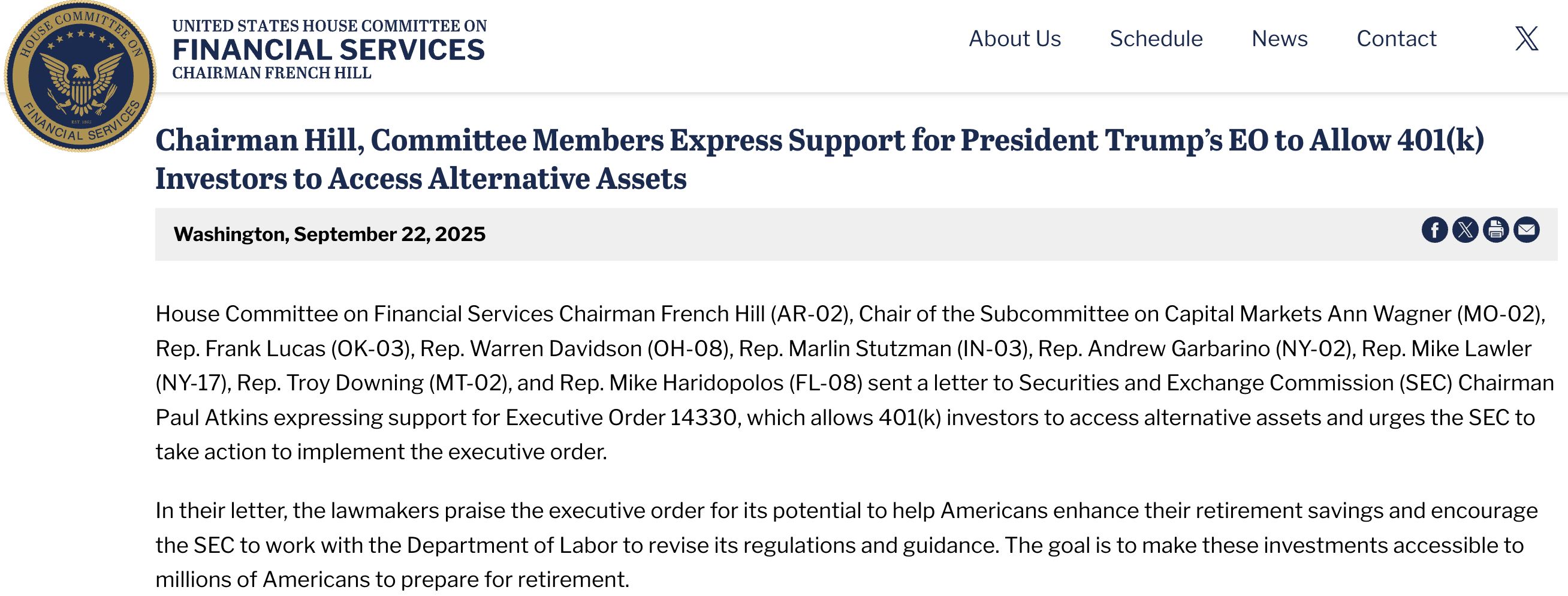
In their letter to SEC Chairman Paul Atkins, the representatives called for rapid coordination between the SEC and the Department of Labor (DOL) to update rules for participant-directed defined-contribution plans. If fully implemented, this initiative could directly affect approximately 90 million US retirement savers.
“Every American preparing for retirement should have access to funds that include investments in alternative assets when plan fiduciaries determine such options are appropriate,” the letter stated.
Separately, the lawmakers also highlighted bipartisan legislation advancing in the 119th Congress that seeks to modernize the definition of “accredited investor,” a longstanding hurdle preventing ordinary Americans from accessing broader private markets and digital assets.
This point is distinct from the 401(k) crypto access initiative but reinforces the overall push for expanded investment opportunities.
401K Stickiness Could Greatly Impact Crypto
Analysts estimate that even modest allocations to cryptocurrencies within 401(k) plans could generate significant investment flows. A 0.1% default allocation across just 10% of plans would represent over $1 billion in potential crypto exposure, with broader adoption scenarios possibly reaching tens of billions of dollars.
Particularly, the inherent stickiness of 401(k) investments strongly influences participant investment behavior and potential crypto allocations. A 2025 Vanguard report shows that 84% of US plan participants rely on target-date funds, with contributions rising from 46% in 2015 to 64% today. Notably, only 1% of these investors made any trades in 2024, illustrating how default allocations—including those in target-date funds—affect investor actions.
If the SEC acts promptly, the order could redefine retirement planning in the US, letting participants align long-term portfolios with emerging asset classes. Next steps include SEC guidance, regulatory revisions, and product filings before plan committees can adjust investment policies.
Meanwhile, Market observers caution that meaningful changes to retirement plan structures may not occur immediately. Some forecasts suggest substantive adjustments could be delayed until 2026 or later.
Disclaimer: The content of this article solely reflects the author's opinion and does not represent the platform in any capacity. This article is not intended to serve as a reference for making investment decisions.
You may also like
Despite falling oil prices and dovish comments from Fed officials, US Treasury yields continue to rise
The wave of US Treasury sell-offs continues to spread, with the 30-year yield reaching a 24-year high of 5.621% and the 10-year yield rising to its highest level since 2002—oil price declines and dovish signals have both failed, and long-term rates remain unaffected. High yields are reshaping the structure of US equities; as the AI narrative becomes the market’s final pillar, any cracks could trigger a chain reaction of turbulence.
Morgan Stanley trading desk, dubbed the "most accurate in the past two years," turns bullish
The supporting logic encompasses five major pillars: unexpected macro trends, consumer resilience, low profit expectations, stabilized yields, and technical improvements. Since the previous shift on August 31, the Nasdaq 100 long and Russell 2000 short paired trades have accumulated gains of over 8%. This latest "bullish reversal" is even more convincing. Strategically, technology remains the core long position, but the hedging tool has shifted from shorting RTY to derivatives. Meanwhile, the risk of long-term interest rate hikes still persists.

Four major favorable factors emerge, international oil prices respond by falling
Crypto prices
More


