
Bitcoin hits all-time high as USD on track for worst year since 1973: Analyst

Precious metals and Bitcoin (BTC) are rising to new all-time highs, alongside risk assets like stocks, as the US dollar (USD) is on track for its worst year since 1973, signaling a “generational” macroeconomic shift, according to market analysts at The Kobeissi Letter.
The S&P 500 stock market index is up over 40% in the last six months, BTC hit a new all-time high of over $125,000 on Saturday, and gold is also trading at all-time highs — $3,880 per ounce at the time of this writing — nearing $4,000, Kobeissi Letter wrote.
“The correlation coefficient between gold and the S&P 500 reached a record 0.91 in 2024,” the analysts wrote, adding that this unusual correlation between safe-haven assets and risk assets indicates that markets are now pricing in a “new monetary policy,” Kobeissi added:
“There is a widespread rush into assets happening right now. As inflation rebounds and the labor market weakens, the Federal Reserve is cutting rates. The USD is now on track for its worst year since 1973, down over 10% year-to-date. The USD has lost 40% of its purchasing power since 2000.”
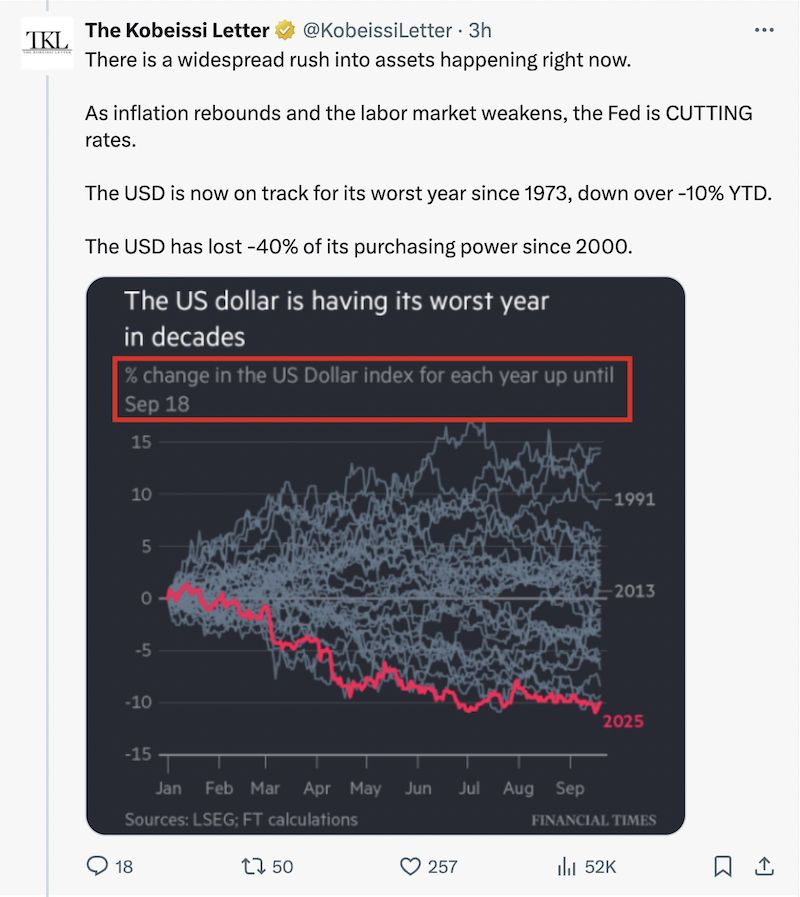
The analysis came amid a US government shutdown, massive downward revisions of US jobs numbers that signal a weakening labor market, interest rate cuts, and growing concern over the eroding value of the dollar, which are all positive price catalysts for BTC.
Related: Bitcoin corrects from $125K all-time high: Where will BTC price bottom?
Analysts agree new BTC all-time high is fueled by macroeconomic factors
BTC’s rally to a new all-time high was driven by macroeconomic factors, including the recent US government shutdown, according to Fabian Dori, chief investment officer at global digital asset bank Sygnum.
The US government shutdown that began on Wednesday closed down operations at regulatory agencies and bureaucracies entirely or forced them to operate on a bare bones budget and minimal staff.
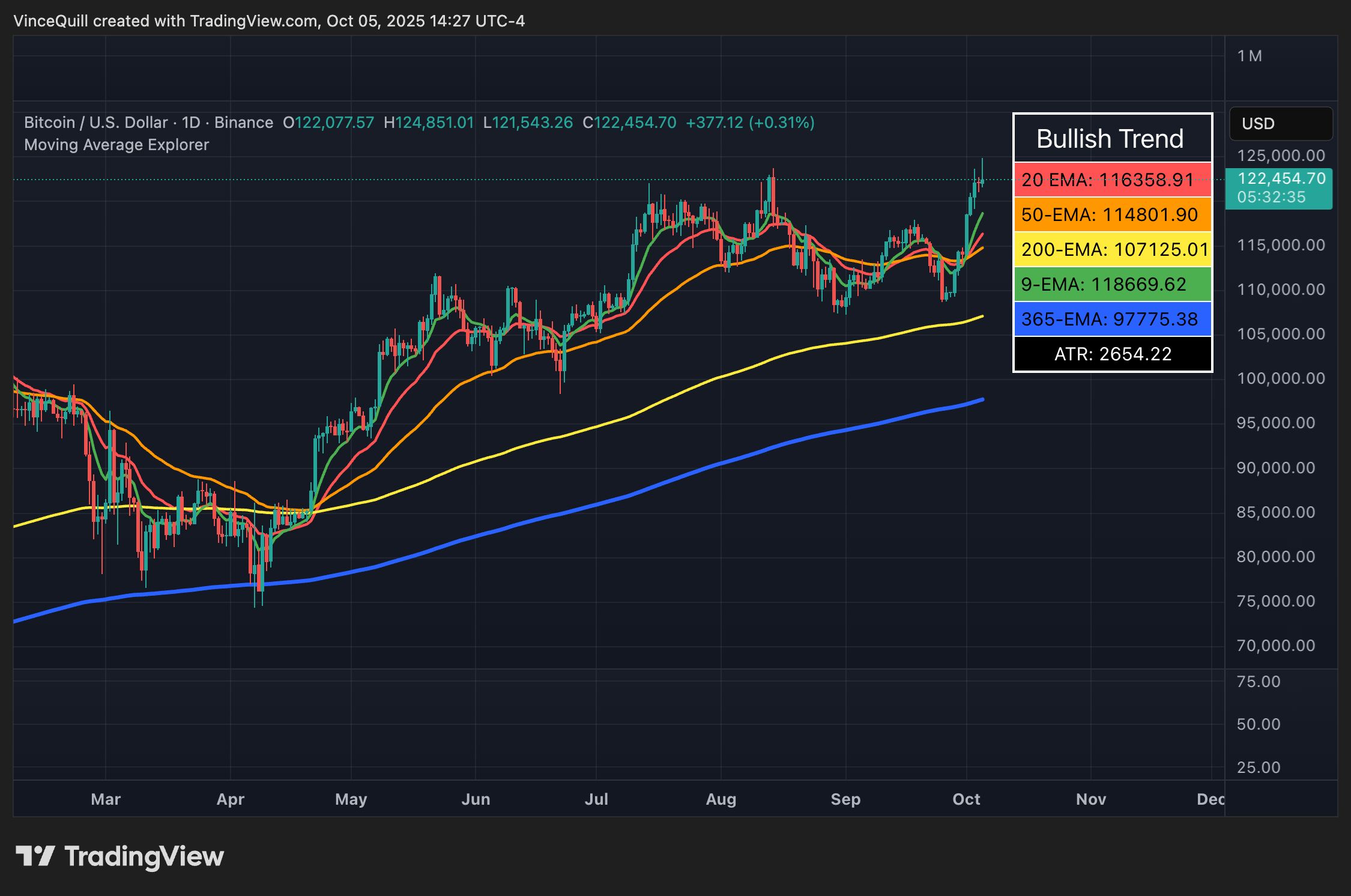
The “political dysfunction” stemming from the shutdown has renewed investor interest in BTC as a store-of-value monetary technology, as faith in traditional institutions falters, Dori told Cointelegraph.
Magazine: Scottie Pippen says Michael Saylor warned him about Satoshi chatter
Disclaimer: The content of this article solely reflects the author's opinion and does not represent the platform in any capacity. This article is not intended to serve as a reference for making investment decisions.
You may also like
Samsung Electronics' 2nm yield approaches 60%, aiming at TSMC to compete for tech giants' orders
The yield rate of Samsung Electronics' foundry division's 2nm process has increased to nearly 60%, a significant improvement from around 30% in mid-2023. After stabilizing the yield, Samsung has shifted its engineering focus to power consumption and heat dissipation optimization, and is accelerating the development of the more powerful second-generation process, SF2P, aiming for mass production within the year. Strategically, Samsung plans to supply 2nm chips to Tesla next year, using this as a stepping stone to enter the large-scale tech client market.

From connecting users to hosting computing power, Philippine telecom giant Globe bets on AI data centers! Targeting the next billion-dollar business.
Globe Telecom Inc. plans to invest at least $1 billion by 2027 to expand its data business. The company regards its data center business as the next billion-dollar venture, with the rapid development of artificial intelligence being a key driving factor behind this goal.
Quantum Computing Reaches Historic Turning Point: Moving Beyond "Physical Experiments," Supply Chain and Manufacturing Become Key to Success
After attending the Quantum World Congress, Jefferies issued a major evaluation: the industry's core challenge has shifted from "creating good qubits" to "building truly usable computers." The source of competitive advantage has fully moved from physics innovation to system engineering and manufacturing barriers. The U.S. government has elevated its role from a funding provider to a rule-maker, with federal funding now linked to performance and the NQI Act about to be implemented. Whoever first achieves repeatable manufacturing and supply chain resilience will earn the ticket to compete in commercializing this technology.
Crypto prices
More


