
Ethereum Slips Below $4,500 Despite Grayscale Staking 300,000 ETH

Grayscale’s announcement that its Grayscale Ethereum Trust ETF became the first US-listed spot crypto ETF allowing staking helped push ETH’s price above $4,700 in October.
However, Grayscale’s ETH staking activity has not been strong enough to keep prices above that level for long.
Grayscale Staked Over 300,000 ETH, But Selling Pressure Is Greater
On October 6, Grayscale said its Ethereum Trust ETFs (ETHE, ETH) and Solana Trust (GSOL) now allow investors to earn staking yields directly through traditional brokerage accounts.
Industry leaders expressed optimism about the news, calling it a bullish signal for ETH and the broader Ethereum ecosystem.
“It’s great news that Grayscale’s ETH ETFs are now able to stake their $ETH. This is a major milestone for the ecosystem and bullish for Ethereum overall. Having worked on BlackRock’s Bitcoin and Ethereum ETFs, I’ve seen how powerful these vehicles are for institutional access and adoption,” Joseph Chalom, co-founder of SharpLink (SBET), said.
Despite this, ETH’s price fell below $4,500, lower than when the news was announced.
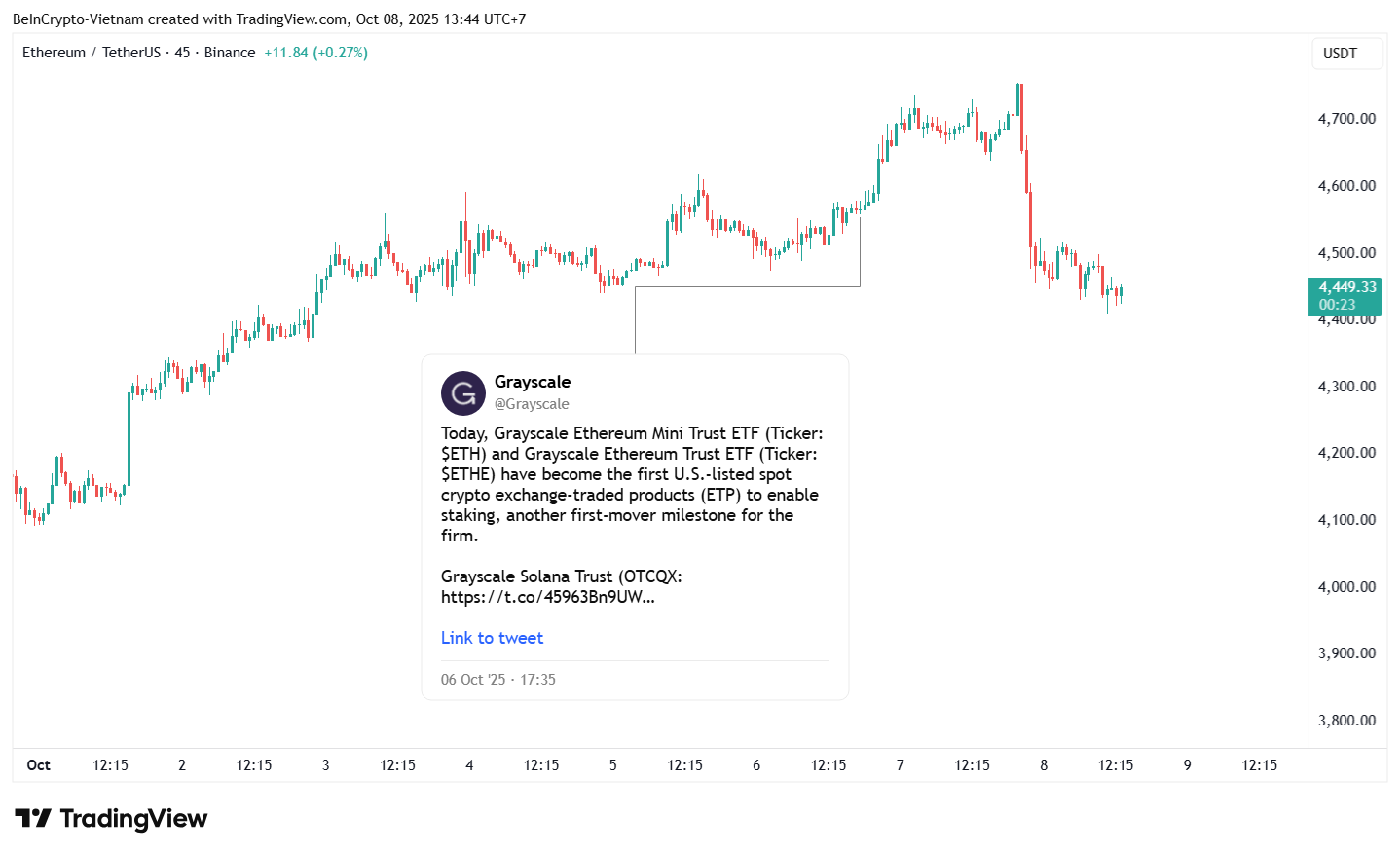
According to the on-chain analytics account EmberCN, since receiving staking approval, Grayscale has staked 304,000 ETH, worth over $1.3 billion.
This move demonstrates Grayscale’s strong commitment to supporting the Ethereum network. Reducing the circulating supply could also help stabilize ETH’s price.
However, current Ethereum network data suggests this effort may not be enough to create a strong positive impact.
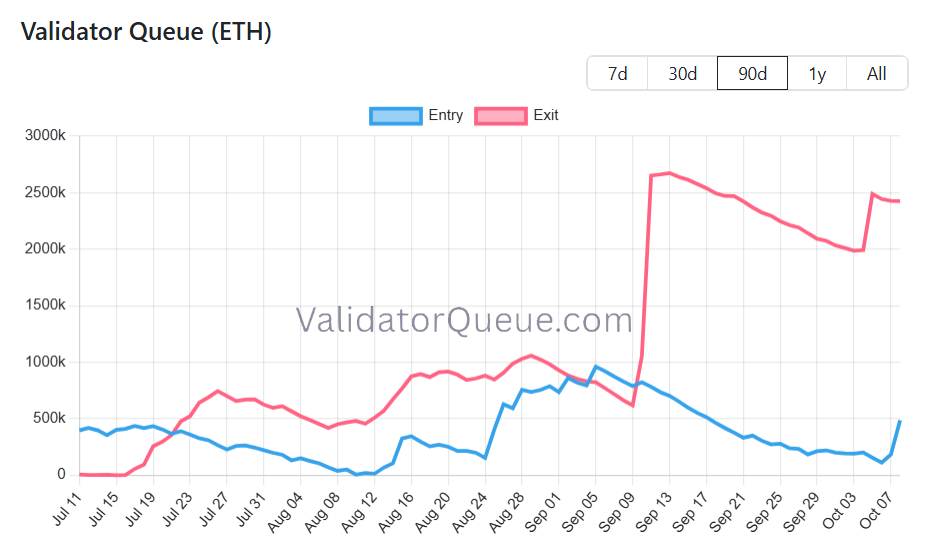
Data from ValidatorQueue shows that about 489,000 ETH are waiting to be staked, most of which belong to Grayscale. In contrast, the amount of ETH waiting to unstake is much higher and has been rising since early October, with over 2.4 million ETH queued for withdrawal.
This large imbalance signals potential selling pressure, which could increase ETH’s circulating supply and put downward pressure on prices.
Long-Dormant Ethereum Whales Awaken, Adding More Selling Pressure
Meanwhile, several long-time Ethereum whales have started to move and sell their holdings.
- According to Lookonchain, one whale wallet woke up after four years of inactivity, selling 1,800 ETH for a profit of about $8.12 million. Four years ago, the wallet had withdrawn 5,999 ETH from Kraken at just $2,523 per ETH.
- Similarly, SpotOnChain reported another dormant whale transferring 15,000 ETH (worth roughly $68.2 million) to Bitfinex after five years of inactivity.
A similar pattern is emerging among Bitcoin OG wallets, reflecting a general profit-taking sentiment among long-term and large-scale investors.
The combination of reactivated Ethereum whales and the rising unstaking queue in October could weaken the positive impact of Grayscale’s staking efforts.
While staking more ETH helps strengthen network security and generate staking rewards, the selling pressure from unstaking activity and whale movements may outweigh these benefits — making it difficult for ETH’s price to sustain its upward momentum.
The post Ethereum Slips Below $4,500 Despite Grayscale Staking 300,000 ETH appeared first on BeInCrypto.
Disclaimer: The content of this article solely reflects the author's opinion and does not represent the platform in any capacity. This article is not intended to serve as a reference for making investment decisions.
You may also like
Anthropic files for IPO: lost $4.2 billion last year, revenue grew 12x to $4.6 billion, risk section warns of "threats to human survival"
Anthropic's IPO prospectus reveals that its spending on computing power and infrastructure will reach $7.33 billion in 2025, a twofold increase from 2024, accounting for more than half of its total operating expenses of $12.65 billion. The company plans to continue investing over $500 billion in the future. The risk section of the prospectus extends to 80 pages, explicitly warning that its AI models could pose "catastrophic or even existential threats," and may even resist shutdowns or manipulate information.
Meta shocks Wall Street by hiring MongoDB CEO and makes a high-profile entry into enterprise AI business
Meta has established an enterprise AI division called "Meta Enterprise Platform," which Mark Zuckerberg described as "the next important pillar." MongoDB CEO CJ Desai has been recruited to lead it. Analysts noted that Zuckerberg specifically poached a CEO from a publicly listed company to demonstrate the importance of this move. Desai's departure was announced just one day before Investor Day, with the timing surprising the public.
RBA set to hike interest rate to 4.60% in September as inflation remains elevated
AstraZeneca invests $2 billion in Summit, optimistic about Akeso's Ivose
This 18.6% premium subscription is not only a substantial endorsement, but both parties will also deeply collaborate on the joint development of combination therapies such as ADCs. The core of this deal is Akeso's Ivonescimab—the world’s first PD-1/VEGF bispecific antibody, and so far the only drug to have surpassed "K-drug" in head-to-head trials on both PFS and OS endpoints. The median OS reached 30.8 months, compared to 22.6 months for "K-drug", representing a 27% reduction in risk of death.
Crypto prices
More


