
Trader Peter Brandt warns of a possible drop in the price of the cryptocurrency XRP

- XRP Could Drop Below $2,22, Says Peter Brandt
- Bearish Divergence in RSI Worries XRP Investors
- Increased supply and liquidations increase pressure on the token
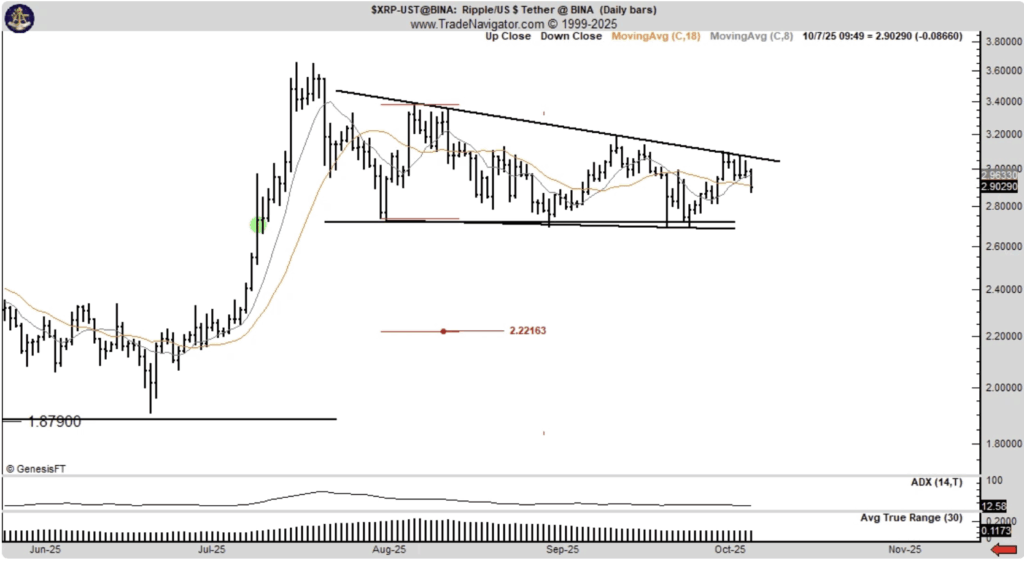
Veteran trader Peter Brandt has once again issued a warning for XRP, highlighting that the asset may be forming a descending triangle technical pattern. According to the analyst, the token's price has an intermediate target of around $2,68, but if this support is lost, XRP could decline further, reaching the $2,22 region.
Brandt observed XRP's weekly chart and noted a bearish divergence in the RSI, a signal that historically precedes weakening price movements. For traders waiting for a clear trend definition, this technical formation reinforces caution and indicates that the asset may face resistance to resuming its upward momentum.
On-chain data reinforces this pessimistic view. Information from Glassnode revealed that more than 320 million XRP were transferred to exchanges in the last week alone. This brings the total volume stored on these platforms to over 3,8 billion, which is likely to put pressure on the price, as it increases the potential supply available for sale.
Furthermore, demand from whales, large holders of the cryptocurrency, has not kept pace with this movement. According to the data, these institutional investors appear to be pulling back, while short-term traders maintain market liquidity. This imbalance could increase selling pressure if bearish sentiment intensifies.
Another factor that aggravated the situation was the increase in liquidations. In the last 24 hours, leveraged traders lost approximately $23 million, $21 million of which came from long positions. This dynamic created an effect known as a "long squeeze," when the forced liquidation of long positions accelerates market selloffs.
With these technical and on-chain elements converging, XRP faces a decisive moment, and analysts are closely monitoring whether the price can hold above the critical levels highlighted by Peter Brandt.
Disclaimer: The content of this article solely reflects the author's opinion and does not represent the platform in any capacity. This article is not intended to serve as a reference for making investment decisions.
You may also like
Anthropic files for IPO: lost $4.2 billion last year, revenue grew 12x to $4.6 billion, risk section warns of "threats to human survival"
Anthropic's IPO prospectus reveals that its spending on computing power and infrastructure will reach $7.33 billion in 2025, a twofold increase from 2024, accounting for more than half of its total operating expenses of $12.65 billion. The company plans to continue investing over $500 billion in the future. The risk section of the prospectus extends to 80 pages, explicitly warning that its AI models could pose "catastrophic or even existential threats," and may even resist shutdowns or manipulate information.
Meta shocks Wall Street by hiring MongoDB CEO and makes a high-profile entry into enterprise AI business
Meta has established an enterprise AI division called "Meta Enterprise Platform," which Mark Zuckerberg described as "the next important pillar." MongoDB CEO CJ Desai has been recruited to lead it. Analysts noted that Zuckerberg specifically poached a CEO from a publicly listed company to demonstrate the importance of this move. Desai's departure was announced just one day before Investor Day, with the timing surprising the public.
RBA set to hike interest rate to 4.60% in September as inflation remains elevated
AstraZeneca invests $2 billion in Summit, optimistic about Akeso's Ivose
This 18.6% premium subscription is not only a substantial endorsement, but both parties will also deeply collaborate on the joint development of combination therapies such as ADCs. The core of this deal is Akeso's Ivonescimab—the world’s first PD-1/VEGF bispecific antibody, and so far the only drug to have surpassed "K-drug" in head-to-head trials on both PFS and OS endpoints. The median OS reached 30.8 months, compared to 22.6 months for "K-drug", representing a 27% reduction in risk of death.
Crypto prices
More


