
Crypto market shakes off record liquidation as Bitcoin, Ethereum technicals ‘flip positive’: Bitmine chair

After the biggest crypto deleveraging event in five years, Tom Lee, chairman of Bitmine Immersion Technologies, says the worst may be over — and a year-end rally could be in sight.
The Oct. 10 liquidation, triggered in part by rising U.S.-China trade tensions, erased billions in leveraged positions across digital assets.
“That was the biggest liquidation event in five years for crypto,” Lee said. “So, there are still those ripple effects, two weeks later, that are plaguing the crypto market.”
Yet despite the shock, Lee — who also co-founded research firm Fundstrat — told CNBC this weekend that both Bitcoin and Ethereum are showing surprising resilience, pointing to record-low open interest levels and improving technicals as signals that the market is stabilizing.
The deleveraging earlier this month — multiples of what happened during FTX — saw Bitcoin fall “three or four percent,” Lee explained. Today, technicals for both Bitcoin and Ethereum are “flipping positive.”
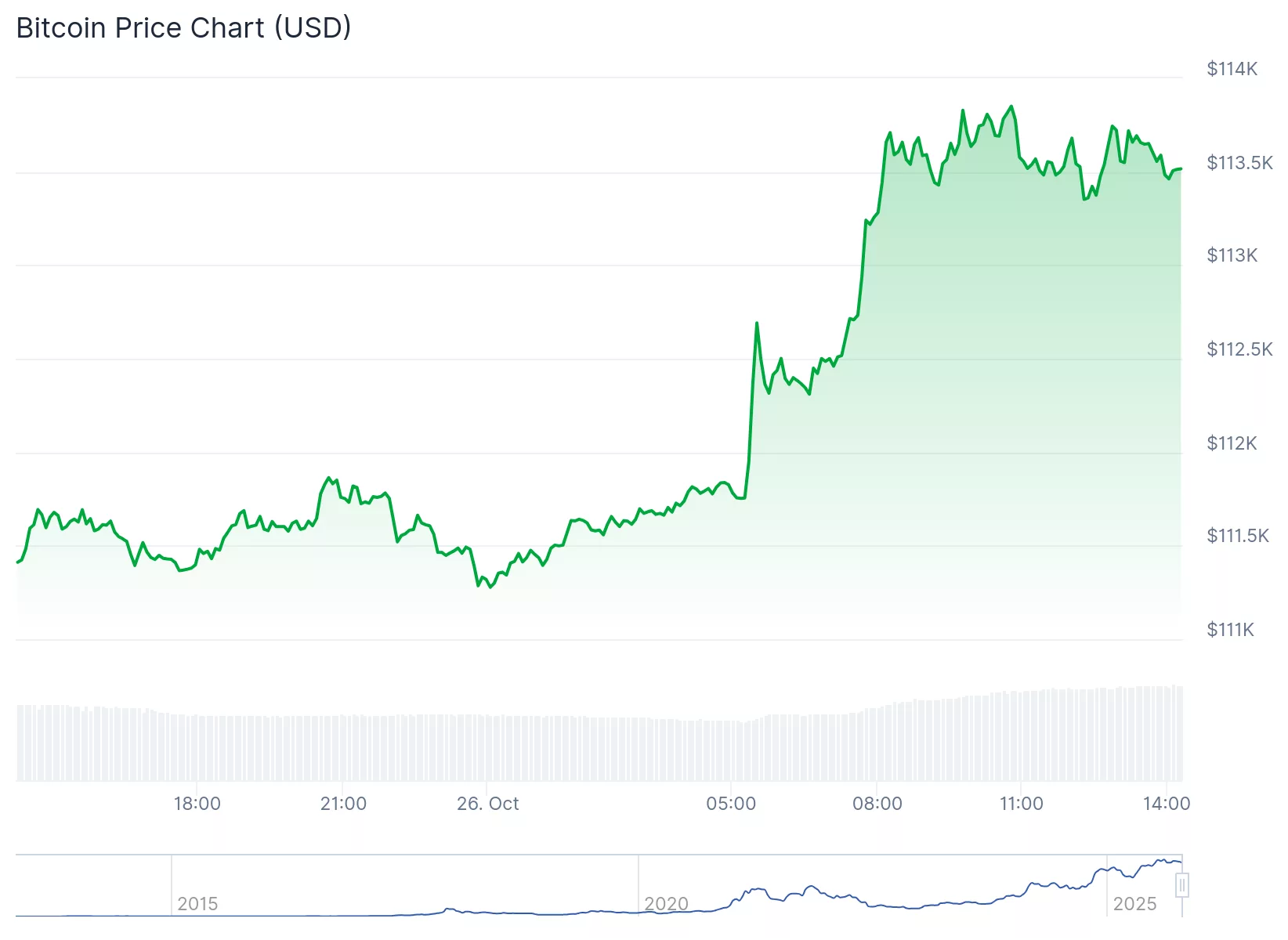
At last check on Sunday, Bitcoin was trading at around $113,500. See the chart below.
 Source: CoinGecko
Lee argues that crypto often acts as an early signal for equities and broader market liquidity. He says Bitcoin’s steadiness and Ethereum’s growing on-chain activity—particularly from stablecoin usage on both Layer 1 and Layer 2 networks—suggest improving fundamentals that could translate into broader risk-on sentiment across asset classes.
Lee’s comments come as JPMorgan plans to let institutional clients use Bitcoin and Ether as collateral for loans by year’s end. The move, which will rely on third-party custodians, marks another step in Wall Street’s crypto makeover, especially with the Trump administration loosening regulatory screws.
It’s a full-circle moment for CEO Jamie Dimon, who once called Bitcoin a “pet rock.” Now, that same “rock” can secure a multimillion-dollar loan from the nation’s biggest bank.
“It really does help to see JPMorgan say they’re open to the idea of using crypto as collateral,” Lee added. With fundamentals improving, he argues for “a pretty big movement by the end of the year.”
Disclaimer: The content of this article solely reflects the author's opinion and does not represent the platform in any capacity. This article is not intended to serve as a reference for making investment decisions.
You may also like
AI boom reshapes the wafer foundry landscape! UBS: Explosive demand accelerates advanced process expansion, mature process enters upward cycle
UBS stated in a recent research report that within the foundry market, the Total Addressable Market (TAM) for the N2 (2nm) node far exceeds expectations, A14 (1.4nm) production expansion is accelerating, and the upcycle for mature process nodes has already begun.
$1,999 Foldable iPhone Is Ready, but Apple (AAPL.US) Faces Over $5.7 Billion Patent Penalty
As Apple intensifies its efforts in foldable displays and AI business, it faces a haptic technology patent compensation ruling exceeding $5.7 billion. On September 25, a federal jury in California found that Apple's Taptic Engine, used in certain iPhone and Apple Watch models, infringed on two patents held by Taction Technology.
Prospects for the opening of the Hormuz Strait are overshadowed, Asian bonds under pressure: 2Y Japanese bond yield approaches 2%, 3Y Korean bond yield rises to highest level since 2022
With high oil prices, short-term bond yields in South Korea and Japan have risen.
5% US Treasury pressure weighs on global assets, while Australian government bonds open up a window for allocation? Fixed income giant Pimco calls the rate hike expectations too aggressive
Pacific Investment Management Company (Pimco) holds a constructive view on Australian bonds, believing that market expectations for rate hikes are too high. Pimco stated that the rate hike cycle in Australia has been "fully priced in," and cracks are beginning to appear in the economy, making Australian bonds look attractive, especially in the 5- to 10-year segment of the yield curve.
Crypto prices
More


