
The co-founder of Solana challenges the security of Ethereum Layer-2s

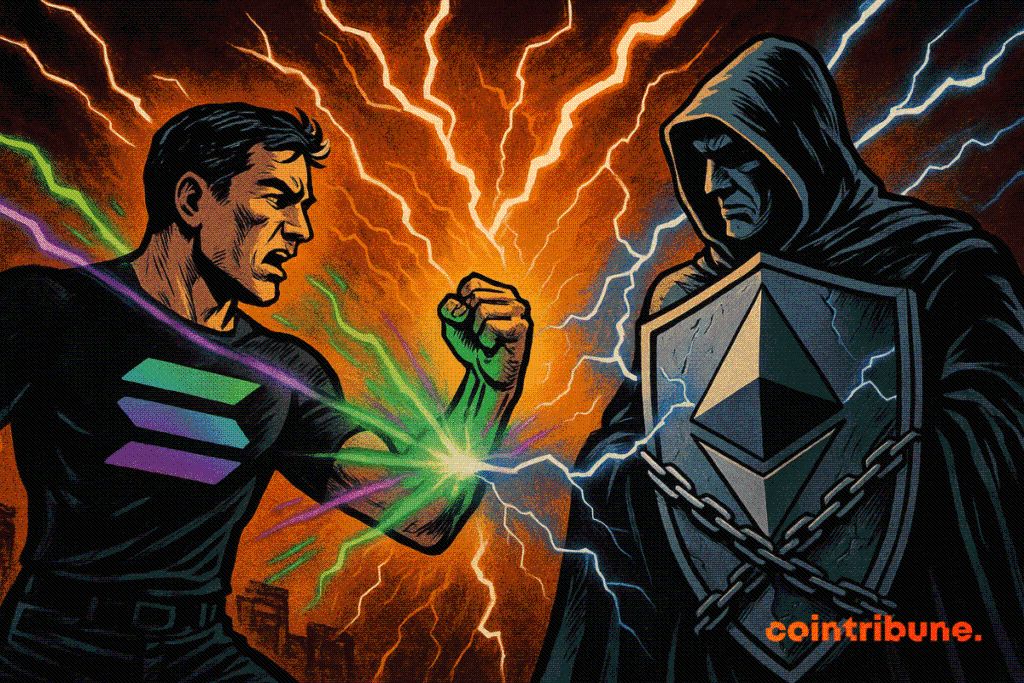
Ethereum, a true peaceful digital paradise? Behind the promises of decentralization, some see cracks in the armor. Anatoly Yakovenko, co-founder of Solana, throws a stone in the pond. In a series of exchanges on X, he claims that Ethereum scaling solutions, far from being invulnerable, hide critical flaws. The battle of narratives in the crypto universe is more active than ever. And at the heart of the ring: the security of bridges, multisigs, and the famous promise of ETH L1’s security inheritance.
In brief
- Yakovenko denounces multisigs capable of modifying L2 bridges without any user transparency.
- More than 120 Layer-2s swarm around Ethereum, creating fragmentation, confusion, and security risks.
- Binance Research warns: L2s shrink the revenue of Ethereum’s main layer with their fees.
- Some actors defend these networks, arguing they strengthen the crypto ecosystem through technological diversity.
Can the Ethereum ecosystem really guarantee the security of its Layer-2s?
The criticism by Anatoly Yakovenko, a major promoter of Solana’s Saga smartphone, quickly sparked the crypto-sphere. For him, the illusion is persistent: the Layer-2 (L2) are not protected by Ethereum, despite what their supporters claim. These secondary networks have auditability flaws, a massive attack surface, and above all, governance that is still too centralized. The use of upgrade multisigs, in his view, destroys any real guarantee.
In a sharp tweet, Yakovenko states: “All existing second-layer (L2) solutions have a permissioned multisig that can override the bridge contract without notice“.
His example? The ETH token transferred to Solana via Wormhole presents, according to him, the same risks as ETH used on Base, an L2 signed by Coinbase. Yet these two systems generate as much revenue for ETH L1 stakers. In other words: the L2 model does not rest on as solid a foundation as one might think.
But some, like @lex_node, counter: Ethereum offers the ability to force the inclusion of transactions in L2 blocks. And thus a form of native security.
Crypto multiplication or fragmentation? The L2 boom raises questions
The crypto universe has more than 120 Layer-2s verified according to L2Beat, and 29 more await evaluation. A wealth? Not for everyone. Adrian Brink (Anoma) sees it as excess. Igor Mandrigin (Gateway.fm), on the other hand, celebrates necessary diversity. And Anurag Arjun (Polygon) highlights their value as high-throughput blockchains. But this proliferation has a price: Binance Research warns of a cannibalization of Ethereum base layer revenues.
In the sights: the ultra-competitive fees of L2s, which fragment liquidity and divert ETH L1 transactions. Yakovenko, again, goes further: he even proposes building a bridge to Ethereum that would make… Ethereum itself an L2 of Solana. A technical jab, but revealing of tensions over network sovereignty.
Some truths in numbers
- 129 active Ethereum Layer-2s in October 2025 according to L2Beat;
- 1 centralized multisig on each L2 according to Yakovenko;
- 1 $ revenue L1 per ETH moved on Base or Wormhole;
- 0 need to change the ETH protocol for the bridge to guarantee the exit.
While Yakovenko shakes certainties, Charles Hoskinson – founder of Cardano – boldly predicts the end of Ethereum within 15 years . A provocation or a prophecy to ponder.
Disclaimer: The content of this article solely reflects the author's opinion and does not represent the platform in any capacity. This article is not intended to serve as a reference for making investment decisions.
You may also like
$1,999 Foldable iPhone Is Ready, but Apple (AAPL.US) Faces Over $5.7 Billion Patent Penalty
As Apple intensifies its efforts in foldable displays and AI business, it faces a haptic technology patent compensation ruling exceeding $5.7 billion. On September 25, a federal jury in California found that Apple's Taptic Engine, used in certain iPhone and Apple Watch models, infringed on two patents held by Taction Technology.
Prospects for the opening of the Hormuz Strait are overshadowed, Asian bonds under pressure: 2Y Japanese bond yield approaches 2%, 3Y Korean bond yield rises to highest level since 2022
With high oil prices, short-term bond yields in South Korea and Japan have risen.
5% US Treasury pressure weighs on global assets, while Australian government bonds open up a window for allocation? Fixed income giant Pimco calls the rate hike expectations too aggressive
Pacific Investment Management Company (Pimco) holds a constructive view on Australian bonds, believing that market expectations for rate hikes are too high. Pimco stated that the rate hike cycle in Australia has been "fully priced in," and cracks are beginning to appear in the economy, making Australian bonds look attractive, especially in the 5- to 10-year segment of the yield curve.
Only a few stocks are rising! Goldman Sachs warns: US stock market breadth hits the worst level since the 2000 internet bubble, with rare divergence in bond volatility
Flood, a Goldman Sachs partner, believes that leading AI companies are propping up the market indexes, while median stocks have fallen 16% from their highs. More unusually, Garrett, the head of derivatives trading at Goldman Sachs, warns that the bond volatility MOVE index is at an extremely high percentile, yet the VIX remains subdued. Jonathan Krinsky, a strategist at BTIG, points out that while total hedge fund leverage is rising, net leverage is falling, indicating a contradiction of "increasing exposure without increasing direction," and warns: "Something has to give."
Crypto prices
More


