
Vitalik Buterin Champions “Trustless Manifesto” to Reinforce Ethereum’s Decentralization Ethos

Quick Breakdown
- “Trustless Manifesto” calls for preserving decentralization amid growing adoption.
- Buterin and co-authors warn against adding intermediaries and convenience-driven checkpoints.
- Ethereum Foundation remains committed to a fully decentralized and censorship-resistant network despite rising institutional involvement.
Ethereum Co-Founder reignites decentralization debate
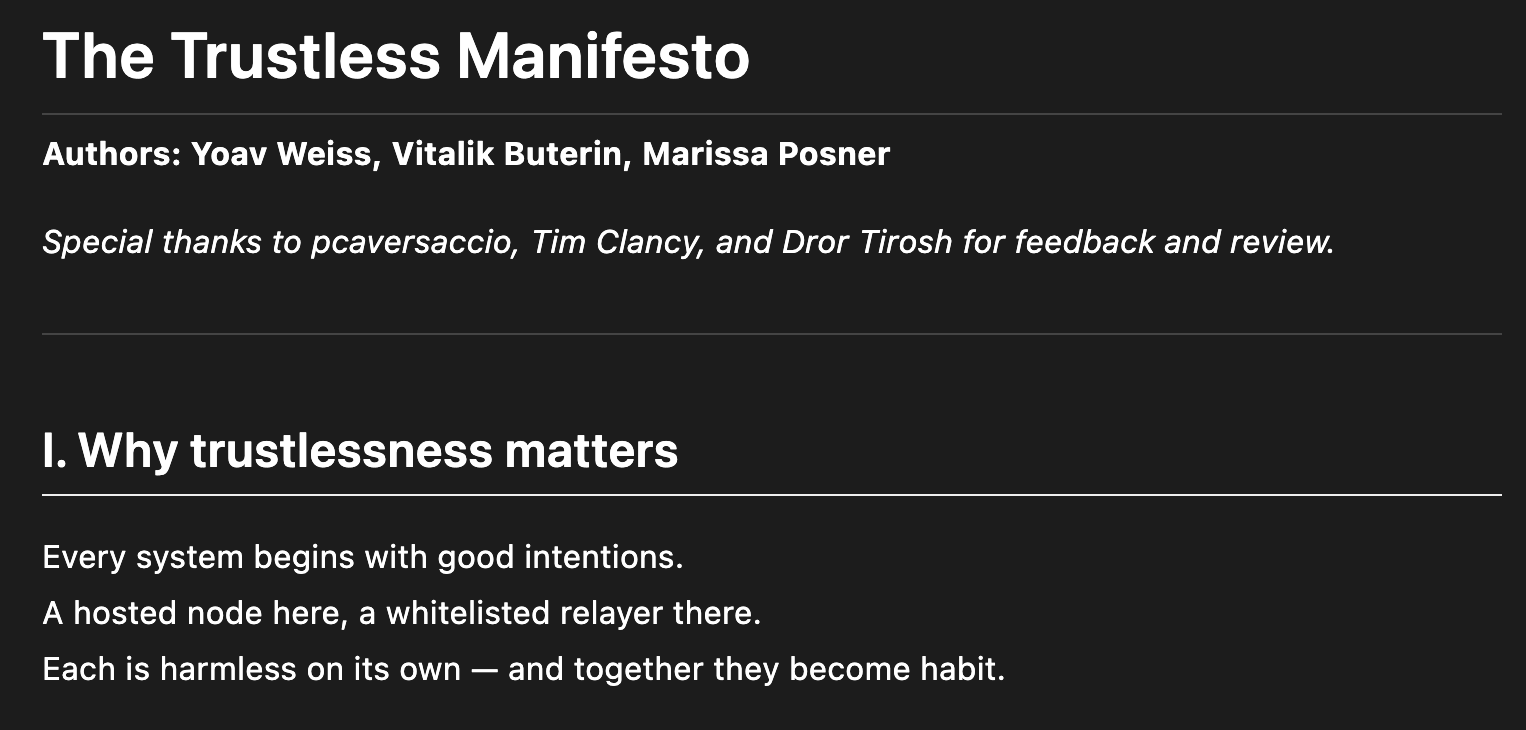
Ethereum co-founder Vitalik Buterin has co-authored a new document titled the “Trustless Manifesto,” reaffirming the project’s foundational commitment to decentralization and censorship resistance. The manifesto urges blockchain developers to avoid centralizing shortcuts in pursuit of scalability and mainstream adoption.
 Source
: Trustlessness.eth
Source
: Trustlessness.eth
The document , jointly written by Ethereum Foundation researchers Yoav Weiss and Marissa Posner, warns that once projects rely on hosted nodes or centralized relayers, they begin to erode the very principles that make blockchain trustless and permissionless.
“Trustlessness is not a feature to add after the fact, it is the thing itself”,
the authors declared.
“Without it, everything else — efficiency, UX, scalability — is decoration on a fragile core.”
The dangers of convenience and centralization
The manifesto argues that the pursuit of convenience often leads developers to add “intermediaries and checkpoints” that ultimately compromise the integrity of decentralized systems.
Buterin and his co-authors stressed,
“Every line of convenience code can become a choke point.”
They defined success not by speed or throughput, but by the
“amount of trust reduced per transaction.”
The issue of overreliance on intermediaries surfaced during last month’s Amazon Web Services (AWS) outage , which disrupted several Ethereum layer-2 networks. Coinbase’s Base chain saw throughput drop by roughly 25% due to its AWS-hosted sequencer, while Arbitrum and Optimism remained fully functional thanks to diversified multi-cloud setups.
Echoes of Ethereum’s cypherpunk roots
This isn’t Buterin’s first call to preserve Ethereum’s original ethos. In December 2023, he published a vision paper encouraging the ecosystem to make “Ethereum cypherpunk again” through privacy-focused tools like zero-knowledge proofs and account abstraction.
The latest manifesto continues that philosophy — emphasizing resilience, independence, and the importance of resisting centralizing forces even as institutional players show growing interest in Ethereum.
Institutional adoption vs. decentralized vision
Ethereum has seen a surge of institutional participation since spot Ether ETFs debuted in July 2023. Several public companies have also begun adding ETH to their balance sheets, reflecting growing confidence in the asset.
However, the Ethereum Foundation maintains that decentralization remains the network’s ultimate goal. Core developers are focused on completing the project’s technical roadmap to ensure Ethereum remains self-sovereign, censorship-resistant, and trustless — regardless of mainstream pressures.
Disclaimer: The content of this article solely reflects the author's opinion and does not represent the platform in any capacity. This article is not intended to serve as a reference for making investment decisions.
You may also like
UBS: Maintains Tesla (TSLA.US) “Neutral” rating, target price $385, AI narrative dominates stock price pricing logic
UBS predicts that Tesla's global deliveries in the third quarter of 2026 (3Q26) will be approximately 470,000 vehicles, representing a year-on-year decrease of 5% and a quarter-on-quarter decrease of 1%.
Altcoin Price Targets Point to Six 2027 Levels
The AI frenzy withstands the "5% US Treasury yield"! Nasdaq hits new highs, strengthening the "80/20" pattern as Wall Street reassesses stock-bond allocation
The 30-year US Treasury yield briefly reached about 5.53%, hitting its highest level since 2004, while Brent crude remains above $100 per barrel. Risk assets have once again withstood the pressure, reflecting investors' continued belief that the commercialization of AI applications and corporate profit growth can to some extent offset the impact of rising financing costs and discount rates.
AI infrastructure hits a "wall"! Marvell: Copper interconnects and memory bottlenecks become key to the next stage of computing power expansion
The AI computing power competition is evolving into a system-level game encompassing interconnection and memory. According to Marvell executives, inference models have driven KV cache growth by about 10 times in nine months, and rack-level memory can no longer meet demand. Copper connections are approaching their limits, making optical interconnection and memory expansion core to computing power growth. Customization has become an industry trend, and Marvell is set to benefit from its expertise in analog SerDes, photonic fabric memory, and end-to-end customization.
Crypto prices
More


