
Grayscale formalizes its IPO filing

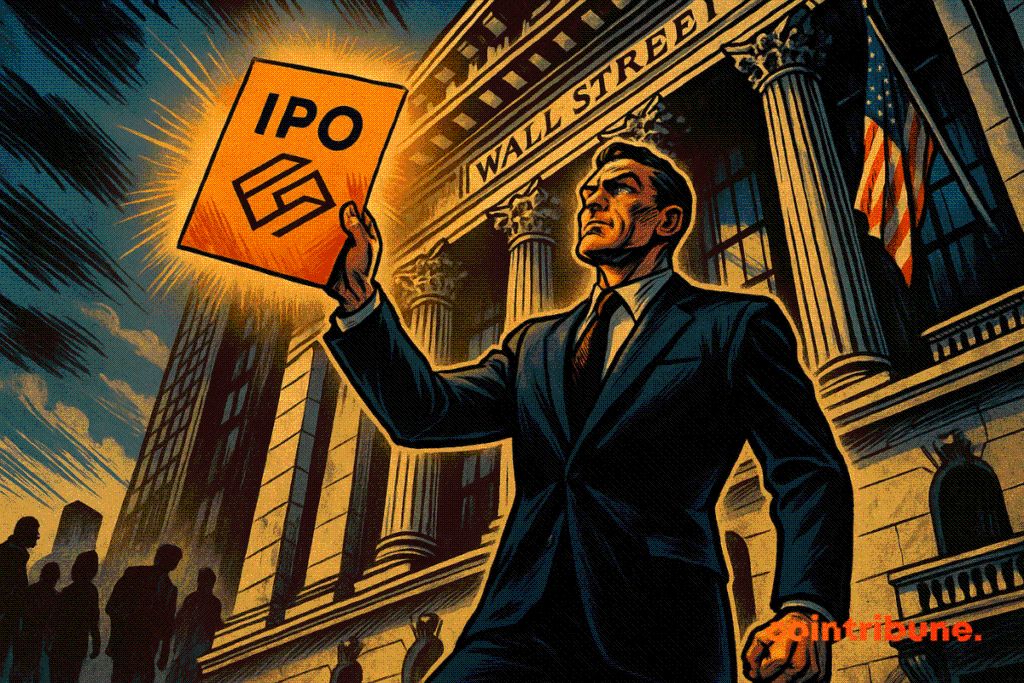
In the crypto universe, Grayscale does not just follow the wave, it shapes it. The New York asset manager, creator of GBTC, has become essential whenever digital finance is discussed. Combining legal maneuvers, market strategies, and bold positioning, it has just filed its application to go public. The IPO is on track, the Grayscale machine in conquest mode. And it does not intend to stop there.
In brief
- Grayscale officially announces its stock market debut with a centralized control model.
- The company shows a 20% decline in revenues for the first nine months of 2025.
- The procedure comes right after the SEC’s reopening post 43-day shutdown.
- Shares will be reserved for loyal investors via a special program for historic crypto investors.
Grayscale IPO: When numbers fall, strategy accelerates
Grayscale’s IPO, very different from a purely crypto ICO, looks ambitious, even if the accounts shine a bit less. Between January and September 2025, the asset manager saw its revenues drop by 20%, to $318.7 million. Net profit slipped to $203.3 million. However, the company continues to manage $35 billion in crypto assets, a performance few can claim.
The chosen IPO model ? A classic in tech finance: the Up-C structure. The capital raised will not finance the company directly but will be used to buy internal shares. Control remains locked in DCG’s hands, the parent company. The stock market pays, DCG controls.
We are a pioneer who has enabled — and contributed to broadening — investor access to the fastest growing asset class in recent history… Our platform offers investors diversified exposure to the digital asset universe, based on management fees, capital efficiency, and cash flow generation.
Barry Silbert, Grayscale chairman
Grayscale bets not only on numbers, but on its leading role in the crypto industry.
The SEC, the ballots, and crypto giants: time is running
Grayscale did not choose its date by chance. The filing was made public on the day of the SEC’s reopening, after 43 days of shutdown. A political and regulatory window was finally open.
This strategic move allows Grayscale to act before the 2026 midterm elections, where pro-crypto balances could shift. Analyst Matt Kennedy summarizes it this way :
The 2026 midterm elections are approaching, and they could fundamentally change the crypto landscape. I expect many crypto companies, like Grayscale and BitGo, to seek to go public before this uncertainty materializes.
The company also benefits from its post-victory aura against the SEC in 2023, a battle that paved the way for spot Bitcoin ETFs. The IPO is therefore not just a fundraising, it is a statement of existence in a standards battle.
DEX, crypto, and Wall Street: convergence or façade?
Grayscale’s IPO fits into a larger momentum. In 2025, several crypto giants took the step: Gemini, Circle, Bullish. All seek new legitimacy in the stock market arena.
But Grayscale plays a different tune. With its Directed Share Program, a portion of shares is reserved for its historic clients ( GBTC , ETHE). The crypto community is prioritized, but public opening remains fenced.
In a world where DEXs advocate radical decentralization, Grayscale embodies another vision: concentration, strategy, and influence. The market opens its doors to it, but the keys remain in the creator’s hands.
What to remember
- Revenues down 20% over nine months;
- Net profits at $203.3 million;
- $35 billion in assets under management;
- Up-C structure: control retained by DCG;
- IPO target: late 2025 to early 2026, according to analysts.
Grayscale has passed a milestone but keeps several files on the table. The SEC must still rule on its ETF requests for XRP, Dogecoin, and, more recently, Avalanche . The crypto giant remains aggressive, ready to align with upcoming trends… or impose them.
Disclaimer: The content of this article solely reflects the author's opinion and does not represent the platform in any capacity. This article is not intended to serve as a reference for making investment decisions.
You may also like
Why suspend RMPs? Explanation from New York Fed SOMA Manager Perli
"Agent vs US Treasury" — Who Will Dominate the US Stock Market?
The wave of AI Agents and US Treasury yields are splitting the US stock market into two worlds: Meta's release of the Muse model boosted its market value by $220 billion in a single week, propelling the Nasdaq's standout performance; however, excluding AI stocks, the S&P 500 actually fell 1% this week, with the number of new lows on the New York Stock Exchange surpassing new highs for nine consecutive days, signaling the near end of "breadth trading." Goldman Sachs bluntly stated that this is a "frustrating cat-and-mouse game" between the stock market and interest rates—any breakout can be snuffed out by the bond market at any time, so equity holders must short US Treasury bonds to hedge simultaneously.
Hopes for a ceasefire between the US and Iran encounter obstacles again! Trump rejects Iran's seven-day proposal; inflation pressure under $100 oil prices remains difficult to ease
Trump rejects a ceasefire with Iran, and it is expected that bombings will occur again after the midterm elections. The president doubts whether Tehran will meet his demands.
Tesla ramps Optimus production 10-fold but robot hands are holding Elon back
Crypto prices
More


