
In this bull market, even those who stand still will be eliminated: only "capital rotation" can survive the entire cycle.

In the crypto market, most people are destined to lose money during a bull run—not because of bad luck, but because they don’t know how to move.
Still obsessed with airdrops, hoping for the next meme wave?
There’s only one way for people to truly survive this cycle: Rotation.
Capital is never stationary; it is always searching for the next narrative, the next hotspot, the next momentum.
Those who understand rotation go with the flow; those who don’t are crushed by the trend.
❶ Why do so many people lose money every cycle? Because they “don’t move”
Every cycle’s losers share one thing in common:
Asset allocation remains unchanged, always stubbornly sticking to the same sector.
But the reality is:
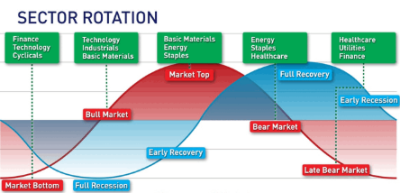
Capital moves through different stages
Sectors take turns performing
Stories keep shifting
From BTC → ETH → Alts → Meme,
From L1 → AI → GameFi → DeFi……
Only a rotation strategy can run through all stages from ignition to bubble to correction.
❷ What is “rotation”? Capital always follows momentum and narrative
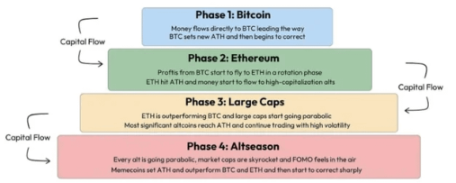
The essence of rotation is moving funds to where momentum is strongest and sentiment is most concentrated.
Typical capital migration paths include:
BTC → ETH → Major Altcoins → Meme
Infrastructure → AI → GameFi → DeFi → New Narratives
Capital always follows the narrative, and your job is not to guess the future, but to read the direction of market sentiment.
❸ The core structure of building a rotation portfolio: The three-layer model
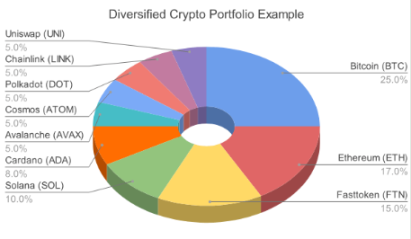
A professional rotation portfolio consists of three layers:
1. Core Layer
BTC, ETH
Stable base position
Prevents systemic risk
Provides a “never dies” foundation for the portfolio
2. Growth Layer
Top altcoins with strong fundamentals
Capture medium-speed growth
Balance risk and reward
3. Speculative Layer
New narratives, trending sectors, meme
Small positions, high flexibility
Capture explosive gains when the market ignites
This three-layer structure allows you to:
Stay alive, ride the trend, and catch the breakout.
❹ The core of rotation is “triggered rebalancing”
Rebalancing is not done arbitrarily, but triggered based on conditions:
When an asset’s volatility exceeds X%
When an asset’s proportion deviates from the portfolio by Y%
This structure allows you to:
When a hotspot is overbought → automatically sell a portion
When an unpopular asset is excessively undervalued → automatically buy a bit
No need to guess the top or bottom,
With “structure,” you can achieve the counterintuitive but correct approach of buying low and selling high.
❺ Different market stages require different strategies
Within the rotation framework, strategies adjust with market rhythm:
When a sector is rising (trending period)
→ Use momentum strategies, go with the trend, don’t go against it.
When the market cools (sideways or correction period)
→ Use stable strategies: mean reversion, DCA, reduce high-risk positions.
This way you can:
Earn more in uptrends, lose less in downtrends.
❻ Use on-chain and derivatives indicators to improve rotation accuracy
Professional players never operate by gut feeling—they look at data:
Exchange netflow: inflow = preparing to sell; outflow = accumulation
Whale Transfers
Funding Rate: is sentiment overheated?
Open Interest
Combine with RSI and trading volume for confirmation,
You can spot reversals and sentiment turning points ahead of the market.
❼ The most effective model in uncertain markets: The Barbell Strategy
The so-called barbell strategy means putting funds at two extremes:
One end: Core assets (BTC, ETH)
Safe, risk-resistant
The other end: High-risk sectors (strong narratives or new hotspots)
High potential, high flexibility
When the market starts → move some from core to high risk
When the market overheats → move some from high risk back to core
Never go all-in on one side, and never go all-out.
❽ The key to successful rotation is not prediction, but disciplined execution
The most important rules include:
Write down your goals and maximum tolerable risk before entering
All operations follow the formula: Trigger → Signal → Position → Take Profit / Stop Loss
Record every rotation, review data not emotions
No execution, no rotation;
No discipline, no profit.
❾ What you should do right now
Build your three-layer structure: core, growth, speculative
Set rebalancing ranges (e.g., ±20%)
Monitor volatility and sector sentiment
Use on-chain dashboards to avoid emotional decisions
Use triggers to automate and systematize rotation
You don’t need to predict the market’s future, you just need to follow capital migration.
❿ The truth of this bull market: Capital likes to “move,” hates to “wait”
Every bull market weeds out those who don’t understand rotation.
This cycle, capital moves even faster, narratives are shorter, and hotspots are more intense.
Maintain structure, rotate smartly, take profits ruthlessly,
Only then can you survive between market frenzy and panic.
If you understand rotation, you stand with the market.
If you don’t, you stand against it.
Conclusion:
The core of the crypto market is not prediction, but adaptation.
You can’t control the market, but you can control how your assets flow at different stages.
Rotation strategies allow you to:
Catch trends during upswings
Preserve capital during corrections
Accumulate chips during sideways periods
Be in the right place when a new narrative starts
In this bull market, the biggest risk is not volatility, but stubborn inaction.
Maintain structure and discipline, and you can become one of the few who survive the cycle, rather than the majority who are eliminated.
Disclaimer: The content of this article solely reflects the author's opinion and does not represent the platform in any capacity. This article is not intended to serve as a reference for making investment decisions.
You may also like
The More Impressive AI Agents Become, the More Valuable Storage Is! SK Hynix's NAND Business Plans $100 Billion US IPO
According to informed sources, Solidigm, a company under SK Hynix, is considering an initial public offering in the United States as early as next year. The sources revealed that the world's second-largest memory manufacturer is in talks with potential advisors regarding the listing of its NAND memory division.
A wave of AI applications is surging toward federal governance! Jensen Huang and Elon Musk will share a stage with Trump, further expanding the new landscape of AI commercialization
President Donald Trump will co-host an event with leading figures from the technology and artificial intelligence sectors to launch a new government website, America.gov, which aims to help the American public access federal information and resources. The event will feature panel discussions on artificial intelligence, energy dominance, health, space, and agriculture, with leaders such as Jensen Huang, Elon Musk, and Tom Brown in attendance.
Oracle (ORCL.US) "Force Majeure" Notice Shakes AI Bond Market! Morgan Stanley: Data Center Financing Contracts Face Reassessment
Oracle issued a “force majeure” notice to a major data center developer in New Mexico, raising concerns in the market about the strength of contract protections in AI infrastructure financing. Morgan Stanley warned that this move may prompt investors to reassess the lease terms and credit risks of data center projects.
Overnight US Stock Market | US-Iran negotiations enter technical consultation stage, major indexes close higher, Dell (DELL.US) rises over 5%
At market close, the Dow Jones rose by 478.64 points, or 0.93%, to 51,828.62 points, posting a weekly gain of 0.28%. The S&P 500 increased by 39.28 points, or 0.51%, to 7,743.41 points, up 1.22% for the week. The Nasdaq gained 129.34 points, or 0.48%, to 27,068.71 points, with a weekly increase of 2.06%.
Crypto prices
More


