
BitMine spends heavily again to buy 70,000 ETH! Holdings surpass 3% of total circulating supply; Tom Lee: Ethereum's worst-case scenario is a drop to $2,500

BitMine Immersion Technologies increased its holdings by 69,822 ETH, bringing its total holdings to 3.62 million ETH, which accounts for 3% of the circulating supply, with total assets of $11.2 billions. Tom Lee believes that ETH's risk/reward is asymmetric, with limited downside potential. Summary generated by Mars AI. The accuracy and completeness of this summary are still being iteratively improved by the Mars AI model.
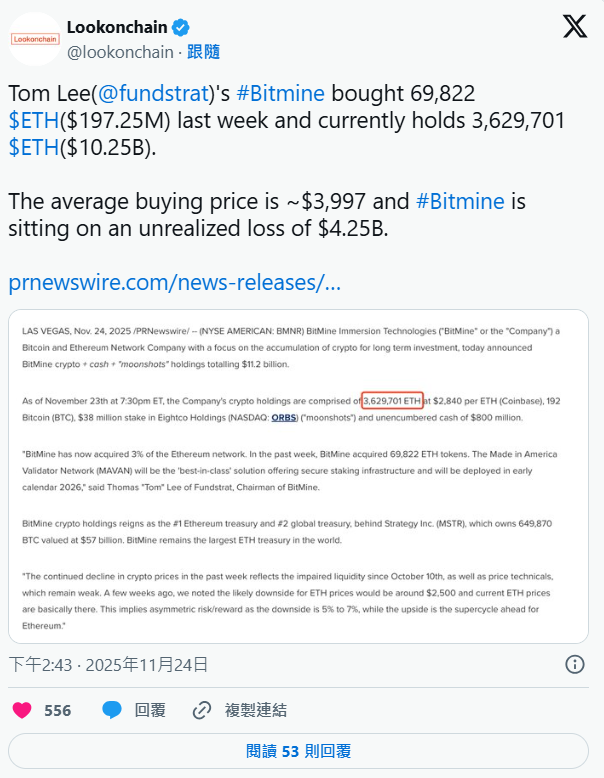
The world's largest Ethereum treasury company, BitMine Immersion Technologies (BMNR), issued an announcement on the evening of November 24, stating that it had once again made a major purchase in the past week, spending to acquire 69,822 ETH.
BitMine pointed out that this purchase has officially pushed BitMine's Ethereum holdings past the 3.62 million mark, reaching 3,629,701 ETH, which accounts for 3% of the total circulating supply of Ethereum. This means BitMine has completed two-thirds of its long-term publicly stated "5% Alchemy" goal (i.e., holding 5% of the total Ethereum supply).
Tom Lee: Ethereum's lowest could drop to $2,500
BitMine further stated that its total assets (cryptocurrencies + cash + high-risk investments) have reached $11.2 billions, with the following breakdown: 3,629,701 ETH; 192 Bitcoin; $38 million invested in Eightco Holdings (ORBS) (internally referred to as the "Moon Landing Plan"); and $800 million in unrestricted cash.
Regarding this recent purchase and the future outlook for Ethereum, BitMine Chairman Tom Lee remains optimistic. In the announcement, he stated:
BitMine has now acquired 3% of Ethereum's circulating supply. In the past week, BitMine acquired 69,822 ETH tokens. The US Manufactured Validator Network (MAVAN) will also become a "first-class solution," providing secure staking infrastructure and is scheduled for deployment in early 2026.
Over the past week, cryptocurrency prices have continued to decline, reflecting the impaired market liquidity since the plunge on October 10, as well as technical weakness in prices. Weeks ago, we pointed out that the downside risk for ETH was around $2,500, and ETH prices have now basically reached this level. This means the risk/reward has become asymmetric, with only 5% to 7% downside left, while any upward movement could trigger an unprecedented super cycle for Ethereum.
BitMine's Unrealized Losses Reach $4.25 billions
However, despite BitMine's continued accumulation, on-chain data analysis agency Lookonchain pointed out on the same day that after this Ethereum purchase, BitMine's total holdings exceeded 3.62 million ETH, but its average purchase price per ETH remains as high as $3,997. As ETH continues to decline, BitMine's unrealized losses have once again expanded to $4.25 billions.
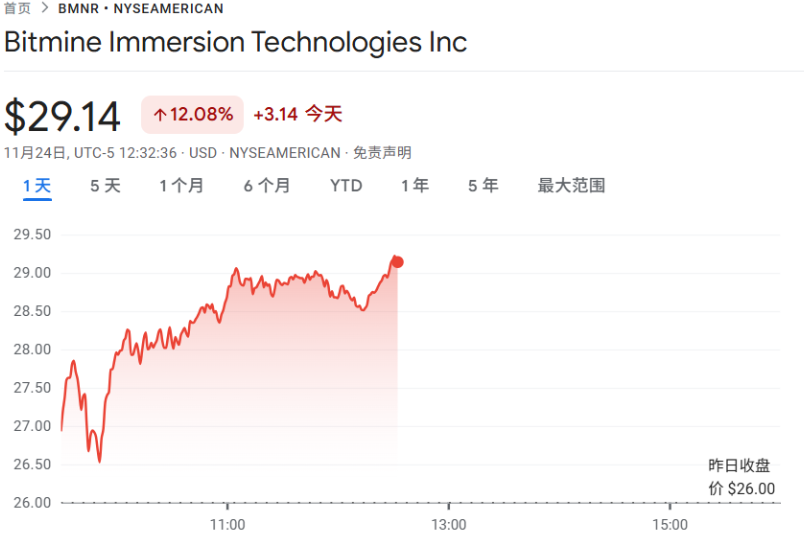
BMNR Rebounds 12%
However, it is worth noting that BitMine saw a rebound after the US stock market opened on the evening of November 24 (Taiwan time), with its share price surging to $29 at one point. The intraday increase reached as high as 12%, and its market value also recovered to $7.4 billions.
Disclaimer: The content of this article solely reflects the author's opinion and does not represent the platform in any capacity. This article is not intended to serve as a reference for making investment decisions.
You may also like
Meta goes all-in on personal Agent: Muse integrates with glasses, Mac, email, connecting shopping and work
Meta announced that Muse will become the strategic core of its all-scenario "personal super intelligence." Muse not only integrates upgraded smart glasses and the portable device Charm, but also expands functionalities such as Mac control and email agent. In addition, it collaborates with retail giants like Walmart to build a shopping ecosystem, aiming to monetize through transaction commissions, demonstrating its ambition to comprehensively cultivate consumer-grade AI.
Global Bond Sell-Off Spreads! Japan 10-Year Government Bond Yield Surges to Highest Level Since 1996
Japan's 10-year government bond yield surged to 3.075%, driven by threefold pressures: US Treasury sell-off, Bank of Japan’s signals towards interest rate hikes, and concerns over fiscal expansion. The yield on 5-year US Treasury bonds breaking above 5% acted as the catalyst, while Japan's plan to raise its defense budget to 3.5% of GDP further intensified market panic. Analysts warn that as the last global anchor of low interest rates begins to shake, yen carry trades face the risk of collapsing, potentially leading to increased market volatility.
Crypto prices
More


